


TL;DR:
- Scheduling multi-unit cleaning consolidates operations, reduces costs, and prevents property damage through proactive maintenance. It improves hygiene, accountability, and workflow efficiency while ensuring consistent tenant experiences. Using centralized contracts, digital tools, and standard procedures enhances quality and scalability across property portfolios.
Scheduled multi-unit cleaning is defined as the practice of organizing all cleaning activities across multiple residential or commercial units under a single, unified timetable to maximize operational efficiency and quality. Property managers and real estate investors who treat this as a core operational function, rather than a reactive task, protect asset value, reduce costs, and maintain consistent tenant experiences. Centralizing cleaning management eliminates duplicate vendor relationships, simplifies invoicing, and creates the kind of predictable maintenance cadence that prevents expensive repairs. The question of why schedule multi-unit cleaning comes down to one answer: it converts a fragmented cost center into a controlled, scalable operation.
Why schedule multi-unit cleaning for better operational efficiency?
A cleaning schedule ensures tasks are completed regularly, properly, and on time, which directly improves hygiene and safety across every unit in a portfolio. Without a schedule, some areas get overcleaned while others are neglected. That inconsistency creates liability, tenant complaints, and deferred maintenance costs that compound over time.
Scheduling solves three operational problems at once: staff accountability, area coverage, and task sequencing. A clear schedule defines responsibility for each task and each location, so no unit falls through the cracks and no two crews duplicate effort on the same corridor. That clarity reduces conflicts between on-site teams and external vendors, particularly in shared spaces like lobbies, parking structures, and laundry rooms.
Coordinated scheduling also cuts reactive maintenance. When cleaning happens on a fixed cadence, small problems like mold growth, debris buildup, or surface staining get caught early. Recurring scheduled cleaning prevents property decline rather than responding to accumulated messes. That shift from reactive to preventive is the single biggest operational gain property managers report after implementing a formal schedule.
Key workflow improvements from structured scheduling include:
- Defined area accountability: Each crew member or vendor knows exactly which units and common areas they own on any given day.
- Reduced travel overlap: Routing crews efficiently across a building or campus eliminates wasted time between assignments.
- Consistent SOPs: Standard operating procedures applied across all units produce uniform results regardless of which crew is on site.
- Faster tenant response: Scheduled visits create natural checkpoints for identifying and logging issues before tenants escalate them.
Pro Tip: Build a rotating schedule that staggers deep cleans across units rather than hitting every unit on the same day. This keeps labor costs flat and prevents bottlenecks during high-turnover periods.
What are the cost benefits of coordinated multi-unit cleaning schedules?
Consolidating cleaning services under a single provider for multi-unit properties reduces administrative overhead and overall costs by eliminating duplicate travel time, simplifying invoicing, and enabling volume-based pricing. That is not a marginal saving. For a portfolio of 20 or more units, the difference between fragmented vendor management and a centralized contract is measurable in both time and dollars every billing cycle.
Professional cleaning teams reduce property damage by 62% compared to unscheduled or ad hoc approaches. Preventing damage is always cheaper than repairing it. A cracked grout line, a stained facade, or a mold-compromised wall cavity costs far more to fix than the cleaning visit that would have prevented it.
Budget predictability is another direct benefit. A centralized contract with fixed service intervals means finance teams can forecast cleaning costs accurately across a full fiscal year. Fragmented contracts with multiple vendors introduce variable pricing, inconsistent billing cycles, and hidden fees that make portfolio-level budgeting unreliable.
| Management model | Administrative load | Cost structure | Quality consistency |
|---|---|---|---|
| Centralized contract | Low: single point of contact | Predictable: volume pricing | High: uniform SOPs across all units |
| Fragmented vendors | High: multiple contacts and invoices | Variable: no volume leverage | Low: inconsistent standards per vendor |
| Mixed model | Medium: partial consolidation | Moderate: some volume savings | Medium: depends on vendor overlap |
Standardizing cleaning through centralized contracts and checklists reduces operational friction and supports portfolio expansion. As you add units or properties, a centralized model scales without proportionally increasing administrative complexity.
Which best practices ensure quality in multi-unit cleaning schedules?
Quality in multi-unit cleaning does not happen by accident. It requires standardized SOPs, digital visibility, and structured quality controls applied consistently across every location.
The foundation is a written SOP for each area type: common areas, unit interiors, exterior surfaces, and mechanical spaces. SOPs remove ambiguity. When a new crew member arrives on site, the checklist tells them exactly what to clean, in what order, and with what products. Digital SOPs and checklists that onboard staff quickly are more valuable for scaling than hiring more people alone. That insight matters for property managers adding units to a portfolio without adding proportional management overhead.
Digital scheduling platforms provide real-time operational visibility. Managers can see which units have been serviced, flag exceptions, and generate compliance reports without walking every floor. Quality control frameworks with service logs, response-time SLAs, and centralized oversight reduce complaints and improve tenant experience across multi-site portfolios.
Best practices for maintaining quality at scale:
- Standardized checklists per area type: Prevents missed tasks and creates an auditable record of completed work.
- Response-time SLAs in vendor contracts: Defines acceptable turnaround for both scheduled visits and emergency calls.
- Regional supervisor oversight: A single supervisor covering multiple properties catches quality drift before it becomes a tenant issue.
- Consistent product specifications: Specifying approved specialty cleaning products prevents surface damage from incompatible chemicals.
- Regular audit cycles: Monthly or quarterly walkthroughs against the SOP checklist identify gaps before they become complaints.
How can property managers implement multi-unit cleaning schedules effectively?
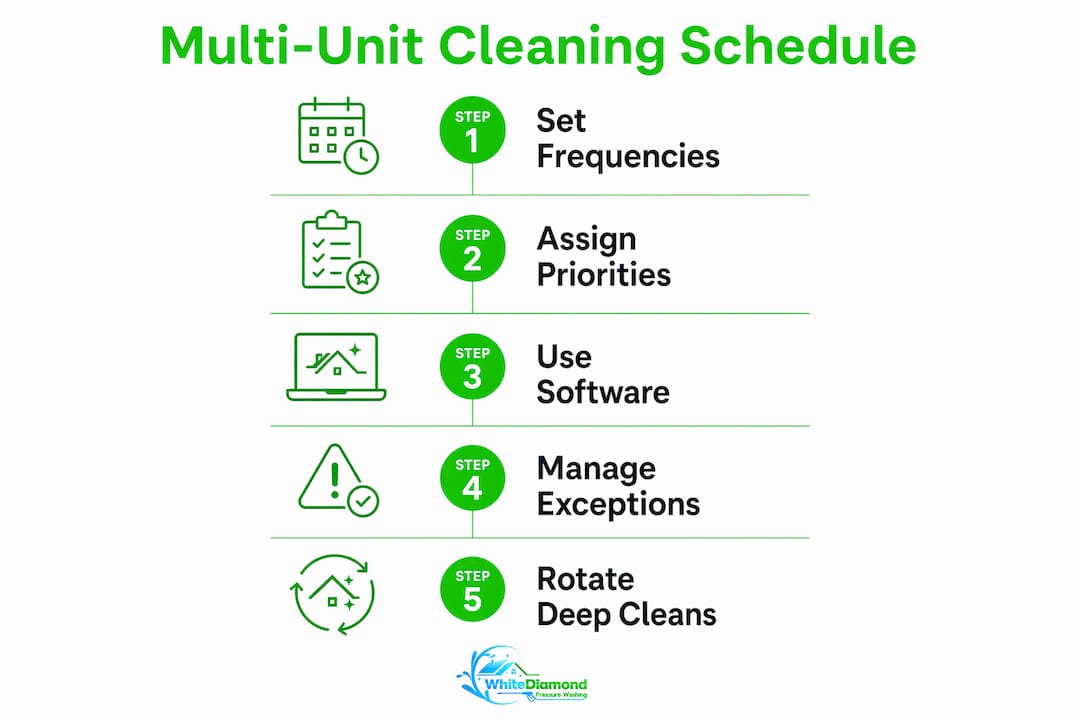
Effective implementation starts with setting cleaning frequencies by area priority. High-traffic common areas like lobbies, elevators, and restrooms need daily attention. Unit interiors typically follow a weekly or biweekly schedule during occupancy and a deep-clean protocol at turnover. Exterior surfaces, including facades, driveways, and walkways, fit a monthly or seasonal cadence depending on local conditions.
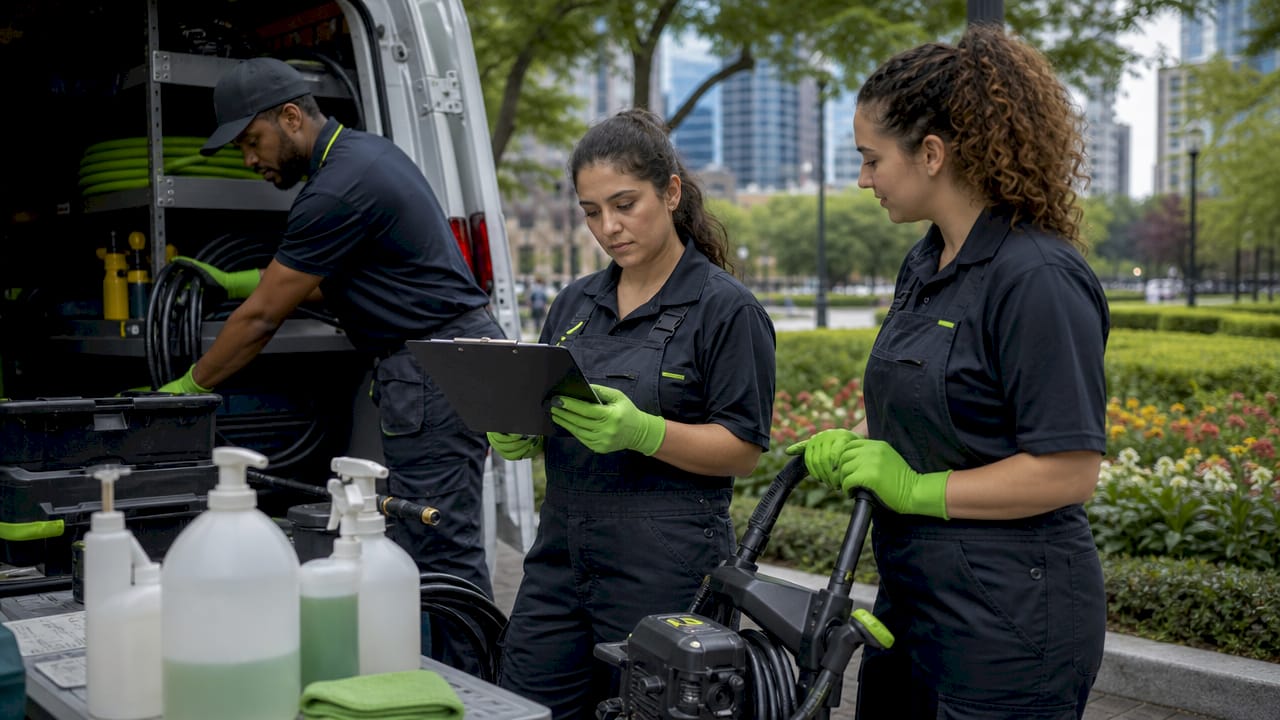
Seasonal cleaning schedules for apartment complexes and condos save both time and money by aligning exterior work with weather patterns and tenant turnover cycles. Scheduling exterior pressure washing in spring and fall, for example, addresses the organic growth and debris accumulation that builds up between seasons.
Managing exceptions is where most schedules break down. A tenant reports a spill in a hallway, a storm leaves debris on a rooftop terrace, or a unit turns over unexpectedly. Exception-based cleaning management integrates tenant-reported issues into scheduled maintenance cycles, minimizing blind spots and preventing problem buildup. This dynamic approach avoids rigid schedules that miss unpredictable incidents in high-traffic properties.
Software tools for scheduling and reporting close the loop between field crews and property management. Operators who scale beyond 25 sites benefit by treating scheduling systems as assets similar to equipment. A platform that sends automated alerts, tracks completion rates, and flags overdue tasks gives managers the visibility they need without requiring constant manual follow-up.
Pro Tip: Assign a single point of contact at your cleaning vendor for each property. That person owns the schedule, handles exceptions, and reports directly to your property manager. One relationship replaces a dozen phone calls.
What are the most common pitfalls in multi-unit cleaning schedules?
Fragmented vendor management is the most expensive mistake property managers make. Using three different vendors across a ten-unit building means three billing cycles, three quality standards, and three sets of SOPs that may contradict each other. The result is variable cleanliness, tenant complaints concentrated in vendor-boundary areas, and no single party accountable for overall building standards.
Rigid schedules create a different problem. A static calendar that never adjusts for occupancy changes, seasonal conditions, or tenant feedback will miss real-world incidents. High-traffic properties need dynamic scheduling that responds to reported issues rather than ignoring them until the next scheduled visit.
Using the wrong cleaning method for a surface is a pitfall with real financial consequences. High-pressure washing on sensitive cladding can cause property damage and void warranties. Soft washing is the industry standard for protecting multi-unit building exteriors while removing organic growth effectively. It uses low pressure combined with biodegradable cleaning solutions to clean surfaces without forcing water into building assemblies.
Common pitfalls and their fixes:
- Multiple vendors, no accountability: Consolidate under one provider with a master service agreement covering all units.
- Static schedules: Build exception-handling protocols into the schedule from day one.
- Wrong cleaning method for the surface: Specify soft washing for exterior facades, roofs, and any surface with a manufacturer warranty.
- No audit trail: Require digital service logs from every vendor visit to maintain compliance records.
- Skipping tenant communication: Notify tenants of scheduled cleaning windows to reduce access conflicts and improve cooperation.
Key Takeaways
Scheduled multi-unit cleaning is the most direct way to reduce facility spend, protect asset value, and maintain consistent tenant experiences across a property portfolio.
| Point | Details |
|---|---|
| Centralize vendor management | One provider, one contract, and one SOP set eliminates quality gaps and reduces administrative load. |
| Schedule by area priority | Daily for high-traffic common areas, weekly for unit interiors, and seasonal for exterior surfaces. |
| Use exception-based scheduling | Integrate tenant-reported issues into the maintenance cycle to prevent blind spots in high-traffic properties. |
| Specify soft washing for exteriors | High-pressure methods damage cladding and void warranties; soft washing is the industry standard for multi-unit buildings. |
| Treat scheduling as infrastructure | Digital scheduling systems with real-time visibility are assets, not overhead, especially beyond 25 units. |
What I’ve learned about treating cleaning schedules as infrastructure
Property managers who struggle with cleaning costs almost always share one trait: they treat cleaning as a line item to cut rather than a system to build. I’ve seen this pattern repeatedly. A manager trims the cleaning budget, vendors get swapped out, standards drift, and six months later there’s a mold remediation bill that costs ten times what the cleaning contract would have.
The shift that changes everything is viewing a cleaning schedule the same way you view a maintenance calendar for HVAC or elevators. You wouldn’t skip a scheduled elevator inspection because it seemed like an unnecessary expense that month. The same logic applies to exterior washing, common area sanitation, and unit turnover cleaning. Investing in regular cleaning protects both the physical asset and the tenant relationship simultaneously.
Professional investors already understand this. They treat cleaning as a brand consistency issue. A tenant in unit 4B should experience the same cleanliness standard as a tenant in unit 12A. That consistency is what drives lease renewals and referrals. It is also what protects the property’s appraised value when it comes time to refinance or sell.
The practical advice I give every property manager is this: build the schedule before you need it. Do not wait for a tenant complaint or a failed inspection to formalize your cleaning program. The importance of scheduling cleaners across a portfolio is not just operational. It is financial, reputational, and strategic.
— Bobby
Whitediamondpressurewashing: scheduled cleaning built for property portfolios
Property managers in Citrus County and surrounding regions trust Whitediamondpressurewashing to deliver consistent, scheduled exterior cleaning across multi-unit residential and commercial properties.

Whitediamondpressurewashing builds customized cleaning plans around your property’s specific surfaces, traffic patterns, and turnover cycles. The team uses soft washing techniques that protect building materials and maintain warranty compliance, which matters when you’re managing multiple units with different cladding types. Volume pricing keeps costs predictable across a full portfolio, and flexible scheduling means exterior work fits around tenant occupancy without disruption. Get a free estimate at Whitediamondpressurewashing and put a real cleaning schedule behind your property investment.
FAQ
Why is scheduling multi-unit cleaning better than on-demand service?
Scheduled cleaning prevents property decline by maintaining a consistent baseline rather than reacting to accumulated problems. Recurring cleaning is faster, more thorough, and less expensive per visit than one-time cleans.
How often should exterior surfaces be cleaned on multi-unit properties?
Exterior facades, driveways, and walkways typically require cleaning on a monthly or seasonal cadence, with spring and fall being the most effective timing for organic growth removal.
What is soft washing and why does it matter for multi-unit buildings?
Soft washing uses low pressure combined with biodegradable solutions to clean exterior surfaces without damaging cladding or voiding manufacturer warranties. It is the industry standard for multi-unit building exteriors.
How does centralized cleaning management reduce costs?
Consolidating cleaning under one provider enables volume-based pricing, eliminates duplicate travel costs, and simplifies invoicing to a single monthly statement instead of multiple vendor bills.
What digital tools help manage multi-unit cleaning schedules?
Scheduling platforms that provide real-time completion tracking, automated alerts, and service logs give property managers visibility across all units without manual follow-up. Operators beyond 25 sites see the greatest return from treating these systems as core operational assets.
Recommended
- Why Track Seasonal Property Cleaning: Save Money and Time – white-diamond-pressure
- Parking Structure Cleaning Guide for Property Managers – white-diamond-pressure
- Time-Saving Cleaning Hacks for Busy Homeowners – white-diamond-pressure
- How cleaner experience impacts property care quality – white-diamond-pressure
One thought on “Why Schedule Multi-Unit Cleaning: A Property Manager’s Guide”