

TL;DR:
- Dwell time is the minimum period a disinfectant must stay visibly wet on a surface to be effective. Shortening or skipping this step leads to disinfection failure and increased health risks. Proper product selection and workflow planning are essential to ensure surfaces remain wet long enough for effective cleaning.
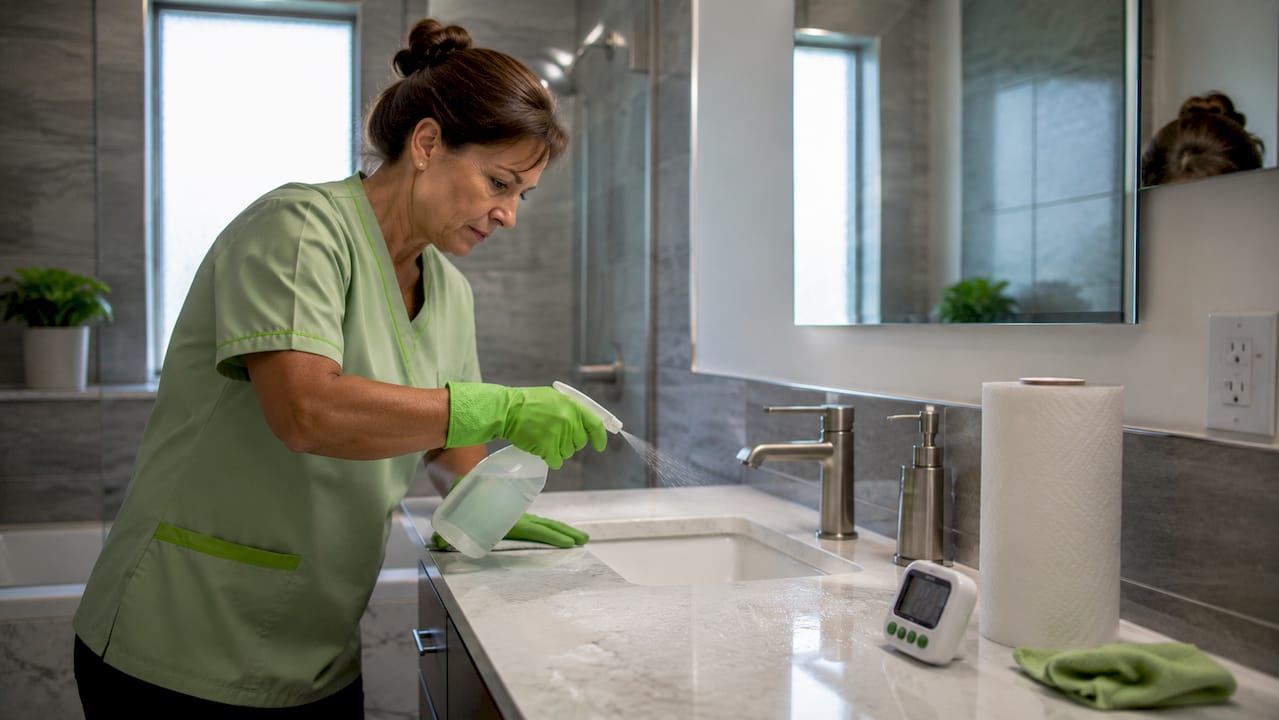
Dwell time, also called contact time, is the minimum period a cleaning agent or disinfectant must stay visibly wet on a surface to achieve its labeled efficacy against soils or pathogens. EPA-registered disinfectants require contact times ranging from 30 seconds to 10 minutes depending on the product and target pathogen. That range is not a suggestion. It is a validated performance threshold. Surfaces that look clean but dried too fast are not disinfected. Understanding the role of dwell time in cleaning is what separates a surface that passes inspection from one that actually protects people.
How does dwell time affect cleaning and disinfection effectiveness?
Dwell time works because chemical reactions take time. A disinfectant must penetrate cell walls, disrupt metabolic processes, and denature proteins to kill a pathogen. Cut that time short, and the chemistry stops before the job is done.
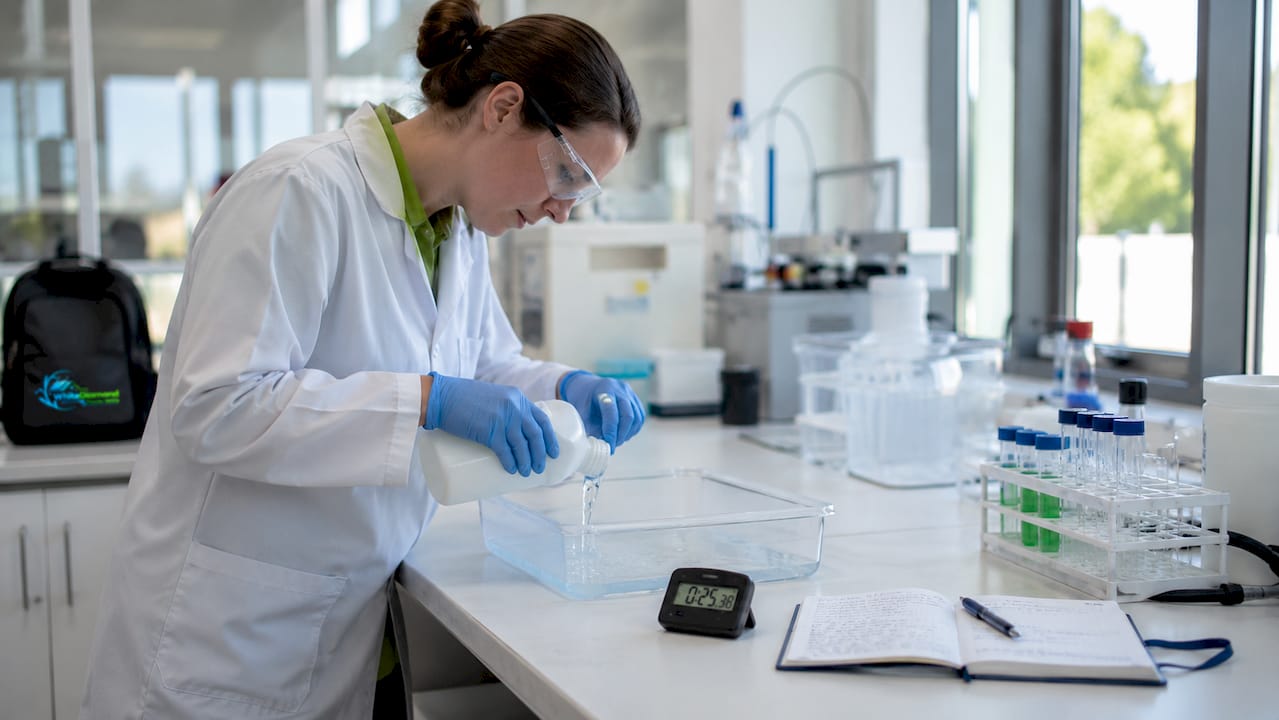
The numbers make this concrete. Cutting required dwell time in half can drop pathogen kill rates from a 4-log reduction (99.99%) to below a 2-log reduction (99%) for resistant organisms like Candida auris. That gap sounds small in percentages. In a healthcare setting or a rental property with vulnerable occupants, it is the difference between controlled risk and an active hazard.
Premature drying is the most common failure point. If a surface dries in 20 seconds but the label requires 2 minutes of contact, less than 17% of the required exposure time has been achieved. That is a disinfection failure, not a close call.
Dwell time is a dual-benefit concept: it enables chemical breakdown of grime for cleaners and allows sufficient pathogen kill for disinfectants. Both require surfaces to stay wet without premature drying. Skipping or shortening this step does not save time. It restarts the problem.
The key principle is this: dwell time is a hard threshold, not a safety buffer. Failure to observe it is a primary cause of disinfection program failure across facilities of every size.
- Visible wetness is the standard. If the surface looks dry, the dwell time clock has stopped, regardless of how much time has passed.
- Efficacy is not linear. Pathogen kill rates drop sharply at the beginning of a shortened contact window, not gradually.
- Organic matter blocks the process. Food residue, grease, and organic soils consume disinfectant active ingredients before they reach the pathogen. Clean the surface first, then disinfect.
How do dwell time requirements vary by product and pathogen?
Not all disinfectants work the same way, and not all pathogens die at the same rate. Cleaning professionals need to match the product to the target organism and the workflow to the label.
| Chemical class | Typical contact time | Best use case |
|---|---|---|
| Quaternary ammonium (quats) | 1–3 minutes | General bacteria, enveloped viruses |
| Sodium hypochlorite (bleach) | 1–10 minutes | Broad spectrum, spores, norovirus |
| Alcohol-based (70%+ isopropyl) | 30 seconds–2 minutes | Hard, non-porous surfaces |
| Hydrogen peroxide-based | 1–5 minutes | Healthcare, food-contact surfaces |
| Disinfecting wipes | 2–4 minutes | High-touch points, spot disinfection |
Quaternary ammonium compounds typically achieve broad pathogen kills with shorter contact times than alcohol-based products. That makes quats a practical choice when workflow speed matters.
Pathogens also vary in resistance. Enveloped viruses like influenza die quickly. Non-enveloped viruses like norovirus require longer contact. Bacterial spores, including Clostridioides difficile, demand the longest dwell times and often require bleach-based products at specific concentrations.
When a product label lists multiple pathogens with different contact times, use the longest time listed to cover all organisms. Using the shortest time only guarantees efficacy against the easiest target.
Sanitizers and disinfectants are not interchangeable. Sanitizers reduce bacterial counts to safe levels on food-contact surfaces, typically in 30–60 seconds. Disinfectants kill a broader range of pathogens but require longer contact. Using a sanitizer where a disinfectant is needed, or vice versa, creates compliance gaps that audits will catch.
Pro Tip: Read the label for every product in your rotation at least once per quarter. Manufacturers update formulations, and contact times can change between product versions.
What challenges prevent effective dwell time in real workflows?
Knowing the required contact time and achieving it in practice are two different problems. Real cleaning environments create friction at every step.
The most underestimated factor is evaporation. Contact times validated in laboratory conditions may not hold in warm or well-ventilated environments where surfaces dry faster. A Florida property in summer, or any space with active HVAC, can cut effective wet contact time significantly compared to lab benchmarks.
- Insufficient application volume. A light mist does not create the continuous wet film required. Surfaces must glisten continuously, not show patchy or beaded coverage.
- Staff wiping too soon. Time pressure in high-turnover environments pushes workers to wipe surfaces before the clock runs out. This is the single most common cause of contact time failure.
- Ignoring label instructions. Many cleaning staff apply products by habit rather than by label. Products get rotated without retraining, and old habits persist.
- Surface damage risk. Extended wet contact of some disinfectants can damage sensitive materials like natural stone, certain metals, or finished wood. Professionals must balance efficacy with material compatibility.
Workflow design is the root cause of most dwell time failures. When a cleaning sequence requires staff to move immediately from one surface to the next, there is no structural time built in for contact. The problem is systemic, not individual.
Pro Tip: Time your surfaces. Spray a test area with water and measure how long it stays visibly wet under your actual working conditions. That number tells you whether your product’s labeled contact time is achievable in your environment.
What strategies actually improve dwell time compliance?
Improving dwell time compliance works better through product selection and workflow design than through staff training alone. Training helps, but it cannot override a schedule that makes proper contact time physically impossible.
- Select products with shorter validated contact times. If your workflow allows 60 seconds between tasks, choose a product validated at 60 seconds. A product requiring 5 minutes will fail every time in that environment.
- Apply enough product to maintain visible wetness. Trigger sprayer applications must saturate surfaces until they glisten continuously. Underapplication is the fastest path to dwell time failure.
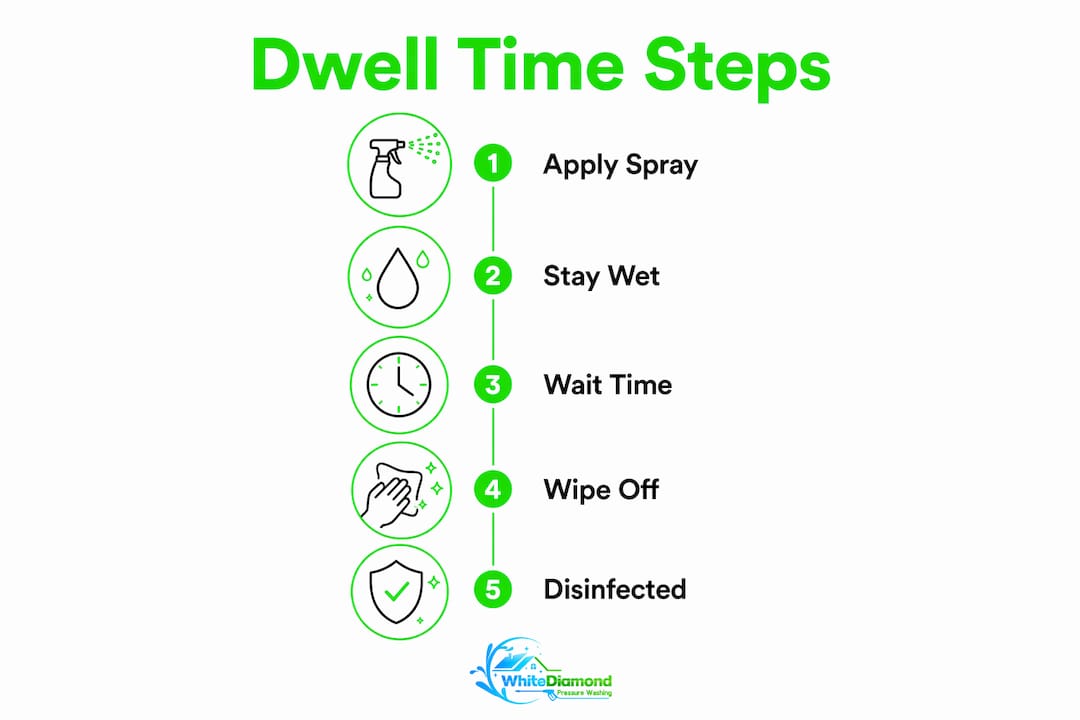
- Sequence tasks to use dwell time productively. Spray surface A, move to surface B, return to wipe A after the required time. This approach builds contact time into the workflow without adding total cleaning time.
- Measure actual drying times on-site. Test your specific surfaces under your specific conditions. Porous concrete, sealed tile, and stainless steel all behave differently. The soft washing process used in exterior cleaning applies this same logic: match the chemical application to the surface’s actual absorption rate.
- Pre-clean before disinfecting. Organic matter blocks chemical contact. Cleaning first removes the barrier and lets the disinfectant reach the surface it needs to treat.
| Approach | Best for | Limitation |
|---|---|---|
| Shorter contact time products | High-turnover workflows | Narrower pathogen spectrum |
| Sequential surface spraying | Multi-surface routines | Requires planning and training |
| Increased application volume | Porous or warm surfaces | Higher product cost |
| On-site drying time testing | Environment-specific compliance | Requires initial time investment |
For exterior surfaces, the same principles apply. Non-abrasive washing methods that allow cleaning agents to dwell on driveways, roofs, and walkways before rinsing produce far better results than high-pressure approaches that blast product off before it can work. Professionals in the cleaning services sector increasingly recognize that chemical contact time is as important as mechanical force in achieving a genuinely clean surface.
Key Takeaways
Dwell time is a non-negotiable performance standard: surfaces must stay visibly wet for the full labeled contact time to achieve validated pathogen kill rates and effective soil breakdown.
| Point | Details |
|---|---|
| Dwell time is a hard threshold | EPA registration treats contact time as a minimum requirement, not a guideline. |
| Premature drying causes failure | A surface drying in 20 seconds during a 2-minute contact window achieves less than 17% of required exposure. |
| Product selection drives compliance | Choosing products with shorter validated contact times eliminates the primary source of non-compliance. |
| Sequence tasks to build in contact time | Spray one surface, move to the next, return to wipe. This method adds zero total time to a routine. |
| Pre-cleaning is not optional | Organic soils block disinfectant contact. Clean the surface first, then apply the disinfectant. |
What I’ve learned from watching dwell time get ignored every day
I have watched cleaning crews in residential and commercial settings go through the motions of disinfection for years. The spray-and-wipe cycle looks thorough. It almost never is.
The hardest part of this conversation is that surfaces look the same whether dwell time was observed or not. There is no visible difference between a surface wiped at 10 seconds and one wiped at 3 minutes. That invisibility is exactly why the problem persists. Staff are not cutting corners out of laziness. They are responding to a schedule that was never designed with contact time in mind.
My honest recommendation: stop trying to fix this with laminated reminder signs. Fix the product selection first. If your team cannot realistically hold a surface wet for 5 minutes, you need a product validated at 60 seconds. That single change, done correctly, eliminates the compliance gap without changing a single behavior. For exterior cleaning specifically, avoiding common application mistakes matters just as much as choosing the right product. Applying too little chemical, rinsing too fast, or working in direct sun on a hot surface all undermine contact time before the clock even starts.
The professionals who get this right treat dwell time as a workflow design problem, not a training problem. That shift in thinking produces results that training alone never will.
— Bobby
Whitediamondpressurewashing: professional cleaning that respects contact time
Exterior surfaces present the same dwell time challenges as interior ones, often with more variables. Sun, heat, wind, and surface porosity all affect how long a cleaning agent stays active on concrete, roof tiles, or siding.

Whitediamondpressurewashing applies industry-approved soft washing techniques across Citrus County that account for these variables. Cleaning agents are applied at the right volume and left to work before rinsing, which is exactly what the science requires. Whether you manage a residential property or a commercial establishment, their team matches the product, application method, and contact time to your specific surface and environment. Visit Whitediamondpressurewashing to request a free estimate and see what a properly timed clean actually looks like.
FAQ
What is dwell time in cleaning?
Dwell time, also called contact time, is the period a cleaning agent or disinfectant must remain visibly wet on a surface to achieve its labeled efficacy. EPA-registered disinfectants require contact times ranging from 30 seconds to 10 minutes depending on the product and target pathogen.
Why does dwell time matter for surface sanitization?
Cutting contact time short drastically reduces pathogen kill rates. Halving the required dwell time can drop efficacy from a 4-log reduction (99.99%) to below a 2-log reduction (99%), leaving resistant pathogens like Candida auris alive on the surface.
How long should a disinfectant dwell on a surface?
The label is the legal and scientific answer. Most EPA-registered disinfectants require 3–10 minutes of wet contact time, though newer formulations can achieve efficacy in 15–60 seconds. When multiple pathogens are listed, always use the longest contact time on the label.
What happens if a disinfectant dries before the dwell time is up?
Premature drying stops the chemical reaction. A surface that dries in 20 seconds during a required 2-minute contact window has achieved less than 17% of the necessary exposure, which constitutes a disinfection failure regardless of how the surface looks.
How can property managers improve dwell time compliance?
Select products with contact times that fit your actual workflow, apply enough product to keep surfaces visibly wet, and sequence tasks so surfaces dwell while you work on adjacent areas. Product selection is the most reliable fix; training alone cannot compensate for a schedule that makes proper contact time impossible.
Recommended
- Drying Time After Cleaning: A Homeowner’s Guide – white-diamond-pressure
- Time-Saving Cleaning Hacks for Busy Homeowners – white-diamond-pressure
- How cleaner experience impacts property care quality – white-diamond-pressure
- Exterior Cleaning Before Tenant Move-In: Landlord Guide – white-diamond-pressure