

pH-neutral cleaning means using a cleaning solution with a pH close to 7, the midpoint of the 0–14 pH scale where hydrogen ions and hydroxide ions are balanced. At that balance point, the cleaner is neither acidic nor alkaline, so it won’t etch stone, corrode metal, or strip protective finishes the way stronger cleaners can. For everyday home maintenance, that gentleness is exactly what most surfaces need.
Here’s what sets pH-neutral cleaners apart at a glance:
- pH range: Around neutral, typically close to 7 at 25°C (77°F)
- Surface safety: Won’t cause etching, discoloration, or corrosion on sensitive materials
- Skin and eye safety: Low irritation risk compared to strongly acidic or alkaline products
- Best use: Routine maintenance cleaning on floors, countertops, siding, and sealed surfaces
- Not ideal for: Heavy grease, rust, or mineral deposits that require a targeted pH shift
How does pH actually affect your cleaning products?
The pH scale measures how acidic or alkaline a liquid is, and each step on that scale represents a tenfold change in ion concentration. So a cleaner at pH 9 is ten times more alkaline than one at pH 8, not just a little stronger. That logarithmic jump is why choosing the wrong cleaner can cause real damage fast.
Common household cleaners fall across a wide range. Bleach typically sits around pH 11–13. Baking soda lands near pH 8–9. Vinegar runs between pH 2.0 and 3.0, making it genuinely aggressive despite its reputation as a gentle, natural option. True pH-neutral products cluster near 7, though the EPA’s Safer Choice program recognizes a practical range of pH 4–9.5 for products that balance safety and cleaning performance. Chemically, the standard definition of neutral at 25°C (77°F) is pH 7.0, when hydrogen and hydroxide ions are balanced.
How you measure a product’s pH matters too. Options include:
- pH test strips: Inexpensive, widely available, accurate enough for household decisions
- Digital pH meters: More precise, useful if you’re mixing your own solutions
- Product labeling: Many professional-grade cleaners list pH directly; check the technical data sheet if the label doesn’t show it
- Manufacturer websites: Often list pH under product specifications or safety data
One nuance worth knowing: pH 7 is the neutral point at 25°C, but temperature and ionic strength can shift that value slightly. Professionals working with sensitive surfaces account for this by targeting a range rather than a single number.
Why pH-neutral cleaners protect your home surfaces over time
The biggest argument for pH-neutral cleaning solutions isn’t a single dramatic result. It’s what doesn’t happen over months and years of regular cleaning. Acidic cleaners slowly etch stone and corrode metals. Alkaline cleaners can dull finishes, break down sealants, and leave residue that attracts more dirt. Neutral cleaners sidestep both problems.
Professional maintenance guidelines consistently recommend neutral pH products for floors, countertops, and exterior siding precisely because cumulative damage is invisible until it isn’t. By the time you notice a haze on your hardwood or pitting on a tile grout line, the damage is already done. Routine use of a pH-balanced cleaner prevents that progression.
Key benefits for homeowners:
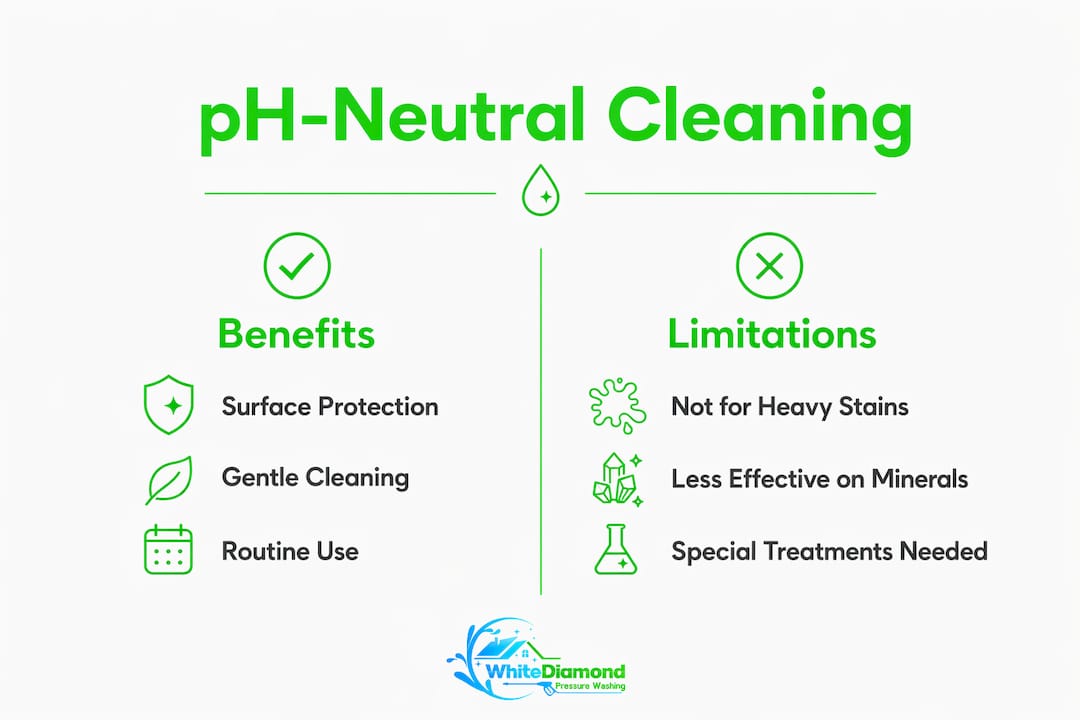
- Surface finish preservation: Neutral pH won’t strip wax, sealant, or factory finishes
- Material compatibility: Safe for wood, stone, tile, vinyl, aluminum, and most painted surfaces
- Lower skin and eye irritation risk: Gentler on hands during regular use
- Environmentally friendlier: Less corrosive chemistry means lower risk to plants, soil, and waterways
- Residue-free rinsing: Neutral solutions typically rinse clean without leaving alkaline film or acidic residue
Pro Tip: If you’re cleaning a surface you’ve never treated before, test your cleaner in a small, hidden spot first. Even pH-neutral products can interact unexpectedly with certain sealants or finishes.
Neutral cleaners also hold up well for routine dirt, dust, light grime, and general soil. They’re not weak. They’re specialized for gentle maintenance rather than heavy-duty stain removal, and that distinction is exactly what makes them the right tool for regular upkeep.
Which surfaces work best with pH-neutral cleaners?
Most of the surfaces inside and outside your home respond well to neutral pH products. The materials most at risk from acidic or alkaline cleaners are also the ones you’re most likely to encounter in a typical house.
Compatible surfaces include:
- Hardwood and engineered wood floors: Acidic cleaners can raise the grain; alkaline ones dull the finish
- Natural stone (marble, granite, travertine, limestone): Highly vulnerable to acid etching, even from vinegar
- Ceramic and porcelain tile: The tile itself is durable, but grout is porous and degrades with repeated harsh cleaner exposure
- Laminate and vinyl flooring: Alkaline cleaners can cause swelling or surface haze over time
- Aluminum and zinc surfaces: Both metals corrode with acidic cleaners; neutral pH keeps them intact
- Painted exterior siding: Strong alkaline cleaners strip paint; neutral solutions clean without lifting the coating
- Sealed concrete driveways and walkways: Sealants break down faster under repeated acid or alkali exposure
Surfaces that typically need something stronger include heavily stained concrete (alkaline degreaser), calcium or mineral deposits on glass or fixtures (mild acid), and rust stains (oxalic acid-based products). For those jobs, a targeted cleaner matched to the specific soil type does the work a neutral product can’t.
Knowing which surfaces to prioritize for routine neutral cleaning is one of the most practical things a homeowner can do to extend the life of their property.

When pH-neutral cleaners aren’t the right tool
Neutral cleaners have real limits, and knowing them prevents frustration and wasted effort. They work by lifting loose soil and light grime through surfactant action, not by chemically breaking down tough deposits.
Heavy grease on a garage floor or kitchen exhaust hood needs an alkaline degreaser, typically pH 10–13, to saponify the fats and lift them off the surface. Mineral scale, hard water deposits, and calcium buildup on shower glass or faucets respond to mild acids, not neutral solutions. Rust stains require an acid-based treatment entirely.
Use cases where neutral cleaners fall short:
- Heavy grease or oil: Alkaline cleaners cut through fat chemistry that neutral products can’t touch
- Mineral deposits and hard water scale: Require mild acid to dissolve calcium carbonate bonds
- Rust stains: Need oxalic or phosphoric acid-based products
- Mold and mildew on exterior surfaces: Often require a biocidal or alkaline solution for full kill
- Heavily soiled concrete: May need a pre-treatment with an alkaline degreaser before rinsing
The practical approach is to use neutral cleaners as your default for routine maintenance, then reach for a targeted acidic or alkaline product only when a specific soil type demands it. Matching pH to soil type is how professionals get results without damaging surfaces. Using a strong alkaline cleaner on everything “just to be safe” is one of the most common ways homeowners accidentally degrade their finishes over time.
Common misconceptions about pH-neutral cleaning products
A few widely repeated ideas about neutral cleaners are simply wrong, and they lead homeowners to make choices that damage surfaces or leave them under-cleaned.
Dawn dish soap is not pH-neutral. Independent testing shows Dawn’s pH generally falls between 8.0 and 9.8, making it mildly to moderately alkaline. That alkalinity is what gives it grease-cutting power. It’s a good product for its intended purpose, but using it on natural stone or hardwood floors regularly will cause cumulative dullness and finish breakdown.
Vinegar is not a gentle, all-purpose cleaner. With a pH of 2.0–3.0, vinegar is genuinely acidic. It works well for dissolving mineral deposits on glass or descaling a coffee maker, but it will etch marble, damage grout, and corrode certain metals with repeated use. The “natural” label doesn’t mean safe for every surface.
“Gentle” on the label doesn’t mean neutral pH. Marketing language and chemistry are different things. A product described as gentle may still be pH 9 or higher. Check the product’s technical data sheet or test it with pH strips before using it on sensitive materials.
Common questions homeowners ask:
- Is castile soap pH-neutral? Pure castile soap is mildly alkaline, typically around pH 8.9–9.3. Diluted significantly in water, it becomes closer to neutral and is generally safe for most surfaces, but it’s not technically pH-neutral at full concentration.
- Can I make a pH-neutral cleaner at home? A very dilute solution of mild dish soap in water can approach neutral pH, but without testing, you’re guessing. For sensitive surfaces, a commercially labeled pH-neutral product is more reliable.
- Are pH-neutral cleaners less effective? No. They’re effective for routine maintenance and gentle cleaning. They’re not designed for heavy-duty stain removal, which is a different task requiring a different tool.
- Do pH-neutral cleaners disinfect? Most do not. Disinfection typically requires alkaline or acidic chemistry, or specific biocidal agents. Neutral cleaners clean; they don’t necessarily kill pathogens.
When Whitediamondpressurewashing handles exterior cleaning for homes in Citrus County, product selection is part of the process, not an afterthought. Soft washing and low-pressure washing techniques pair naturally with pH-appropriate solutions, because the right chemistry at the right pressure is what cleans surfaces without shortening their lifespan. If you want a professional assessment of what your home’s exterior actually needs, get a free estimate from Whitediamondpressurewashing today.

Key Takeaways
pH-neutral cleaners, centered on pH 7, protect sensitive surfaces from cumulative damage while handling routine dirt and grime effectively across most home materials.
| Point | Details |
|---|---|
| Neutral pH defined | pH 7.0 at 25°C (77°F) is the standard neutral point, where hydrogen and hydroxide ions are balanced. |
| Surface compatibility | Hardwood, natural stone, tile, vinyl, aluminum, and painted siding all benefit from neutral pH routine cleaning. |
| Real product limits | Heavy grease, mineral scale, rust, and mold require acidic or alkaline cleaners, not neutral ones. |
| Common misconceptions | Dawn dish soap (pH 8.0–9.8) and vinegar (pH 2.0–3.0) are not pH-neutral despite their household reputations. |
| Professional standard | EPA Safer Choice recognizes pH 4–9.5 as the practical safe range; true neutral targets pH 7 for the most sensitive surfaces. |