

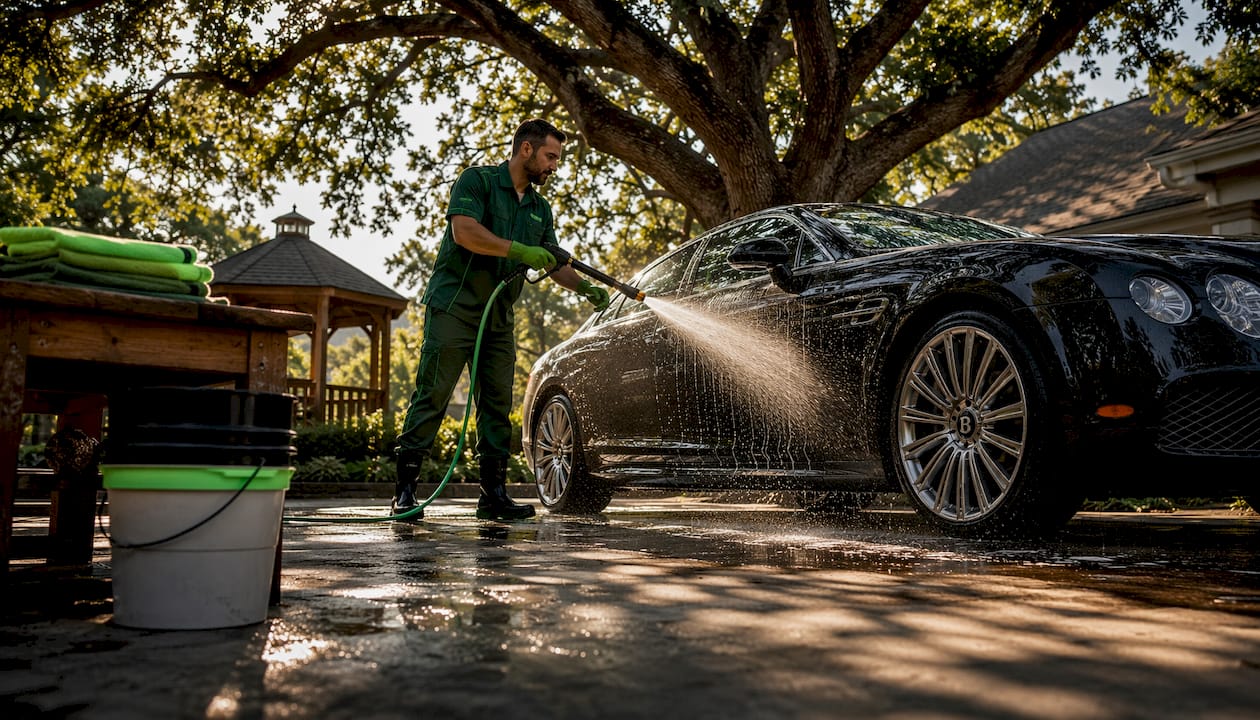
What is spot-free rinsing and why does it work?
Spot-free rinsing means washing a surface with water that contains virtually zero dissolved minerals, so when the water evaporates, nothing is left behind. No calcium rings. No magnesium haze. No white film on dark paint. The industry measures water purity in total dissolved solids (TDS), and true spot-free rinsing requires achieving an extremely low TDS level close to zero.
Regular tap water carries dissolved minerals picked up as it moves through soil and pipes. When that water lands on a car hood or window and dries in the sun, the water itself disappears but the minerals stay put, etching into clear coats and glass over time. Spot-free water removes that problem at the source.
Here is what defines a true spot-free rinse system:
- Water TDS at or near zero, achieved through deionization or a combination of reverse osmosis and deionization
- Removal of hardness minerals, primarily calcium and magnesium, before the final rinse
- No need for towel drying because DI water evaporates without leaving mineral residue
- Consistent water purity verified with a TDS meter before each use
- Applicability across vehicles, windows, solar panels, and other surfaces where spotting is unacceptable
Pro Tip: Check your tap water’s TDS before buying a system. City water in Florida often runs well above 200 ppm, which means a DI-only portable tank will exhaust its resin faster than in softer-water areas. Knowing your baseline helps you size the right system.
How does spot-free rinsing work through deionization and reverse osmosis?
Two technologies do the heavy lifting: deionization (DI) and reverse osmosis (RO). They work differently, produce different purity levels, and are often combined for the best results.
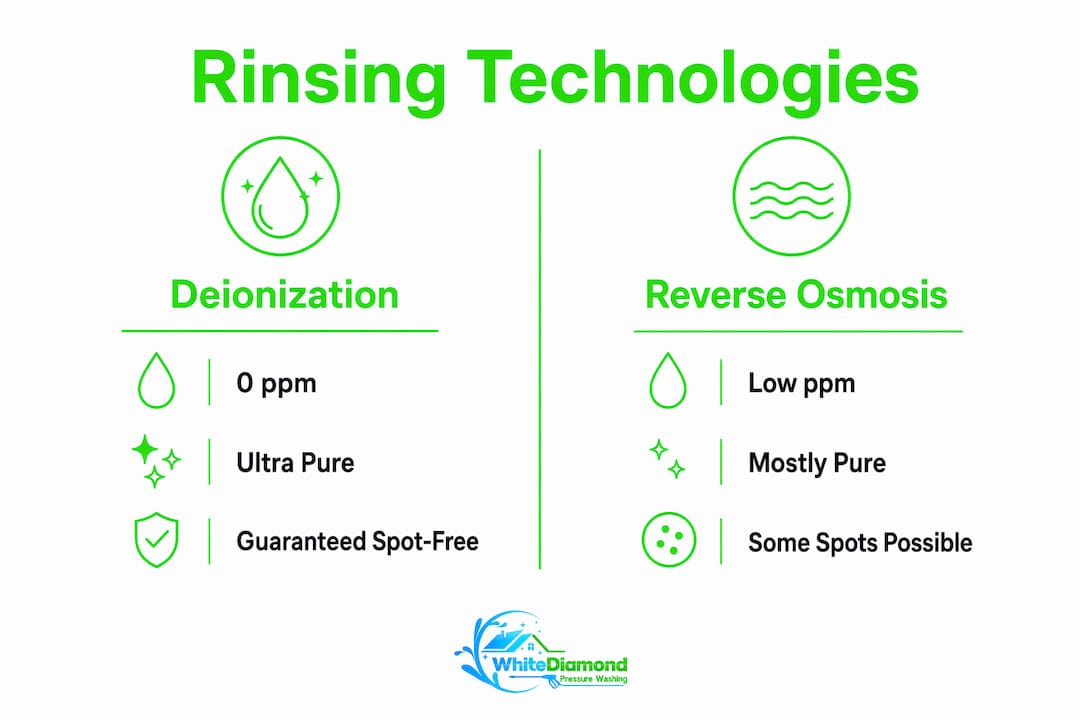
Deionization (DI): the gold standard for ultra-pure water
DI systems pass water through ion exchange resins, small polymer beads carrying fixed positive or negative charges. Cation resins swap calcium, magnesium, sodium, and other positively charged ions for hydrogen (H+). Anion resins swap chloride, sulfate, and other negatively charged ions for hydroxyl (OH-). The hydrogen and hydroxyl combine to form pure H2O. Mixed-bed DI tanks, which blend both resin types in a single vessel, repeat this exchange multiple times per pass and produce very high purity water.
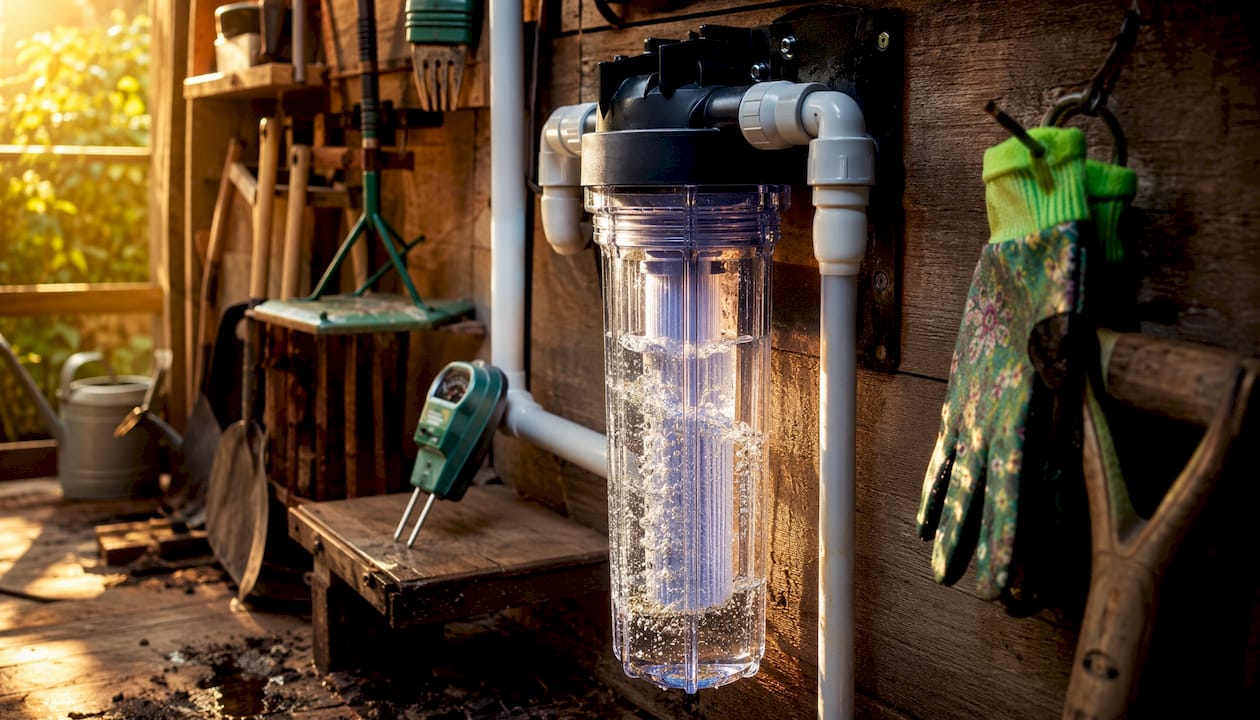
Portable DI tanks connect directly to a garden hose, require no electricity, and are ready in minutes. The main limitation is resin life: the higher your incoming TDS, the faster the resin exhausts and needs replacement.
Reverse osmosis (RO): effective but not completely mineral-free
RO forces water through a semi-permeable membrane under pressure, removing most dissolved minerals and producing output water at low ppm TDS levels. That is dramatically cleaner than tap water, but on dark paint or glass in direct sun, even low ppm levels can leave faint spots. Commercial operators often run RO as a pre-filter before a DI polishing stage. The RO membrane handles the bulk of the mineral load, which extends the life of the DI resin significantly.
Why water softeners fall short
A water softener does not purify water. It swaps calcium and magnesium ions for sodium ions through ion exchange, leaving the total dissolved solids roughly unchanged. Softened water still leaves residual minerals when it dries, appearing as a light haze or soft film. For whole-house plumbing protection, a softener makes sense. For a spot-free final rinse on a vehicle or window, it does not work.
| Method | Output TDS | Spot-free result | Best use case |
|---|---|---|---|
| DI system | 0 ppm | Yes, guaranteed | Car washing, windows, solar panels |
| RO system | 5–20 ppm | Mostly, faint spots possible on dark surfaces | High-volume commercial use with DI polishing |
| Water softener | Same as tap (ion swap) | No, leaves sodium residue | Whole-house scale prevention only |
| Distilled water | 0 ppm | Yes, but impractical | Lab use, small batch applications |
What are the real benefits of spot-free rinsing for vehicles and surfaces?
The advantages go beyond just a cleaner-looking car. Here is what spot-free rinsing actually delivers:
-
No water spots or streaks. Because DI water contains no dissolved minerals, it evaporates cleanly. Dark paint, glass, and chrome all dry without the white rings that standard rinse water leaves behind.
-
No towel drying required. This is the one that surprises most people. You rinse, walk away, and the surface air-dries to a spot-free finish. That eliminates swirl marks from drying towels and saves real time on every wash.
-
Paint and clear coat preservation. Mineral deposits do not just look bad. Over repeated wash cycles, calcium and magnesium residue can etch into clear coats and glass. Removing them from the rinse water stops that damage before it starts.
-
Reduced chemical use. When the rinse water itself is pure, you need fewer detergents and no post-wash spot removers. That cuts chemical runoff and lowers the environmental footprint of each wash.
-
Time and labor savings in commercial settings. DI water systems in car washes and window cleaning reduce the need for repeated drying and touch-ups, which translates directly to faster throughput and lower labor costs.
-
Better results on windows and solar panels. Spot-free rinsing is the standard final step in professional window washing. On solar panels, mineral buildup reduces energy output, so a clean, residue-free rinse after washing protects both appearance and function.
-
Consistent quality regardless of water source. A properly maintained low-pressure rinsing approach combined with purified water delivers the same result whether your tap water is moderately hard or extremely hard.
Practical tips, common applications, and limitations you should know
Answering the questions people actually ask
Should you rinse again after a spot-free rinse? No. The spot-free rinse is the final step. Adding regular tap water after it reintroduces minerals and defeats the purpose entirely.
Does waxing still matter if you use spot-free water? Yes. Wax or paint sealant protects the clear coat from UV damage, oxidation, and contaminants. Spot-free rinsing prevents mineral deposits; wax handles everything else. Apply wax after the surface is fully dry from the spot-free rinse. For surfaces where you want lasting protection, post-wash sealing adds a layer of defense that rinsing alone cannot provide.
Is soft water the same as spot-free water? No. Softened water still contains dissolved solids at roughly the same TDS as your tap water. It just swaps the mineral type. You will still get deposits when it dries.
Monitoring and maintenance
- Use a TDS meter before each session. Target below 10–20 ppm for reliable spot-free results; 0 ppm from a DI system is the benchmark for a guaranteed finish.
- Watch for resin color change in DI tanks. Most mixed-bed resins shift from a mixed color to a uniform color when exhausted. Replace promptly rather than waiting for spots to reappear on finished surfaces.
- For RO systems, inspect membranes quarterly for scale buildup. Hard water can overwhelm membranes faster than expected, causing TDS to creep back up.
- Pre-filter sediment and iron before your RO or DI system. Both contaminants foul resin beds and membranes quickly, shortening their useful life.
Where spot-free rinsing is used
Beyond car washing, spot-free rinse systems are standard in professional window cleaning, RV detailing, boat washing, solar panel maintenance, and industrial parts washing. The Water Quality Association (WQA) notes that ion exchange resins find wide utility in car wash spotless rinse applications because of their high capacity and chemical efficiency.
Limitations worth knowing
DI systems have real costs. Resin replacement is ongoing, and in high-TDS water areas the expense adds up. RO systems require plumbing, electricity, and regular membrane maintenance. Neither system is install-and-forget. Proper upkeep is what separates consistent spot-free results from frustrating inconsistency. Preparing your home exterior correctly before any wash, including checking for surface damage, also matters. Resources like this home exterior prep guide walk through what to address before water ever touches the surface.
What do experts say about spot-free rinsing and water quality?
The professional cleaning industry draws a clear line between a surface that looks spot-free and one that is genuinely clean at a chemical level.
“There is a difference between a surface without spots and a surface without chemical residues. True spot-free rinse leaves nothing behind.”
— Spot-Free Rinse Troubleshooting, Vulcan Descaler
That distinction matters in practice. Some professional car washes use rinse aids, similar to the surfactant in a dishwasher, to reduce water surface tension and promote sheeting. Water sheets off the surface in a thin film rather than beading into large droplets. Smaller droplets mean less dissolved solid per drop, which reduces visible spotting. But rinse aids alter water behavior without removing dissolved solids. The surface may look spot-free while still carrying invisible chemical residue. For vehicle detailing and surfaces where chemical purity matters, DI water at 0 ppm is the only method that leaves nothing behind.
Experts also flag a common failure mode: reactive maintenance. Scale buildup from hard water can overwhelm RO membranes and DI resin beds before operators notice any problem, causing inconsistent rinse quality that only becomes obvious after customer complaints. Proactive TDS monitoring catches this early.
Key expert recommendations for consistent spot-free results:
- Check TDS daily in commercial settings; before each use in home settings
- Never rely on a water softener as a substitute for DI or RO purification
- Use RO as a pre-filter before DI when incoming water TDS is high, to extend resin life
- Verify silica levels in your source water. The WQA notes that silica above 10–15 ppm can leave damaging residue even when other minerals are removed, requiring a full mixed-bed DI system rather than a simpler two-bed setup
- Treat rinse aids as a supplement to purified water, not a replacement for it
Key Takeaways
Spot-free rinsing requires water at or near 0 ppm TDS, achieved through deionization, to guarantee surfaces dry without mineral deposits, streaks, or chemical residue.
| Point | Details |
|---|---|
| 0 ppm TDS is the target | Only DI water consistently reaches 0 ppm, guaranteeing a spot-free result every time. |
| RO alone is not enough | RO removes most minerals but leaves 5–20 ppm TDS, which can still spot dark surfaces. |
| Softeners do not work for rinsing | Water softeners swap minerals for sodium without reducing TDS, leaving visible residue when dry. |
| Monitor TDS proactively | Target below 10–20 ppm; daily checks in commercial settings prevent resin exhaustion surprises. |
| Rinse aids are not a substitute | Rinse aids improve water sheeting but leave chemical residue; purified water leaves nothing behind. |
Get professional exterior cleaning that gets it right

Understanding spot-free rinsing is one thing. Applying it correctly to your home’s exterior surfaces, driveways, roofing, and walkways is another. Whitediamondpressurewashing uses industry-approved low-pressure and soft washing techniques across Citrus County and surrounding areas, with methods designed to protect your surfaces rather than damage them. Whether you need a full house wash, driveway cleaning, or roof treatment, the team brings the right approach to every job.
Avoid the common mistakes that leave mineral staining, streaks, and surface damage behind. See what professional exterior cleaning looks like when it is done properly, or review the pressure washing mistakes that homeowners most often make before booking a service.