

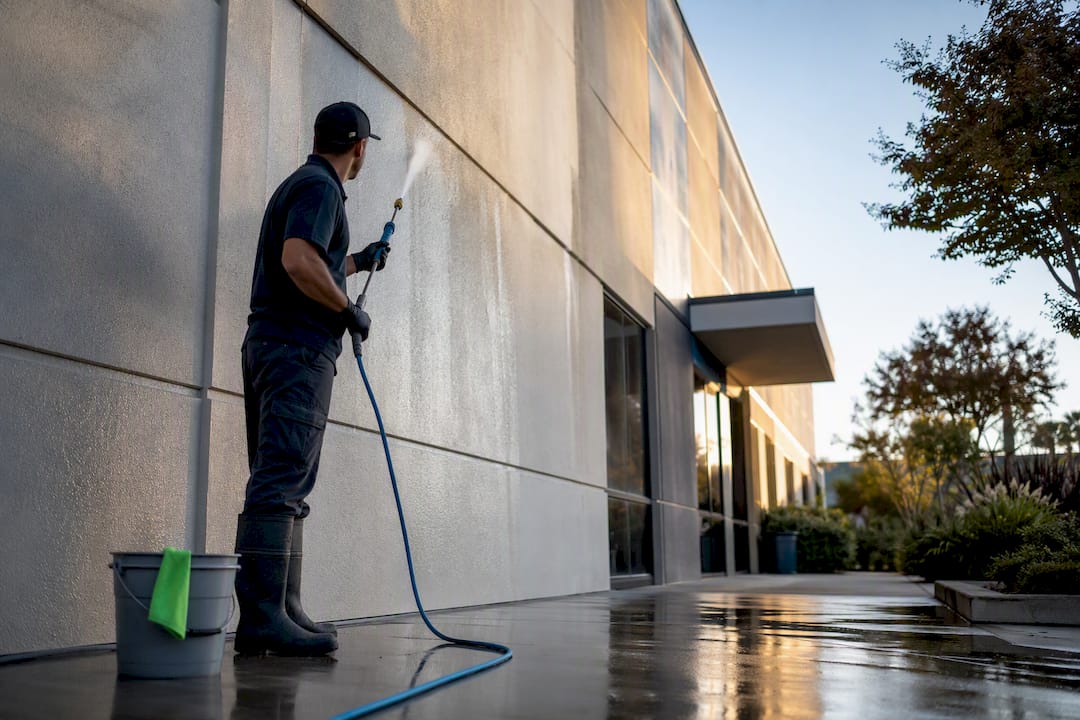
Most commercial building washing in the U.S. runs within a typical price range per square foot, with small storefronts landing in the low hundreds of dollars and larger properties billed on a flat-project or per-space basis. Contractors quote using one of four models: per-square-foot, hourly, flat project fee, or per-space (per parking spot or dumpster pad). The exact number on your quote depends on surface type, building height, and how much grime you’re asking the crew to remove.
TL;DR:
- Equipment rental, building height, and access complexity significantly impact commercial washing quotes, especially when lifts or scaffolding are involved.
- Surface material differences mean brick requires higher pressure than stucco, and soft washing is better for delicate surfaces, often costing slightly more.
- Recurring services generally reduce costs by 10% to 20% per visit and help maintain property value by preventing heavy buildup.
- Accurate quotes depend on property-specific details like square footage, surface type, access restrictions, and stain severity, which should be provided upfront.
- Prioritizing insurance proof and correct cleaning methods over the lowest bid minimizes potential damages and liability in the long run.
Table of Contents
- What Does Commercial Building Washing Cost Per Square Foot?
- How Much Does It Cost by Surface Type?
- What Actually Drives the Price on Your Quote?
- How Do You Get an Accurate Quote?
- Do Recurring Contracts Save Money Over One-Time Jobs?
- What Should a Qualified Vendor Look Like?
- The Real Procurement Priority Isn’t the Lowest Number
- How Do You Request a Commercial Estimate?
- Where These Price Ranges Come From
- Sources
What Does Commercial Building Washing Cost Per Square Foot?
Price scales with how dirty the surface is and how much labor it takes to fix that, not just square footage. A basic wash on a clean, low-access storefront sits at the bottom of the range. A premium job with grease removal, graffiti abatement, or multi-story access equipment sits at the top.
Here’s how the tiers typically break down, based on ranges reported across commercial pressure washing pricing data:
- Basic wash (light dust, pollen, low access): $0.10 to $0.20 per square foot
- Standard wash (moderate grime, one or two stories, some staining): $0.20 to $0.40 per square foot
- Premium wash (heavy staining, grease, graffiti, or difficult access): $0.40 to $1.00 per square foot
Flat-fee jobs follow a similar logic. A small retail storefront commonly costs $200 to $800 for a full exterior wash, while a 10,000 square foot office building typically falls between $1,500 and $4,000, depending on service tier and access difficulty.
These figures assume single-story or modest-height buildings with normal soil levels. A five-story office tower or a restaurant exterior coated in grease will push past these numbers regardless of square footage.
How Much Does It Cost by Surface Type?
Surface material changes both the method and the price. A brick facade tolerates higher pressure than painted stucco, and a parking lot prices completely differently than a window bank. This is one of the biggest sources of quote confusion for property managers comparing bids side by side.
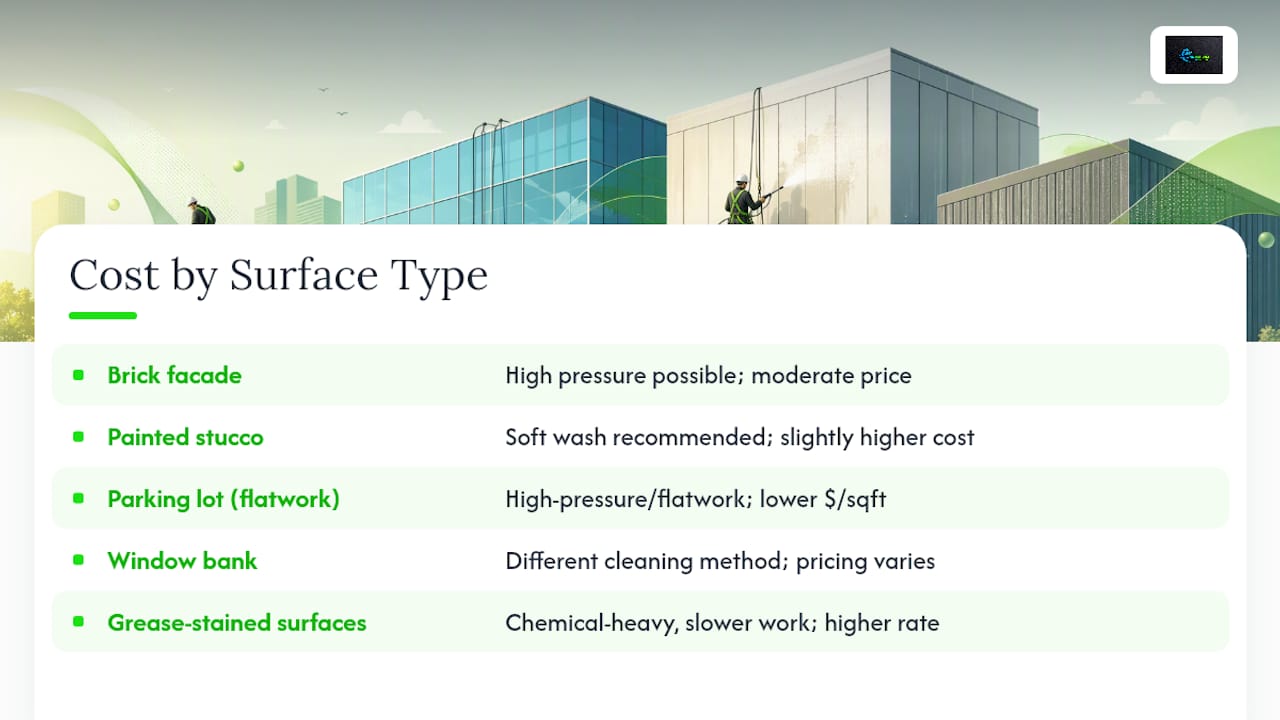
Rates vary by property type more than most people expect. Open flatwork often prices lower per square foot simply because crews cover more ground per hour, while grease-prone or stained surfaces demand slower, chemical-heavy work that commands a higher rate.
Soft washing, which uses low pressure and specialized detergents instead of brute force, is the recommended approach for stucco, painted surfaces, and older siding. It often costs slightly more per visit than straight high-pressure washing, but it protects materials that pressure alone would strip or crack, which matters when you’re managing a building you plan to own for another decade.
What Actually Drives the Price on Your Quote?
Two buildings of identical square footage can get wildly different quotes, and it almost never comes down to the contractor padding the bill. It comes down to four variables.
- Square footage and crew production rate: crews cover flatwork faster than detailed facade work, so total labor hours vary even at equal square footage.
- Height and access: anything above two stories often requires boom lifts or scaffolding, and equipment rental alone can add hundreds of dollars per day to a bid.
- Soil severity: mildew, rust staining, and grease require specialty chemicals and longer dwell times, which stretches labor hours per square foot.
- Water access and disposal: buildings without an easy water hookup or with runoff restrictions near storm drains may carry added logistics fees.
- Scheduling window: after-hours or weekend work to avoid disrupting business operations often carries a premium over a standard weekday slot.
Pro Tip: Ask every bidder to break out the equipment rental line separately from labor. A quote that lumps a boom lift into a flat number makes it nearly impossible to tell whether you’re comparing two apples or an apple and a much smaller orange.
How Do You Get an Accurate Quote?
Getting quotes that you can actually compare starts before you ever call a contractor. Walk your property first.
- Measure your wash zones separately. Note square footage for siding, flatwork, and any specialty areas like dumpster pads or entryways.
- Identify surface material for each zone (brick, stucco, vinyl, concrete) and photograph visible staining or soil buildup.
- Note access constraints, including building height, nearby landscaping, and whether a lift or scaffolding will be needed.
- Choose your target tier (basic, standard, or premium) based on how much visible grime or staining you’re seeing.
- Apply the per-square-foot range for that tier to each zone, then add flat-fee items like windows or dumpster pads separately.
- Add equipment, permit, or disposal lines if your building requires lift rental or runoff containment.
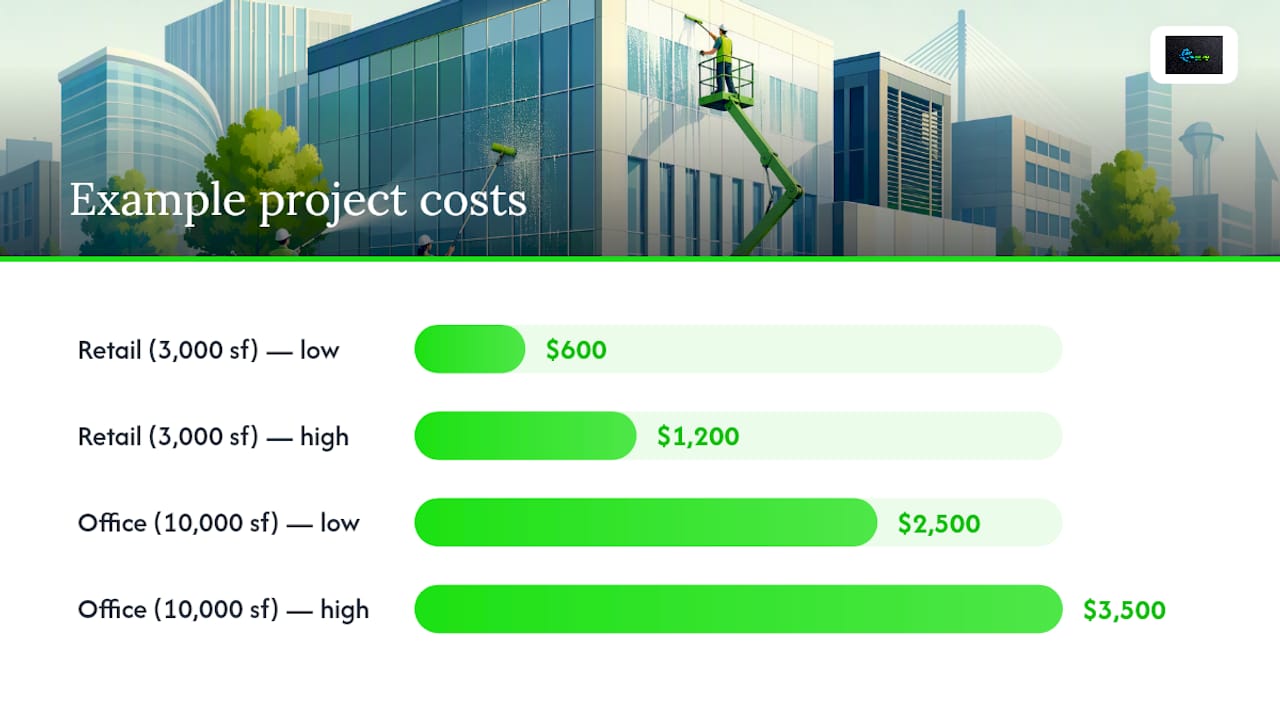
A working example: a 3,000 square foot single-story retail strip with standard soiling and easy access lands around $600 to $1,200 using the standard tier rate. A 10,000 square foot two-story office building with moderate staining and one section requiring a lift might run $2,500 to $3,500, once you add a few hundred dollars for equipment rental on top of the base wash.
When bids come in far below these ranges, check whether the contractor accounted for crew-hour operating costs and equipment rental at all. A bid that skips those line items isn’t necessarily a bargain. It’s often a job that will cut corners on prep time or skip safety steps to hit an unsustainable number.
Every quote request should include these questions: What’s included in the per-square-foot rate? Is equipment rental itemized separately? What method will be used on each surface? What’s the total estimated crew-hours for the job?
Do Recurring Contracts Save Money Over One-Time Jobs?
Yes, and the savings are real enough to change your annual budget math. Recurring service, billed quarterly or monthly, commonly runs 10% to 20% cheaper per visit than booking one-off jobs each time, because contractors save on routing, scheduling, and repeat-site setup.
- Quarterly contracts suit buildings in moderate climates with average soil accumulation.
- Monthly service fits high-traffic storefronts or buildings near heavy pollen, salt air, or industrial exhaust.
- Bundling services (siding, sidewalks, dumpster pads) into one recurring visit often lowers the per-item price versus booking each separately.
Skipping maintenance and waiting for heavy buildup usually costs more in the long run, since ongoing exterior maintenance protects property value better than periodic deep-cleans after neglect sets in. Set your frequency based on your local soil rate, not just your budget cycle.
What Should a Qualified Vendor Look Like?
A vendor worth hiring documents their scope, method, and coverage before you ever sign. Whitediamondpressurewashing publishes service-specific pages covering soft washing, surface-specific methods, and commercial property maintenance, which lets a buyer confirm method match before booking.
Insured, trained crews matter because improper technique risks both worker injury and property damage. Request proof of insurance, a written scope tied to your measured zones, and a per-tier price breakdown before comparing any two bids side by side.
The Real Procurement Priority Isn’t the Lowest Number
Facilities managers get burned more often by underpriced bids than overpriced ones. A quote that skips insurance documentation or ignores method match (pressure washing stucco instead of soft washing it, for instance) can cost far more in repair or liability than the few hundred dollars it saved upfront. Prioritize proof of insurance and correct method assignment over the bottom-line figure every time.
Pro Tip: If your property needs multiple services, ask one vendor to bundle siding, flatwork, and dumpster pads into a single scheduled visit. Route efficiency for the contractor often translates into a lower combined price for you.
— Bobby
How Do You Request a Commercial Estimate?
Some pressure washing companies serve as direct options for property managers who need documented, method-matched quotes rather than rough phone estimates, handling soft washing, building exteriors, flatwork, and dumpster pad cleaning for commercial properties using pressure levels matched to each surface rather than a one-size-fits-all blast.
When you request a quote, include the following so the estimate matches what you’ll actually be billed:
- Total square footage broken out by zone (siding, flatwork, windows, dumpster pads)
- Surface materials for each zone
- Photos of visible staining, mildew, or grease buildup
- Building height and any known access restrictions
- Preferred service frequency (one-time or recurring)
Ready to compare a real number against the ranges above? Request a free estimate from Whitediamondpressurewashing and get a written quote tied to your building’s actual measurements.
Where These Price Ranges Come From
- Commercial pressure washing prices, HomeGuide
- Commercial exterior building cleaning cost: rates and factors, LegalClarity
- Commercial pressure washing rates by property type, SurfaceMeasure
- Commercial power washing: complete guide for businesses, Maryland Pro Wash
Sources
- Commercial pressure washing prices (HomeGuide)
- Commercial exterior building cleaning cost: rates and factors (LegalClarity)
- Commercial pressure washing rates by property type (SurfaceMeasure)
- Commercial power washing: complete guide for businesses (Maryland Pro Wash)