

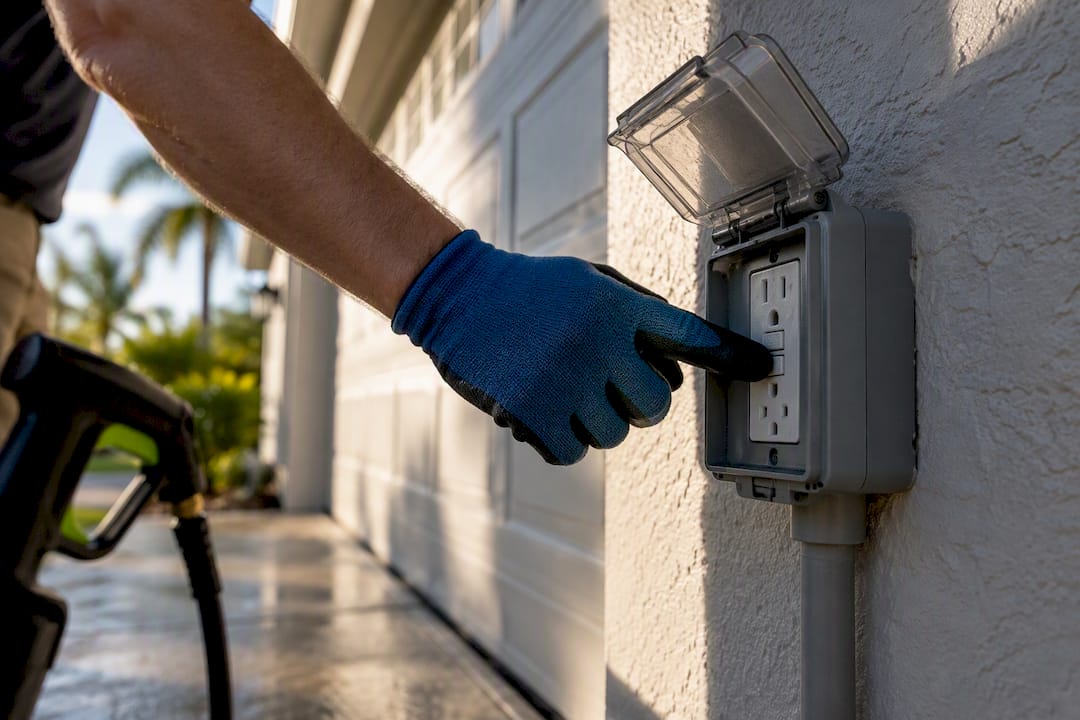
Plug your electric pressure washer into a GFCI-protected, grounded outlet, test the GFCI before you pull the trigger, and never let a connection touch standing water. That single habit, backed by CDC guidance, prevents most electrical injuries tied to this equipment. If a breaker trips or a cord looks damaged, stop working and call a qualified electrician before you touch the unit again.
TL;DR:
- Always test GFCI outlets before each use and avoid using extension cords, especially those not rated for outdoor pressure washing equipment.
- Keep water spray at a safe distance from electrical panels, outlets, and fixtures, angling the wand away from seams and gaps to minimize risk.
- De-energize circuits through proper lockout/tagout procedures when working on or near outdoor electrical components, and verify power is off before starting repairs.
- Regularly inspect cords and plugs for damage, and stop immediately if a breaker trips or if you smell burning, consulting an electrician before resuming.
- Professionals who follow strict safety protocols can reduce electrical hazards significantly, especially in complex setups with uncertain wiring or repeated breaker trips.
Table of Contents
- Why Electric Pressure Washers Create Special Electrical Hazards
- Essential Electrical Precautions Before You Power On
- Your Pre-Use Electrical Safety Checklist
- Safe Operation Steps While You Work
- If Someone Gets Shocked or a Fault Occurs
- What We’ve Learned Running Pressure Washers Day After Day
- Lockout/Tagout for Maintenance Work
- Working Near Outdoor Electrical Panels and Outlets
- When and How to De-Energize Circuits First
- Recommended Spray Distance and Angle Near Electrical Hazards
- When to Hire a Professional vs. Do It Yourself
- How White Diamond Pressure Washing Handles the Electrical Risk for You
- Where This Guidance Comes From
- Sources
- FAQ
Why Electric Pressure Washers Create Special Electrical Hazards
Water conducts electricity, and a pressure washer’s whole job is to spray water at high force across surfaces that often sit right next to live wiring. Standing water on concrete, aluminum siding, or a metal railing turns into an unexpected path for current the moment it touches an energized component. That’s why spraying near electrical apparatus is one of the CDC’s core warnings: the spray itself becomes the hazard, not just the tool in your hands.
Certain targets deserve extra caution because homeowners underestimate how exposed they really are:
- Outdoor junction boxes and meter panels, which often sit lower on a wall than people expect
- Exterior outlets and light fixtures near soffits, porches, and garages
- Service connections where the utility line enters the house
- HVAC disconnect boxes mounted near condenser units
There’s also a delayed-injury problem specific to this equipment. High-pressure spray can inject water or debris under the skin in a wound that looks like a minor scrape, then worsens into infection or nerve damage over the following days. A small shock can feel like nothing more than a jolt at the moment it happens, but any current passing through the body warrants medical evaluation, not a shrug.
Essential Electrical Precautions Before You Power On
Get the setup right and most electrical risk disappears before you ever pull the trigger.
- Confirm GFCI protection. Use a washer with a built-in GFCI plug or plug into a permanently GFCI-protected outdoor outlet. Press “test,” confirm the outlet cuts power, then press “reset” and confirm power returns. Do this before every job, not just the first time you use the unit.
- Use a dedicated circuit. Don’t share the outlet with other high-draw appliances, and never use a two-prong adapter or cut off the ground pin to make an old plug fit. If the plug doesn’t match the outlet, have an electrician install the correct receptacle instead of forcing it.
- Avoid extension cords when you can. Many manufacturer manuals warn against them outright. If one is unavoidable, use a single outdoor-rated cord appropriate for the washer’s amperage, and avoid linking multiple cords together.
- Keep the plug and cord connection elevated and dry, positioned uphill of any runoff and away from splash zones.
Pro Tip: Keep a laminated card in your equipment bag listing your washer’s required cord gauge and max cord length. It takes the guesswork out of a rushed job-site decision.
Your Pre-Use Electrical Safety Checklist
Run this before the trigger gets pulled, every single time, no exceptions for “I just used it yesterday.”
- Inspect the cord end to end for frays, cracks, or exposed copper, and check the plug for a bent or missing ground prong.
- Test the GFCI: press reset, press test, confirm power cuts, press reset again, confirm the indicator light returns to normal.
- Clear bystanders and pets from the work area, and route the cord so it can’t become a trip hazard or drag through a puddle.
- Position the washer itself uphill of where wastewater will flow.
- Put on eye protection, waterproof non-slip boots, and gloves rated for wet work.
Skipping any one of these takes thirty seconds off your setup and adds real risk to your afternoon.
Safe Operation Steps While You Work
Getting the setup right matters, but so does what you do once the trigger’s in your hand.
- Start the unit with the wand pointed at the ground or a safe surface, never at yourself, a bystander, or anything electrical, in case of a pressure surge on startup.
- Keep the spray at least several feet from any outlet, panel, or fixture, and angle it downward or sideways rather than straight into a wall-mounted device.
- Manage your cord as you move. Keep slack out from underfoot, avoid letting it trail through puddles, and never let it wrap around your ankle while you’re focused on the wand.
- If the GFCI trips mid-job, stop immediately. Don’t just reset and keep spraying. A trip usually signals a real ground fault, not a nuisance glitch, and resetting without inspection risks a repeat shock at a worse moment.
- Shut down in reverse order: release trigger pressure, power off the unit, then unplug from the outlet, not the other way around.
Here’s the part most DIY guides skip: a GFCI only protects you if both conductors aren’t touched simultaneously and the wiring upstream is sound. That’s a real limitation, not a theoretical one, which is exactly why the test-before-use step in the checklist above isn’t optional busywork. It’s the only practical way to confirm the device will actually trip when it needs to.
If Someone Gets Shocked or a Fault Occurs
Reacting correctly in the first thirty seconds matters more than anything else in this article.
- Do not touch the person directly if they’re still in contact with the current source. Cut power at the breaker or unplug at the source first.
- Call 911 immediately, even if the person seems fine afterward. Internal effects of shock aren’t always visible right away.
- Seek medical care for any injection-style wound, even a small one, since these injuries frequently worsen over the following days.
- If a breaker trips or you smell burning at the plug, unplug the unit, stop the job, and get a qualified electrician to inspect the equipment and wiring before it’s used again.
- Log the incident, including the date, what tripped, and what the electrician found, so you’re tracking patterns instead of guessing.
What We’ve Learned Running Pressure Washers Day After Day
Crews who work outdoors five or six days a week develop habits that never make it into an owner’s manual. Testing the GFCI monthly, not just before the first job of the year, catches slow degradation before it becomes a live hazard. Favoring shorter cord runs over long extensions cuts down on voltage drop and one more connection point that could get wet. And near any electrical fixture, soft washing at lower pressure reduces the odds of splash reaching wiring or an outlet compared to blasting at full PSI from close range.
There’s also a judgment call every operator eventually has to make. When a panel sits exposed, when a circuit has tripped more than once, or when the wiring’s age or condition is unknown, the smart move is calling a technician rather than pushing through.
Pro Tip: If you can’t identify where a wire run terminates outdoors, treat it as live and keep your spray pattern away from it entirely. Guessing wrong costs more than a service call.
Lockout/Tagout for Maintenance Work
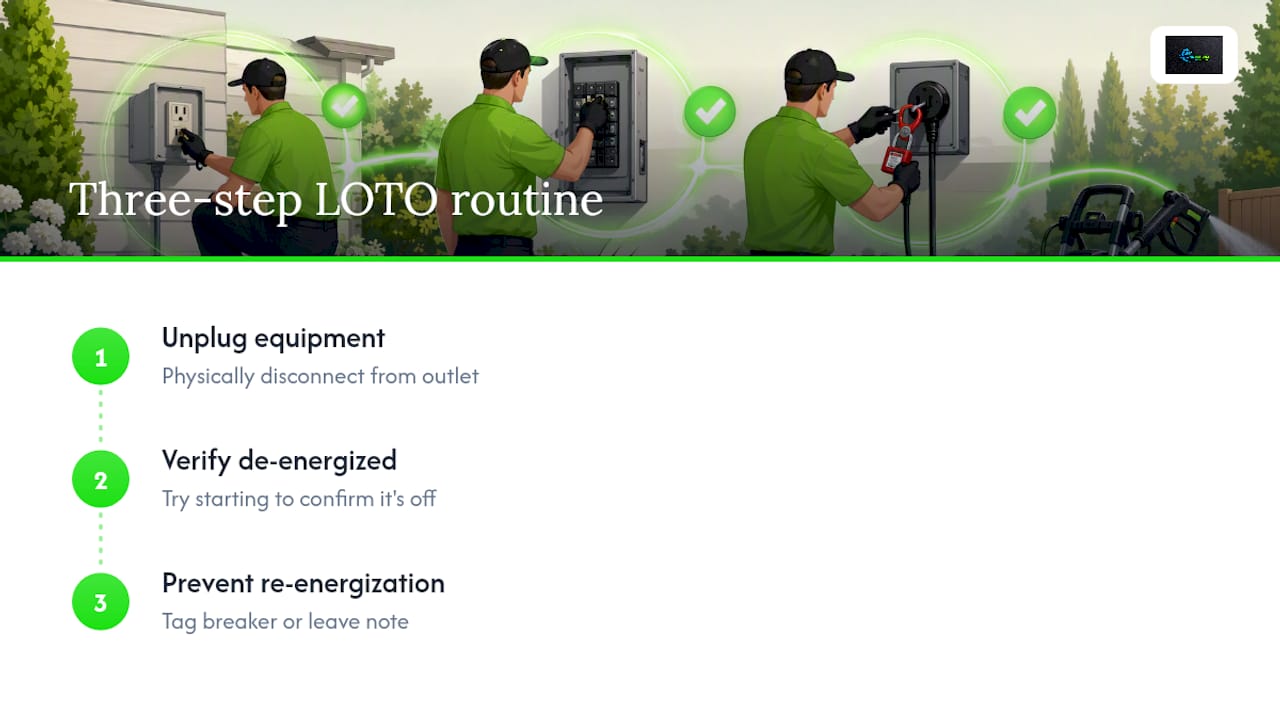
Lockout/Tagout, or LOTO, is the practice of physically de-energizing equipment and tagging it so nobody can accidentally re-energize it while you’re servicing it. OSHA requires LOTO procedures for maintenance work on power tools and connected electrical systems, and the logic applies just as much to a homeowner working on their own equipment.
Before you open a pressure washer’s housing, clean a clogged nozzle assembly near wiring, or service anything connected to a hardwired outdoor circuit, unplug the unit and, where relevant, switch off the breaker feeding that circuit. Tag the breaker panel or leave a visible note at the outlet so nobody flips it back on while you’re mid-repair. This matters most when more than one person might be on the property, whether that’s a family member, a helper, or a hired crew.
For a DIY operator, LOTO doesn’t need to be complicated. It means three things every time: unplug the equipment, verify it’s actually de-energized by attempting to start it, and don’t rely on a switch alone when a physical unplug is available. Skipping this step is how people get shocked doing routine maintenance on equipment they assumed was already off. The habit costs you fifteen seconds. The alternative can cost a trip to the emergency room.
If you’re not confident identifying which breaker feeds which outdoor circuit, that’s a sign to bring in an electrician rather than trace wires by trial and error while the power’s live.
Working Near Outdoor Electrical Panels and Outlets
Outdoor electrical panels and receptacles are common near garages, HVAC units, and where utility service enters the home, and they’re also common targets for accidental spray during a routine house wash. The safest approach treats a minimum standoff distance as non-negotiable rather than a guideline you can shave when you’re in a hurry.
Before starting near a panel or outlet, identify its exact location and mentally map your spray path so the wand never crosses it directly. Angle the nozzle away from the panel face, working from the side rather than head-on, and drop your pressure setting substantially when you’re within a few feet. If the panel door has any gap, warping, or a missing cover plate, don’t work anywhere near it until that’s repaired. Water finding its way through an open panel door isn’t a hypothetical.
Outdoor GFCI outlets typically have a weatherproof cover, but that cover only helps when it’s closed and in good condition. A cracked or missing cover is a signal to skip cleaning that section until it’s fixed, not a reason to spray more carefully around it. The same goes for any outlet with visible corrosion or discoloration, both signs that moisture has already gotten in.
If your property has a subpanel or disconnect box outdoors that you’re not familiar with, the safe assumption is that it’s live and you keep your spray pattern well clear of it. When in doubt, treat every outdoor electrical box as something to work around, not something to clean directly.
When and How to De-Energize Circuits First
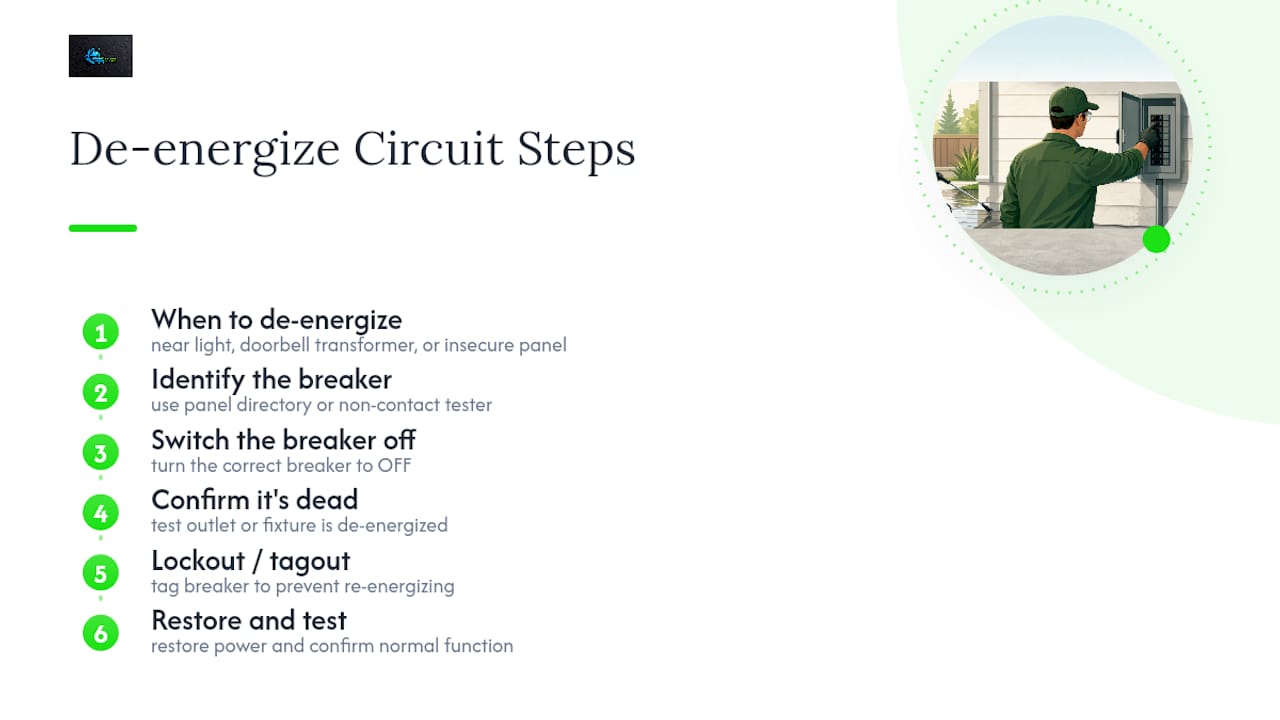
For most residential jobs, the standard is to keep electrical circuits energized but simply avoid spraying them directly. There are situations, though, where de-energizing the relevant circuit first is the smarter call: cleaning directly around a light fixture, working on a section of siding with an embedded doorbell transformer, or servicing an area where a panel’s cover isn’t fully secure.
To de-energize a circuit safely, identify the correct breaker in the main panel using a labeled directory, or test with a non-contact voltage tester if the labeling is unclear or outdated in an older home. Switch the breaker off, then confirm the target outlet or fixture is actually dead before starting work. Never assume a breaker label is accurate, especially in homes that have had electrical work done over multiple decades by different contractors.
Once the circuit’s off, treat it the same way you’d treat any LOTO situation: tag the breaker so it doesn’t get flipped back on by someone else in the house while you’re working. When you’re done, restore power and test the fixture or outlet to confirm it’s functioning normally before you consider the job finished.
If you don’t have confidence identifying the right breaker, or the panel isn’t clearly labeled, this is exactly the kind of task where calling an electrician first, then a pressure-washing professional, beats improvising. Guessing at which breaker controls what is how people either leave a circuit live by mistake or cut power to something they didn’t intend to, like a refrigerator or sump pump.
Recommended Spray Distance and Angle Near Electrical Hazards
Distance and angle do more to prevent electrical incidents than almost any other single technique decision you’ll make on a job. A wide-angle nozzle held several feet back disperses water pressure across a broader area, which reduces the chance of a concentrated stream finding its way into a gap around an outlet or panel seam.
Working from the side rather than straight-on matters just as much as distance. Spraying a panel or outlet head-on pushes water directly into any seam, screw hole, or cover gap. Approaching at an angle and letting water run off and away, rather than driving it into the fixture, cuts that risk substantially. Drop your pressure setting near any electrical component even if you wouldn’t normally adjust it for that surface material.
There’s no universal number that applies to every washer and every fixture, since pressure, nozzle angle, and panel condition all vary. The safer approach is behavioral: increase your standoff distance any time you’re near a panel, outlet, or fixture, angle away from it rather than at it, and if you can complete the section without direct spray contact at all, that’s the better outcome every time.
When to Hire a Professional vs. Do It Yourself
Multiple exterior outlets, an exposed panel, repeated breaker trips, or wiring you suspect is outdated all point toward calling in a professional. A trained crew brings LOTO habits, dedicated safe-distance protocols, and documentation that a one-time DIY job simply won’t. If that’s where you land, White Diamond Pressure Washing’s services page is a reasonable next stop.
— Bobby
How White Diamond Pressure Washing Handles the Electrical Risk for You
Hiring a professional pressure washing service means handing the electrical guesswork covered in this article to a crew that follows safe standard procedures. They favor soft-wash and low-pressure techniques near outlets, panels, and fixtures instead of full-pressure blasting, and their technicians follow consistent GFCI testing and cord-management habits on every visit.

Call White Diamond instead of DIY-ing it when you’ve had a breaker trip more than once, when your home has exterior wiring you can’t identify with confidence, or when you’d simply rather not be the one troubleshooting a live panel with a wand in your hand. Roof cleaning, house washing, driveways, pool cages, and lanai surfaces are all handled with the same safety-first approach. If your property needs any of that attention, book a visit and expect a walk-through of the work area before the water ever turns on.
Where This Guidance Comes From
This article draws on CDC pressure washer safety guidance, OSHA standards for electric power tools, and manufacturer safety instructions covering GFCI use, cord requirements, and grounding. Consult your own washer’s manual for model-specific warnings.
Sources
- Pressure Washer Safety | Natural Disasters | CDC
- Owner’s manual & safety instructions (example manufacturer manual)
- OSHA regulations (electric power-operated tools / relevant standards)
- GFCI testing and limitations guidance
FAQ
How Safe Are Electric Pressure Washers?
Electric pressure washers are safe when used on a GFCI-protected grounded circuit with a properly inspected cord and plug. Most electrical incidents trace back to a skipped GFCI test, a damaged cord, or spray directed too close to an electrical fixture, all of which are preventable with the checklist above.
Does an Electric Pressure Washer Need a GFCI Plug?
Yes. CDC guidance states electric pressure washers must be plugged into a grounded, GFCI-protected receptacle, and many units come with a built-in GFCI plug for this exact reason. Test it before every use since a GFCI won’t stop every fault and needs to be confirmed functional.
How Much Should I Charge to Pressure Wash a 2,000 Square Foot House?
Pricing varies by region, surface material, and whether the job needs soft washing versus standard pressure washing. White Diamond Pressure Washing does not list set per-square-foot rates publicly, so current pricing for a job that size is available by requesting a free estimate through the services page.
What Are Five Safety Rules for Electrical Work?
Common versions of this list include: always test GFCI protection before use, never bypass a ground pin or use damaged plugs, keep electrical connections dry and off the ground, treat any tripped breaker as a sign to stop and call an electrician, and never spray or work directly on energized equipment. Definitions of the exact “five rules” vary by source, but these cover the core practices this article details above.
What Should I Do if a Pressure Washer Trips a Breaker?
Stop working immediately and unplug the unit rather than resetting the breaker and continuing. A trip often signals a genuine electrical fault, and a qualified electrician should inspect the equipment and wiring before it’s used again.