

TL;DR:
- Effective cleaning plans focus on micro-tasks, flexibility, and visible reminders to build lasting habits.
- A simple routine of short daily tasks, weekly theme days, and monthly deep cleans can prevent chaos and reduce burnout.
Most people don’t fail at cleaning because they’re lazy. They fail because they’re working without a plan. When you have no structure, every mess feels like an emergency and every weekend feels like it’s being swallowed by chores. The right examples of cleaning schedules show you how to break that cycle by turning overwhelming tasks into short, repeatable habits that fit your actual life. Whether you’re managing a busy household with kids and pets or just trying to stay ahead of clutter on your own, the right structure changes everything.
Table of Contents
- Key takeaways
- What makes examples of cleaning schedules actually effective
- 1. Daily and weekly cleaning schedule examples
- 2. Monthly and seasonal cleaning schedule examples
- 3. Comparing the most common cleaning schedule types
- 4. How to build your own personalized cleaning schedule
- My honest take after years of watching cleaning plans fail
- Keep the inside clean and let us handle the outside
- FAQ
Key takeaways
| Point | Details |
|---|---|
| Daily routines stay short | A daily cleaning routine should take 15 to 30 minutes and hit high-impact areas like dishes and counters. |
| Layer your schedule | Combine daily maintenance, weekly core cleaning, and monthly deep tasks for sustainable results. |
| Flexibility beats perfection | Rigid plans fail. Theme days and micro-tasks keep you consistent without burning out. |
| Clean before you sanitize | Always clean surfaces first with soap, then sanitize selectively rather than disinfecting everything daily. |
| Visibility drives consistency | Physical checklists and whiteboards outperform app reminders for many households trying to build habits. |
What makes examples of cleaning schedules actually effective
Not every schedule you find online is worth following. Many are too aggressive, too vague, or built for someone with far more free time than you have. Before picking a template or building your own, it helps to know what separates the ones that stick from the ones that get abandoned by Tuesday.
The most effective cleaning schedules share a few key traits:
- Micro-task design. Cleaning one sink takes two minutes. Cleaning “the whole bathroom” sounds like an hour. Breaking tasks into the smallest possible steps reduces the mental friction that stops you from starting. Habit stacking and micro-tasks are the foundation of any schedule that actually survives contact with real life.
- Built-in flexibility. A schedule that only works when life cooperates is not a schedule. Build in buffer days, swappable task days, and low-energy options.
- A layered structure. Think of cleaning in three bands: daily maintenance (15 to 30 minutes), weekly core cleaning (2 to 3 hours total across the week), and monthly or seasonal deep work. Each layer supports the next.
- Avoidance of over-disinfecting. Cleaning with soap comes first. Sanitizing follows cleaning and should be reserved for when it’s genuinely needed, not done daily on every surface.
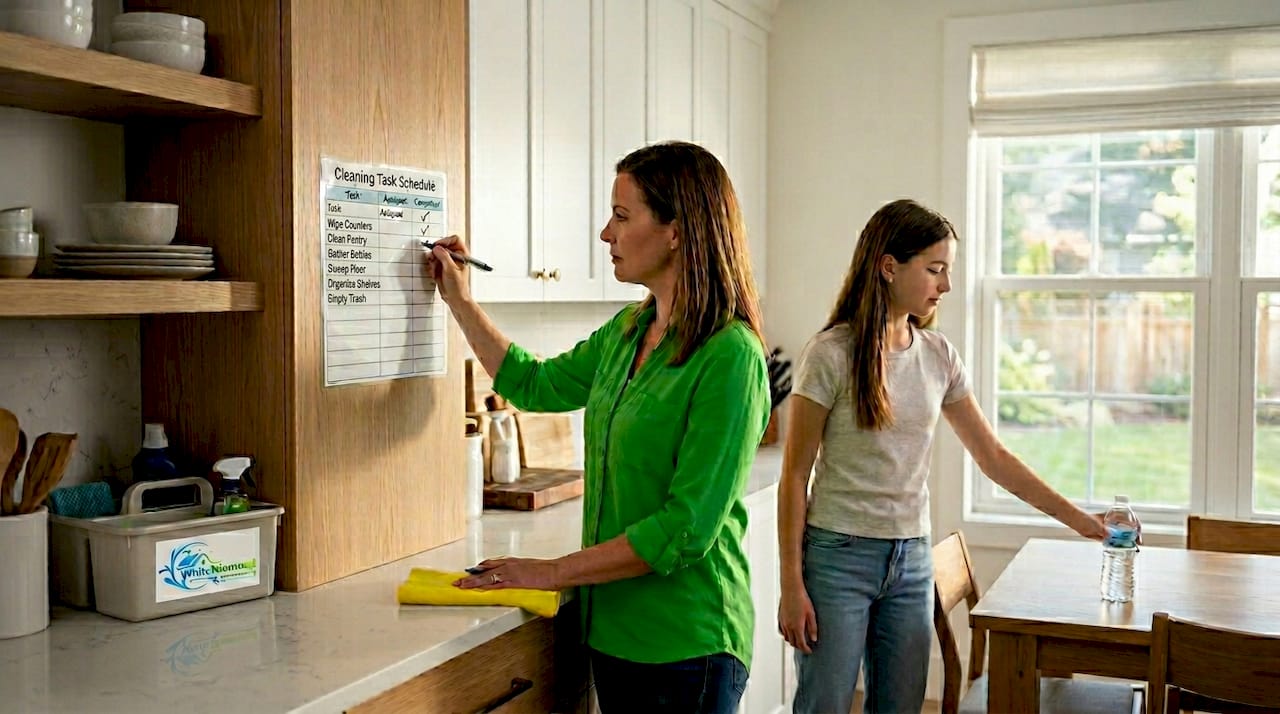
- Visible reminders. Posted checklists and whiteboards work better than phone notifications for many people because the feedback is physical and immediate.
Pro Tip: Start with the minimum. A five-task daily checklist you actually complete beats a 20-task masterplan you ignore.
1. Daily and weekly cleaning schedule examples
The goal of a daily routine is not a spotless home. It’s a controlled, livable home that doesn’t spiral into chaos. Daily tasks should take 15 to 30 minutes and focus entirely on preventing buildup.
A simple daily maintenance routine looks like this:
- Wash or load dishes and run the dishwasher
- Wipe kitchen counters and stovetop
- Do a two-minute clutter pickup in main living areas
- Wipe bathroom sink and mirror (takes under 90 seconds)
- Run a quick sweep or Swiffer through high-traffic floors
For families, add making beds and a quick toy reset. That’s it. You’re not deep cleaning anything. You’re maintaining a baseline.
A weekly schedule works best when organized by theme days, where each day gets one zone or task type rather than trying to clean everything in one Saturday session. Here’s a sample layout:
- Monday: Kitchen deep wipe-down and appliance fronts
- Tuesday: Bathroom scrub day (toilet, tub, floors)
- Wednesday: Vacuuming all carpets and area rugs
- Thursday: Mopping hard floors and wiping baseboards at eye level
- Friday: Laundry, bedding change, and bedroom tidy
- Saturday: Open for catch-up or nothing at all
- Sunday: Light prep for the week ahead
The key advantage of theme days over marathon cleaning sessions is that each task gets done thoroughly because it’s not competing with 20 other tasks. Assigning specific days to rooms or task types dramatically cuts decision fatigue.
Add a closing shift at the end of each evening. The closing shift method, borrowed from the hospitality industry, is a short 10-minute reset before bed. You do the dishes, wipe the counters, pick up clutter, and prep the coffee maker. Mornings become noticeably easier within a week.
Pro Tip: Pair your closing shift tasks with something you already do each night, like listening to a podcast or charging your phone, to make the routine feel automatic faster.
2. Monthly and seasonal cleaning schedule examples
Daily and weekly routines handle the surface layer. Monthly and seasonal tasks are where you address the slow buildup that daily cleaning never reaches: grease behind the stove, dust on ceiling fans, grime in grout lines, and sediment in appliances.
Monthly cleaning tasks to rotate through include:
- Cleaning inside the microwave and wiping the oven door
- Scrubbing grout in bathrooms and kitchen backsplashes
- Dusting ceiling fans, light fixtures, and tops of cabinets
- Wiping baseboards and door frames
- Cleaning washing machine drum and dishwasher filter
- Vacuuming refrigerator coils and behind large appliances
You don’t have to do all of these in one day. In fact, you shouldn’t. Rotational deep cleaning spreads tasks across the month so each week gets one or two extra items added to your regular routine. Rotate through areas on a three or four week cycle and nothing ever gets dangerously neglected.
For seasonal deep cleans, most homes benefit from two to four per year, aligned with the seasons. Here’s how to split the focus:
| Season | Primary focus areas |
|---|---|
| Spring | Windows, window tracks, behind furniture, outdoor surfaces |
| Summer | Air vents, AC filters, patio furniture, garage |
| Fall | Gutters, fireplace, closet purge, dryer vent |
| Winter | Deep kitchen clean, upholstery, pantry organization, baseboards |
Households with pets or children should increase deep clean frequency by roughly 25 to 50 percent because pet dander and higher traffic accelerate buildup in upholstery, carpet, and air filters. That might mean monthly bathroom deep cleans instead of quarterly, and more frequent filter changes.
A quick note on terminology that matters: cleaning removes dirt and debris. Sanitizing reduces bacteria to safe levels. Disinfecting kills germs almost entirely. You clean before you sanitize, and you only disinfect when someone is sick or high-risk. Mixing these up leads to either wasted products or undercleaning.
3. Comparing the most common cleaning schedule types
Not every cleaning schedule style works for every household. Here’s a direct comparison of the main formats so you can pick what fits your life.
| Schedule type | Best for | Main drawback |
|---|---|---|
| Theme day schedule | Families, people who dislike multitasking | One bad day throws off the whole week |
| Full checklist routine | Detail-oriented people who want structure | Can feel rigid and overwhelming |
| Timed sprint cleaning | Busy individuals with limited windows | Doesn’t guarantee full task completion |
| Flexible/adaptive routine | Variable schedules and low-energy days | Requires self-discipline to stay consistent |
| Printable monthly planner | Visual learners and families with shared tasks | Needs updating regularly to stay relevant |
A few things to know about each option:
- Timed sprints (like a 20-minute clean blitz) work well combined with theme days. Set a timer and clean one zone until it goes off. The time limit prevents perfectionism from dragging a quick task into an hour.
- Printable planners function best when posted somewhere visible, like the fridge or inside a cabinet door. Visible systems consistently outperform phone reminders for building real cleaning habits.
- Gamification adds a surprisingly effective layer of motivation. Some families use a sticker chart, a points system, or even a playlist that only plays during cleaning. It sounds simple because it is, and it works.
4. How to build your own personalized cleaning schedule
Templates are a starting point, not a final answer. Your home has different traffic patterns, different people, and different tolerances for mess than anyone else’s. Here’s how to build something that genuinely fits.
- List every cleaning task you can think of across your home, grouped by room. Don’t judge frequency yet. Just get everything on paper.
- Sort tasks by frequency. Which ones need to happen daily to prevent chaos? Which ones matter weekly? Which ones could wait a month or a season?
- Match tasks to your natural rhythms. If you’re sharpest in the morning, front-load cleaning then. If evenings work better, use the closing shift model.
- Stack tasks onto existing habits. Habit stacking means attaching a cleaning task to something you already do. Wipe the sink after brushing your teeth. Sweep the kitchen floor while waiting for coffee to brew.
- Create a minimum baseline. On the worst days, what’s the one thing you’ll always do? For most people, that’s dishes and a counter wipe. Protect that minimum.
- Review monthly and adjust. What got skipped consistently? Move it to a different day or break it into smaller steps. A cleaning schedule that doesn’t get adjusted is a schedule that gets abandoned.
Pro Tip: When life gets busy, switch to micro-tasks only. Ten two-minute tasks spread across a day do more than one big session that never happens.
For exterior and seasonal work that’s beyond your equipment or your time, check out Whitediamondpressurewashing’s seasonal exterior cleaning checklist to understand what tasks come up each season for Citrus County homes.
My honest take after years of watching cleaning plans fail
I’ve seen every version of the cleaning schedule failure. Too ambitious, too detailed, too aspirational. People print a beautiful planner on Sunday and abandon it by Thursday when real life shows up.
What actually works, in my experience, is embarrassingly simple. Keep the daily list under five tasks. Give each day of the week one job. Add a closing shift at night. Post a paper checklist where you can physically cross things off. That’s it. Physical, visible feedback changes behavior in ways a phone notification never will.
The one thing I’d push back on hardest: the obsession with disinfecting everything daily. It’s unnecessary, it’s expensive, and it can actually reduce how well your disinfectants work over time. Clean the mess first. Sanitize when it matters.
And be honest with yourself about what your household actually needs. A single person with no pets and no kids can get away with much less frequent deep cleaning than a family of five with two dogs. Deep cleaning frequency is personal, not universal.
Build the smallest routine that keeps you sane. Then grow it when you’re ready.
— Bobby
Keep the inside clean and let us handle the outside
Once your interior cleaning schedule is running smoothly, the exterior of your home deserves the same kind of consistent attention. Driveways, roofs, siding, and walkways accumulate algae, mold, and grime that no mop or vacuum can touch.

Whitediamondpressurewashing specializes in professional exterior cleaning services for residential and commercial properties across Citrus County and surrounding areas. Using soft washing and low-pressure techniques, the team removes years of buildup from roofs, driveways, and siding without damaging the materials underneath. If you’re mapping out your seasonal cleaning plan and wondering what to do about the outside of your home, the soft washing process is worth understanding. Book a free estimate at whitediamondpressurewashing.com and get your exterior back on schedule.
FAQ
How long should a daily cleaning routine take?
A daily routine should take 15 to 30 minutes and focus on high-impact tasks like dishes, counter wipes, and a quick clutter pickup to maintain a baseline of cleanliness.
What is the closing shift cleaning method?
The closing shift method is a short evening reset, typically 10 minutes, where you do dishes, wipe counters, and clear clutter so mornings start clean without effort.
How often should a house be deep cleaned?
Most homes need two to four deep cleans per year, roughly once per season, though households with pets or children may need more frequent attention.
What is habit stacking in a cleaning schedule?
Habit stacking means linking a cleaning task to an existing daily habit, like wiping the sink after brushing your teeth. It reduces decision fatigue and makes routines stick faster.
What’s the difference between cleaning and sanitizing?
Cleaning removes dirt and debris using soap or detergent. Sanitizing reduces bacteria on already-clean surfaces. Always clean before sanitizing and reserve disinfecting for situations with a real health risk.