

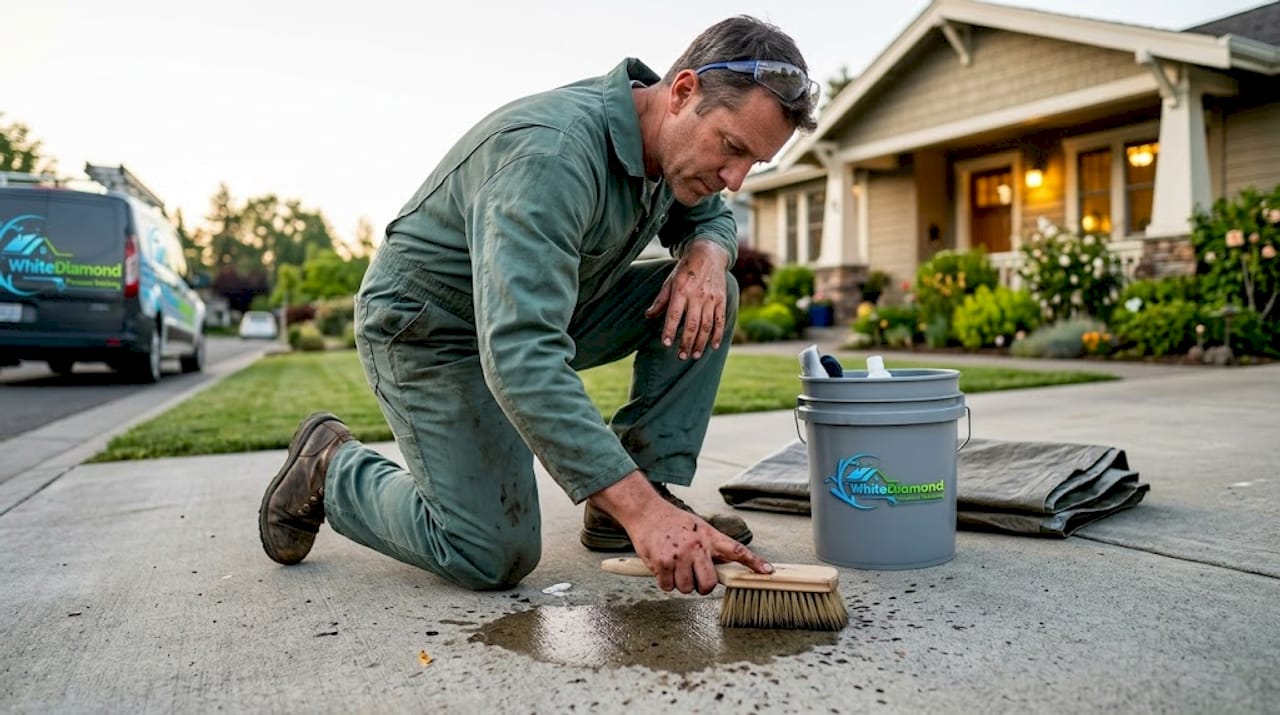
TL;DR:
- Oil stains on driveways penetrate deep into porous concrete, making them difficult to remove with standard cleaning methods. Proper removal requires immediate containment, specialized degreasers, and multiple treatments, often best performed by professionals. DIY approaches frequently spread the stain or cause damage, leading to recurring issues and higher long-term costs.
You clean your driveway, it looks great for a week, and then the stain comes back. Sound familiar? Oil stains on driveways are one of the most frustrating maintenance problems homeowners in Citrus County face, and the reason they keep coming back has nothing to do with effort. It has to do with chemistry. Most standard cleaning routines treat oil like ordinary surface dirt, which is exactly why they fail. This guide breaks down why oil behaves differently, what common mistakes make things worse, and what actually gets lasting results.
Table of Contents
- Why driveway oils are different from other stains
- Why typical cleaning methods often fail
- What actually works: Specialized cleaning processes for oil stains
- Preventing oil stains and maintaining your driveway
- Why the usual DIY advice misses the real driveway oil problem
- Get help with stubborn driveway oil stains
- Frequently asked questions
Key Takeaways
| Point | Details |
|---|---|
| Oil seeps deep | Unlike other stains, oil penetrates below your driveway’s surface and can reappear after basic cleaning. |
| DIY pitfalls | Common cleaning mistakes, like aggressive scrubbing, may worsen oil stains by driving them further into concrete. |
| Special methods work | Immediate absorption and specialized degreasing are needed to truly remove oil stains from a porous driveway. |
| Prevention matters | Regular maintenance and prompt attention to spills protect your driveway and reduce long-term staining. |
Why driveway oils are different from other stains
Most surface stains sit on top of your driveway and respond well to scrubbing, rinsing, or even a simple hose-down. Oil is a completely different story. The reason comes down to how your driveway material works and how oil moves through it.
Concrete and asphalt driveways are packed with tiny holes called micro-pores and capillaries. You can’t see them with the naked eye, but they run deep into the slab. Oil has very low surface tension, which means it flows easily and spreads quickly. The moment oil hits your driveway, it starts wicking down into those tiny channels the same way water soaks into a paper towel. Oil penetrates porous driveway materials rather than sitting on the surface, which is exactly what makes standard cleaning fall short.
Concrete acts like a giant sponge for oil. The older and more weathered the surface, the larger those micro-pores become, and the faster oil travels down into them.
Contrast that with rust stains, which form when water reacts with metal on or near the surface, or ordinary dirt and mud that simply settles on top. Here’s how these three common driveway stains stack up:
| Stain type | Penetration depth | Removal difficulty | Chance of reappearance |
|---|---|---|---|
| Oil/grease | Deep (below surface) | High | Very high |
| Rust | Surface to shallow | Medium | Medium |
| Dirt/mud | Surface only | Low | Low |
The table makes it obvious why oil is in a category of its own. Here’s what makes oil’s behavior so different from most other stains:
- Oil flows into micro-pores using capillary action, traveling well below the surface layer
- Rust forms at or near the surface due to oxidation and rarely penetrates concrete deeply
- Dirt and mud settle on top and are mostly dislodged by water pressure or scrubbing
- Oil bonds with concrete at the molecular level, making it resistant to plain water
- Older oil stains polymerize, meaning they harden and become even more resistant over time
If you want to understand how to tackle surface contamination on outdoor materials more broadly, the stain removal guide covers a wide range of scenarios that go beyond just oil.
Why typical cleaning methods often fail
Here’s the part that most homeowners don’t realize until they’ve already made the problem worse. The cleaning steps that feel natural and aggressive often backfire badly with oil stains.
These are the most common mistakes, ranked from frustrating to genuinely damaging:
- Rinsing with plain water first — Water does not break down oil. Hosing down a fresh spill before absorbing it can actually spread the oil over a wider area, increasing the size of the stain.
- Scrubbing aggressively without a degreaser — Hard scrubbing without the right cleaning agent pushes oil further into the pores rather than lifting it out.
- Using dish soap and water as the only treatment — Dish soap breaks down some grease on surfaces, but it is nowhere near strong enough to pull oil out from deep inside concrete pores.
- Letting it dry and then trying to remove it — Once oil has dried, it starts to cure and bond with the concrete. The window for easy removal closes fast, especially in warm Florida weather.
- Single-pass pressure washing — Aggressive scrubbing can spread or drive oil deeper into the surface, and a single pass with a pressure washer does the same thing without a proper degreaser applied first.
The chart below shows the reality of DIY versus professional approaches when it comes to oil specifically:
| Factor | DIY approach | Professional approach |
|---|---|---|
| Surface oil removed | Yes, usually | Yes |
| Deep-set oil removed | Rarely | Targeted with degreasers and extraction |
| Risk of spreading | Higher | Lower with controlled application |
| Stain reappearance | Very likely | Significantly reduced |
| Material damage risk | Higher (over-scrubbing) | Lower (controlled pressure) |
Stains reappear after DIY washing because the deeper oil is still trapped in pores even when the surface looks clean. The driveway dries, the surface residue is gone, and everything looks fine. Then the sun heats the concrete, the oil below expands slightly, and it wicks back up. That’s the cycle so many Citrus County homeowners experience and can’t figure out.
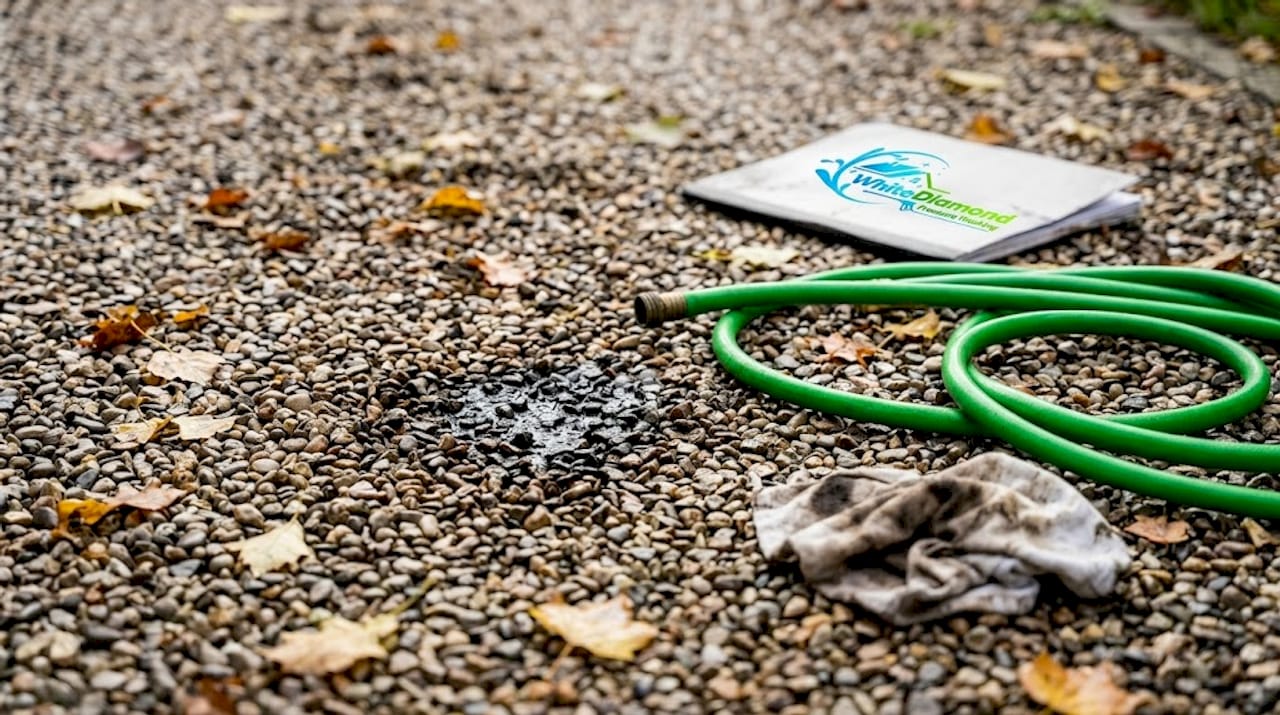
Pro Tip: Never spray water directly onto a fresh oil spill before absorbing it. Your first move should always be containment, not rinsing. Water spreads the spill and accelerates penetration into the concrete. Also, learning to avoid common pressure washing mistakes can protect your driveway from unintentional surface damage during cleanup.
What actually works: Specialized cleaning processes for oil stains
Now that you know why the stain keeps coming back, here’s the process that actually works. The key insight is speed combined with the right chemistry.
Immediate containment and absorption before deeper degreasing is essential because time directly affects how far oil penetrates and how hard it is to remove. Florida heat speeds up the process. On a hot Citrus County afternoon, fresh oil can penetrate significantly deeper in the first 30 minutes than it would on a cooler day.
Here’s the step-by-step process professionals recommend and use themselves:
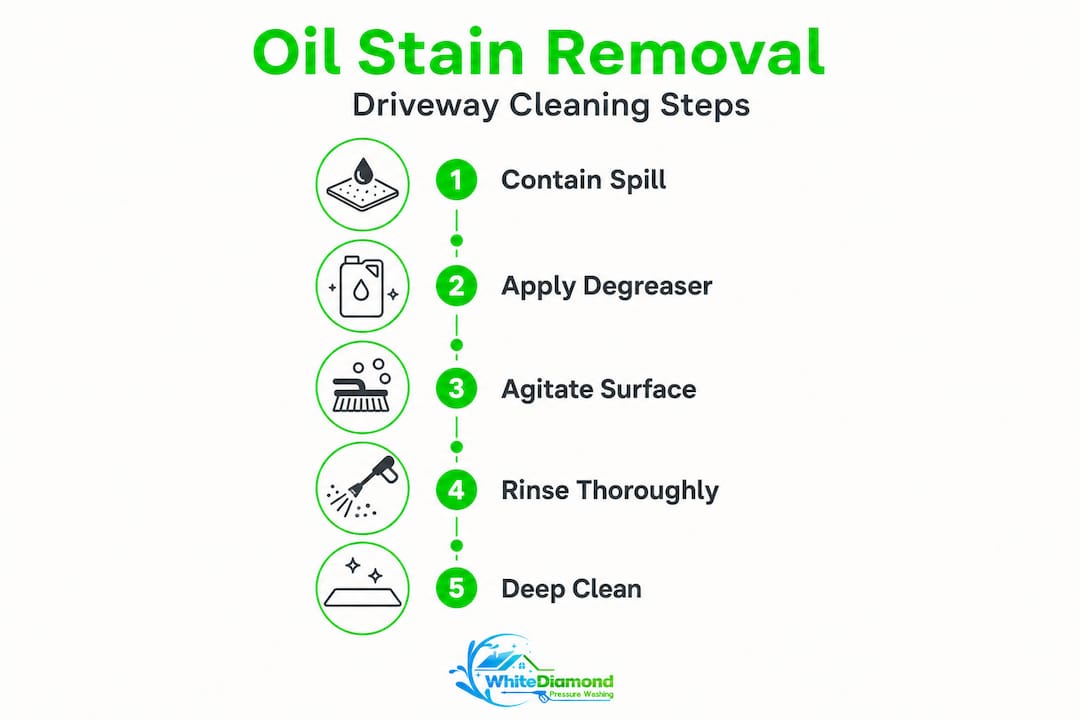
- Step 1: Contain immediately. Pour a generous layer of cat litter, baking soda, or cornstarch directly onto the spill. These materials are absorbent and pull oil up rather than letting it sink further. Do not press down. Let the material sit for at least 15 to 30 minutes.
- Step 2: Remove the absorbent carefully. Use a stiff brush or dustpan to scoop the material away. Avoid sweeping motions that could smear oil across a wider surface.
- Step 3: Apply a quality degreaser. Choose an alkaline-based degreaser formulated for concrete. Apply it to the stained area and let it dwell for the time listed on the product label, typically 5 to 20 minutes.
- Step 4: Agitate with a stiff brush. Work the degreaser into the stain using a firm brush. This helps break the bond between the oil and the concrete walls inside the pores.
- Step 5: Rinse thoroughly. Use warm water and rinse outward from the stain, not into it. For deeper stains, repeat the degreaser application two or more times.
- Step 6: Evaluate and escalate if needed. If the stain is still visible after two rounds, it’s time to call in professional equipment for deep extraction.
Pro Tip: In Citrus County’s climate, alkaline degreasers labeled for use on concrete outperform citrus-based products on motor oil and transmission fluid. The high heat here breaks down citrus-based formulas quickly, reducing their dwell time and effectiveness. For eco-friendly driveway cleaning tips that are safer for your yard and surrounding environment, it’s worth reviewing gentler options that still get the job done.
Some oil stains simply become permanent if left too long without treatment. Older stains, especially those that have been cleaned at the surface level multiple times without deep treatment, can cure inside the concrete to a point where no DIY product will fully remove them. At that stage, professional-grade hot water extraction combined with concentrated degreasers is the only realistic path forward. Reviewing the full range of driveway cleaning methods can help you identify which approach fits your situation before you waste time or money on the wrong one. The maintenance checklist is also a useful resource for staying ahead of problems before they become permanent.
Preventing oil stains and maintaining your driveway
Removal gets all the attention, but prevention is where you save real time and money. A few simple habits can dramatically reduce the chance of oil stains becoming a recurring problem on your Citrus County driveway.
Here’s what consistent prevention looks like in practice:
- Seal your driveway every 2 to 3 years. Concrete sealer fills micro-pores and creates a barrier that slows oil penetration dramatically. Sealed concrete gives you extra time to respond to a spill before it sets.
- Rinse your driveway surface regularly. A simple rinse every couple of weeks removes light contaminants before they have a chance to bond with the surface.
- Act immediately on any new spill. Every minute counts. Have a bag of cat litter in your garage for exactly this situation.
- Use a drip tray or driveway mat under vehicles that are known to leak oil, especially older cars or equipment that sits for extended periods.
- Get your vehicles inspected for leaks. A slow drip is easy to ignore until you have a permanent stain. Fixing the leak costs less than repeated professional cleaning.
- Schedule routine professional cleanings. Regular driveway cleaning by a qualified service removes light oil buildup before it cures and prevents the deep-set staining that requires aggressive treatment.
Reappearing stains signal deeper oil still in the pores even after surface cleaning. If you’re seeing stains come back after every attempt, prevention methods alone won’t fix the underlying issue. You need extraction first, then prevention as a follow-up strategy.
Watch for these warning signs that your driveway needs professional attention: darkened patches that return after rain, oil-rainbow sheen near a parking spot after water exposure, or a grayish film that no amount of scrubbing removes. These are signs that oil has established itself deep in the slab.
Why the usual DIY advice misses the real driveway oil problem
After years of working on driveways across Citrus County, we’ve seen the same pattern repeat itself dozens of times. A homeowner tries the dish soap method. The stain looks gone. Two weeks later, it’s back. They try again, harder this time, with a pressure washer. Still comes back. By the third or fourth cycle, the oil is now set so deep that even professional extraction requires multiple treatments.
The honest truth most homeowner guides skip over is this: oil stain removal is a chemistry problem, not a scrubbing problem. No amount of physical effort overcomes the capillary action that pulls oil down into concrete. The chemistry has to work in your favor, and that means using the right agents at the right concentration with the right dwell time. That’s knowledge most DIYers simply don’t have, and the guides that suggest a bucket of soapy water will do the job are setting readers up for failure.
The financial math is another thing nobody talks about. Buying three or four rounds of store-bought degreasers, renting a pressure washer, and spending your Saturday on the driveway costs more in real time and money than many people realize. When the stain comes back anyway, that cost doubles. Professional cleaning versus DIY isn’t about convenience; it’s about not paying twice for a result you didn’t actually achieve the first time.
There’s also the surface damage factor. Repeated aggressive scrubbing and high-pressure washing on concrete without proper technique opens up the micro-pores further, making the driveway more vulnerable to future stains. You can literally make your driveway easier to stain by cleaning it the wrong way repeatedly. That’s the uncomfortable reality behind the “just pressure wash it” advice that floats around online.
Our position is straightforward: attempt the immediate containment and degreaser steps on a fresh spill. If the stain is more than a few days old or has already returned after cleaning, don’t keep repeating the same approach. Get professional help before you make permanent the one thing that should be solvable.
Get help with stubborn driveway oil stains
The science is clear: oil stains require more than a surface-level response. They need the right chemistry, the right tools, and sometimes the right team.

At White Diamond Pressure Washing, we specialize in exactly the kind of deep, targeted cleaning that oil-stained driveways in Citrus County need. Our approach uses controlled pressure, professional-grade degreasers, and proven extraction methods that pull oil up from within the slab, not just off the top. We specifically avoid the aggressive techniques that spread stains or damage concrete surfaces. The advantages of low-pressure washing extend beyond just safety; they mean your driveway material is preserved while the contamination is removed properly. Browse our driveway cleaning services and schedule a free estimate with our team today. Your driveway deserves a solution that actually lasts.
Frequently asked questions
Why do oil stains keep reappearing after I clean my driveway?
Oil trapped in concrete pores resurfaces after surface cleaning because the deeper contamination was never removed. Cleaning the top layer only addresses part of the problem.
What’s the fastest way to prevent an oil stain from setting?
Cover the spill immediately with cat litter or baking soda to absorb the oil before it sinks further. Immediate absorption before degreasing directly reduces how deep the oil penetrates.
Will pressure washing remove all oil from my driveway?
Standard pressure washing typically removes surface oil but leaves oil that penetrates concrete micro-pores behind. Deep extraction with proper degreasers is needed for complete removal.
How do professionals eliminate deep-set oil stains?
Professionals use concentrated alkaline degreasers, hot water, and specialized extraction techniques that draw oil up from within the slab over multiple treatment passes rather than just cleaning the surface.