

TL;DR:
- Eco-friendly cleaners reduce indoor VOCs, improving air quality and safety for children and pets.
- Using biodegradable eco-cleaners helps protect Citrus County’s waterways and septic systems from chemical damage.
- Most eco-friendly products are as effective as traditional cleaners for daily tasks but require proper use.
Most homeowners assume that cleaning their home makes it healthier. The reality is more complicated. Indoor pollutant levels can run 2 to 5 times higher than outdoor levels, and many traditional cleaning products are a major reason why. Spray a conventional bathroom cleaner, and you release a cocktail of chemicals into the air your family breathes all day. For Citrus County homeowners who care about sustainability and their family’s wellbeing, eco-friendly cleaners offer a smarter path forward, one that protects your health, your home’s surfaces, and the remarkable waterways right outside your door.
Table of Contents
- How eco-friendly cleaners benefit your health and home
- Eco-friendly cleaning and Citrus County’s environment
- Are eco-friendly cleaners as effective as traditional options?
- Selecting and maximizing eco-friendly cleaning results
- Our take: Why Citrus County homeowners should embrace eco-friendly cleaning
- Ready to make your Citrus County home cleaner and greener?
- Frequently asked questions
Key Takeaways
| Point | Details |
|---|---|
| Healthier indoor air | Eco-friendly cleaners help reduce harmful chemicals and improve the air quality inside your home. |
| Protects Citrus County’s waterways | Switching to green products preserves local rivers and springs while supporting septic system health. |
| Comparable cleaning power | Many eco-friendly cleaners are just as effective as traditional options for everyday household use. |
| Safer for families and pets | Certified green products are gentler, making your home safer—especially around children and animals. |
How eco-friendly cleaners benefit your health and home
With health at the forefront, let’s see how the right products truly affect the space you live in.
The biggest invisible threat in most homes is volatile organic compounds, or VOCs. These are gases released by many conventional cleaners, air fresheners, and disinfectants. You can’t see them, but they linger in your rooms long after you’ve finished scrubbing. Eco-friendly cleaners reduce exposure to VOCs, which directly improves the air quality inside your home. That matters especially in Florida, where homes stay sealed against heat and humidity for much of the year, trapping whatever is in the air inside with you.
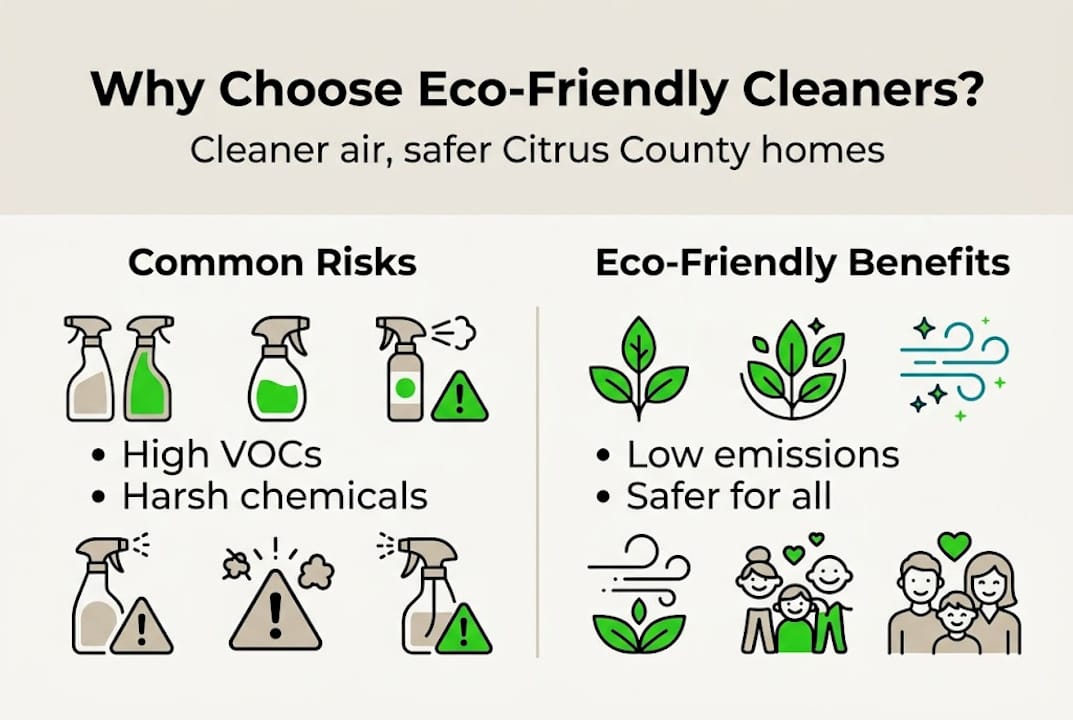
Families with young children, pets, or anyone with asthma or allergies feel this difference most. Kids spend more time on floors and put their hands in their mouths. Pets groom themselves after walking across freshly cleaned surfaces. The residue left by harsh cleaners becomes a direct exposure risk. EPA Safer Choice certified products are formulated with safer ingredients, are biodegradable, and are specifically reviewed for safety around children and pets. Looking for that label on the bottle is one of the fastest ways to make a better choice at the store.
Here’s a quick comparison of what separates traditional from eco-friendly cleaners:
| Feature | Traditional cleaners | Eco-friendly cleaners |
|---|---|---|
| VOC content | Often high | Low to none |
| Biodegradability | Slow or none | Fast |
| Safe for kids and pets | Often not | Yes (when certified) |
| Fragrance chemicals | Synthetic | Plant-derived or none |
| Septic system impact | Can disrupt | Minimal |
When you use industry-approved cleaners that meet modern safety standards, you’re not sacrificing clean for safe. You’re getting both.
Key benefits at a glance:
- Fewer respiratory irritants in your indoor air
- Lower risk of skin and eye irritation during cleaning
- Safer residue on surfaces your family touches daily
- Better long-term protection for finished floors, counters, and fabrics
Pro Tip: Open windows while cleaning even with eco-friendly products. Ventilation always helps flush out any airborne particles and keeps your indoor air fresh.
Eco-friendly cleaning and Citrus County’s environment
Beyond your home’s walls, the cleaners you choose ripple out into Citrus County’s environment.
Citrus County is home to some of Florida’s most treasured natural resources. The Crystal River, Homosassa Springs, and the surrounding spring-fed waterways draw visitors from across the country and define life here for residents. What goes down your drain doesn’t disappear. It travels through your plumbing, through your septic system or municipal treatment, and eventually finds its way toward these waterways. Phosphates, synthetic surfactants, and antibacterial chemicals from conventional cleaners can disrupt aquatic ecosystems and contribute to algae blooms that choke out native plants and wildlife.
For homes on septic systems, which is a large portion of Citrus County properties, the stakes are even higher. Harsh disinfectants kill the beneficial bacteria that make your septic tank function. Without those bacteria breaking down waste, your system can fail faster and require costly repairs. Eco-friendly cleaners are safer for septic systems, break down quickly in the environment, and leave far less chemical residue in local waterways.
Here’s how the two approaches compare when it comes to environmental impact:
| Environmental factor | Traditional cleaners | Eco-friendly cleaners |
|---|---|---|
| Waterway safety | Risk of chemical runoff | Biodegrades quickly |
| Septic system health | Can kill beneficial bacteria | Preserves bacterial balance |
| Aquatic toxicity | Often high | Low to minimal |
| Packaging | Mostly single-use plastic | Often recyclable or concentrated |
“The cleaners you pour down your drain today become part of Citrus County’s water story tomorrow. Choosing biodegradable, plant-based products is one of the most direct ways a homeowner can protect local springs and rivers.”
Exploring safe cleaning methods for Citrus County and learning best cleaning practices for Citrus homes can help you make choices that protect both your property and the environment your family enjoys.
Environmental wins from switching to eco-friendly cleaners:
- Reduced phosphate and nitrate load in local water systems
- Less disruption to septic system biology
- Lower overall chemical footprint from your household
- Support for local biodiversity in spring-fed ecosystems
Are eco-friendly cleaners as effective as traditional options?
Many wonder if eco-friendly solutions actually clean as well. Let’s break down the data.
This is the question most homeowners ask first, and it’s a fair one. The short answer is yes, for most everyday cleaning tasks. Green cleaning products match or exceed traditional cleaners in microbial reduction and also produce lower CO2 emissions during manufacturing. That’s not marketing language. That’s peer-reviewed research comparing the two categories head to head.
Natural alternatives like vinegar and plant-based soaps also hold up well. Vinegar achieves comparable microbial reduction to some commercial products, and soap scrubbing is highly effective at removing pathogens from surfaces. The mechanical action of scrubbing matters as much as the chemistry.
Here’s how eco-friendly cleaners perform across common surfaces:
| Surface type | Eco-cleaner performance | Notes |
|---|---|---|
| Tile and grout | Good | May need scrubbing for deep stains |
| Glass and mirrors | Excellent | Vinegar-based solutions shine here |
| Sealed hardwood | Good | Avoid excess moisture |
| Porous concrete | Moderate | Mechanical action recommended |
| Fabric and upholstery | Good | Test in a hidden spot first |
| Heavy mold growth | Limited | Professional treatment often needed |
Where eco-cleaners sometimes fall short is on heavy biological growth like black mold, or deeply porous surfaces that trap contaminants below the surface layer. In those cases, mechanical action, meaning scrubbing, pressure, or professional-grade equipment, fills the gap. Understanding the difference between pressure washing vs traditional cleaning helps you decide when a product alone is enough and when you need more force behind it.
When eco-friendly cleaners are your best choice:
- Daily and weekly household maintenance cleaning
- Kitchens and bathrooms where food safety and skin contact matter
- Homes with children, pets, or allergy sufferers
- Any surface near a drain that flows to a septic system
- Exterior surfaces near gardens, lawns, or water features
Pro Tip: For stubborn stains on exterior surfaces, review surface cleaning steps to pair the right eco-cleaner with the right technique before you reach for something harsher.
Selecting and maximizing eco-friendly cleaning results
Knowing when and how to use green products ensures their benefits aren’t wasted.
Not all products labeled “natural” or “green” are created equal. Some still contain synthetic fragrances or preservatives that can irritate sensitive airways. Reading the label carefully is your first line of defense. Look for EPA Safer Choice certification, plant-derived surfactants, and a full ingredient list. If a product hides behind vague terms like “cleaning agents” without specifics, that’s a red flag.
Eco-friendly cleaners use plant-derived surfactants and organic acids, which means lower toxicity and faster biodegradation compared to petroleum-based alternatives. That’s the chemistry working in your favor. But even these products have limits. Some eco-cleaners can still emit VOCs or fine particulates, and their performance on porous surfaces can be lower than conventional options. Adding mechanical scrubbing almost always boosts results significantly.
How to get the most from eco-friendly cleaners:
- Match the product to the surface. A citrus-based degreaser works great in the kitchen but may not be ideal for delicate stone.
- Pre-rinse heavily soiled surfaces before applying cleaner. This removes loose debris so the product can focus on what’s stuck.
- Let it dwell. Most eco-cleaners need 30 to 60 seconds of contact time to work properly. Don’t wipe immediately.
- Use microfiber cloths. They boost cleaning power mechanically, reducing how much product you need.
- Store products in a cool, dry place away from direct sunlight, which can degrade plant-based ingredients faster.
For effective surface cleaning on exterior areas like driveways and siding, pairing an eco-friendly solution with the right application method makes all the difference. Understanding the role of detergents in clean homes gives you a clearer picture of how to use these products strategically rather than just swapping one bottle for another.
Pro Tip: Buy concentrated eco-friendly cleaners and dilute them yourself. You reduce plastic waste, save money, and often get a more effective product than pre-diluted versions on store shelves.
Our take: Why Citrus County homeowners should embrace eco-friendly cleaning
Here’s the honest truth most guides skip over: eco-friendly cleaners are not perfect. Some require more scrubbing. Some cost more upfront. A few won’t touch a serious mold problem without professional backup. Acknowledging that is important, because pretending otherwise sets people up for disappointment.
But here’s what we’ve seen working with Citrus County homes: the imperfections of eco-friendly cleaners are small compared to the peace of mind they deliver. You’re not trading effectiveness for safety. You’re making a pragmatic choice that protects your family, your septic system, and the springs your kids swim in.
Citrus County’s waterways mean your cleaning decisions carry more weight than they might in other parts of Florida. The proximity to sensitive ecosystems makes every household choice matter more. Sustainable cleaning isn’t an all-or-nothing commitment. It’s a direction. Start with the products you use most often, learn what works on your specific surfaces, and build from there. The benefits of exterior cleaning extend well beyond curb appeal when you’re using methods that protect what surrounds your home.
Ready to make your Citrus County home cleaner and greener?
If you’re inspired to see real results, here’s how expert help can make the switch easier.
Switching to eco-friendly cleaning at home is a great start, but your home’s exterior surfaces often need more than a spray bottle can offer. At White Diamond Pressure Washing, we use safe, effective solutions designed specifically for Citrus County properties, including soft washing techniques that clean without damaging surfaces or harming local waterways.

Our soft washing process uses low pressure and biodegradable detergents to remove algae, mold, and grime from roofs, siding, driveways, and more. You get the professional exterior cleaning benefits without the environmental trade-offs. Ready to take the next step? Explore our eco-friendly cleaning services and book a free estimate today.
Frequently asked questions
What are VOCs and why should I care about them when cleaning?
Volatile organic compounds (VOCs) are chemicals released into the air by many conventional cleaners, and they can worsen indoor air quality significantly. Since indoor pollutant levels already run 2 to 5 times higher than outdoors, choosing lower-VOC eco-friendly options helps keep your home’s air genuinely safe.
Do eco-friendly cleaners work as well as traditional ones?
For most everyday cleaning tasks, yes. Green cleaning products match or exceed traditional cleaners in microbial reduction, especially on non-porous surfaces where contact time and scrubbing are part of the routine.
Are eco-friendly cleaners safe for septic systems in Citrus County?
Most eco-friendly cleaners are biodegradable and preserve the beneficial bacteria your septic system needs to function properly. They are safer for septic systems and help protect the local waterways that Citrus County depends on.
Can I use eco-friendly cleaners on all surfaces?
They perform well on most household surfaces, but heavy mold growth or deeply porous materials may need added mechanical scrubbing. Efficacy is lower on porous surfaces, so pairing the right cleaner with the right technique always gives you the best outcome.
Recommended
- Why safe cleaning methods matter for your Citrus County home – white-diamond-pressure
- Environmental Impact of Pressure Washing in Citrus County – white-diamond-pressure
- How cleaner experience impacts property care quality – white-diamond-pressure
- Why Invest in Exterior Cleaning for Citrus County Homes – white-diamond-pressure
- 6 Leading Advantages of Eco-Friendly Cleaning for Offices