


Choose eco-safe detergents for professional exterior cleaning because they protect building materials from abrasive damage, reduce toxic runoff into local waterways, and give property managers documented evidence for ESG and LEED reporting. Whitediamondpressurewashing, serving Citrus County and surrounding regions, applies this approach on every soft-wash job.
The three reasons that matter most:
- Asset protection: Biodegradable surfactants kill biological growth at the root without eroding siding, stucco, or roofing substrates.
- Reduced environmental risk: A single unmanaged driveway wash can release 20–40 gallons of contaminated runoff into local creeks and rivers.
- Operational and ESG advantages: Specifying certified green cleaners in vendor contracts supports sustainability reporting and satisfies tenant expectations.
Table of Contents
- What does “eco-safe detergent” actually mean?
- Why eco-safe detergents and soft washing go together
- Environmental and occupant health benefits you can document
- How eco-safe detergents protect your building and deliver ROI
- Operational and ESG advantages for property managers
- How to evaluate eco-safe detergent claims and certifications
- Application best practices and wastewater management
- Common myths and compliance risks to know
- How to vet exterior-cleaning vendors who claim to use eco-safe products
- How Whitediamondpressurewashing applies eco-safe detergents in Citrus County
- Key Takeaways
- The case for treating eco-safe cleaning as a policy, not a preference
- Get a professional eco-safe exterior cleaning assessment for your property
- Useful sources
What does “eco-safe detergent” actually mean?
An eco-safe detergent, in exterior cleaning, is a formulation built around biodegradable, lower-toxicity surfactants designed to minimize harm to human health, aquatic life, and soil. The industry term you will see on legitimate product documentation is biodegradable surfactant, and the formulations that earn that label share a few common traits.
Ingredients to look for:
- Plant-based or synthetic biodegradable surfactants (no nonylphenol ethoxylates, or NPEs)
- Phosphate-free chemistry to prevent freshwater eutrophication
- pH-neutral or near-neutral formulation
- No volatile organic compounds (VOCs) in the carrier
Ingredients that disqualify a product:
- Sodium hypochlorite at undiluted concentrations without a neutralization protocol
- Hydrochloric acid-based formulations
- Any surfactant with no OECD 301B biodegradability data on the Safety Data Sheet (SDS)
Pro Tip: Never rely on marketing copy alone. The EPA Safer Choice program maintains a searchable database of certified products. If a vendor cannot point you to a Safer Choice or Design for the Environment (DfE) listing, ask for the SDS and check the hazard classifications yourself before signing a contract.
Why eco-safe detergents and soft washing go together
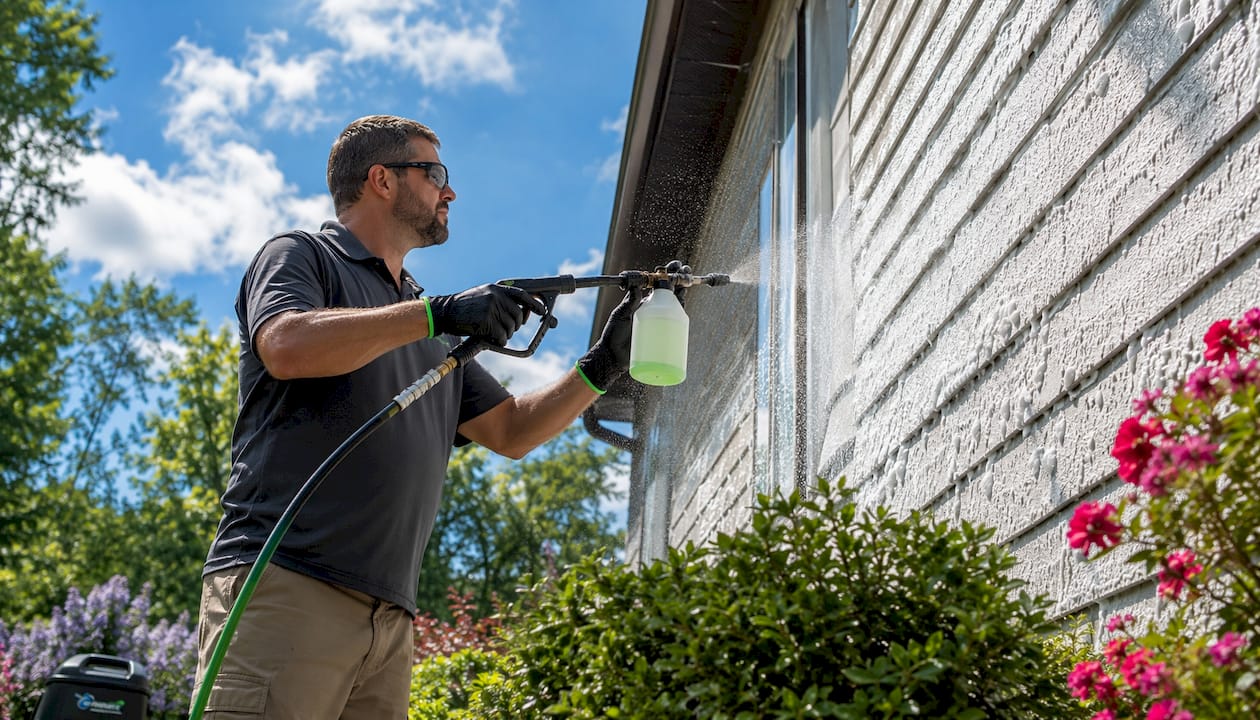
Soft washing pairs low water pressure with dwell-time chemistry. The detergent sits on the surface long enough to penetrate and kill mold, algae, and mildew spores at the root. High-pressure washing strips surface growth by force, which means regrowth is faster and the risk of substrate damage is real.
| Factor | Soft Wash + Eco-Safe Detergent | High-Pressure Washing |
|---|---|---|
| Pressure | Garden-hose range | — |
| Efficacy on biological growth | Kills at the root | Removes surface layer only |
| Risk to vinyl, stucco, EIFS | Very low | High (cracking, water intrusion) |
| Water volume | Lower | Higher |
| Runoff risk | Reduced with containment | Higher without recovery |
A roof cleaned with soft-wash biodegradable surfactants stays cleaner longer because the biology is eradicated, not just blasted off. Concrete driveways, by contrast, can handle higher PSI with different chemistry because the substrate is dense and non-porous. Matching method to material is the core discipline.
Environmental and occupant health benefits you can document
Eco-safe detergents reduce toxic runoff and lower chemical exposure for workers, residents, and landscaping when applied by trained professionals. That is not a marketing claim; it is a measurable outcome.
Research shows a standard driveway wash can release 20–40 gallons of contaminated runoff, contaminated with detergent-based chemicals and biofilm agents, into local waterways. Eco-protocols with containment and recovery systems cut that load significantly.
Documented benefits for your property and its occupants:
- Lower aquatic toxicity risk when biodegradable, phosphate-free formulations replace conventional surfactants
- Reduced VOC emissions, which matters for tenants with respiratory sensitivities
- Safer re-entry conditions after cleaning, with no caustic residue on walkways or entry points
- Preserved soil microbial health around landscaping, which affects drainage and erosion over time
- Reduced slip-and-fall hazard from biological growth on walkways and parking areas
For property managers, the ability to point to eco-friendly cleaning practices in tenant communications is a concrete differentiator, not just a feel-good note.
How eco-safe detergents protect your building and deliver ROI
Soft washing with biodegradable chemistry extends the service life of siding, roofing, and decorative finishes by eliminating the abrasive force that degrades substrates over time. High-pressure methods can etch surfaces, force water behind window seals, and accelerate paint failure. The cost of those repairs compounds quickly.
Preservation outcomes that translate directly to budget:
- Reduced erosion of stucco, EIFS, and painted wood surfaces
- Prevention of water intrusion behind the building envelope
- Avoided stain-setting from algae and mold that, left untreated, permanently discolor materials
- Extended intervals between repaints and re-coatings
Soft washing also links to net operating income. Exterior cleaning for investors shows how curb appeal and building condition affect both lease-up rates and asset valuations. A property that looks maintained commands stronger rents and retains tenants longer.
Pro Tip: Before hiring any vendor, request before-and-after photos from a substrate similar to yours, and ask for a surface-specific assessment in writing. A vendor who cannot produce either is guessing at chemistry.
Operational and ESG advantages for property managers
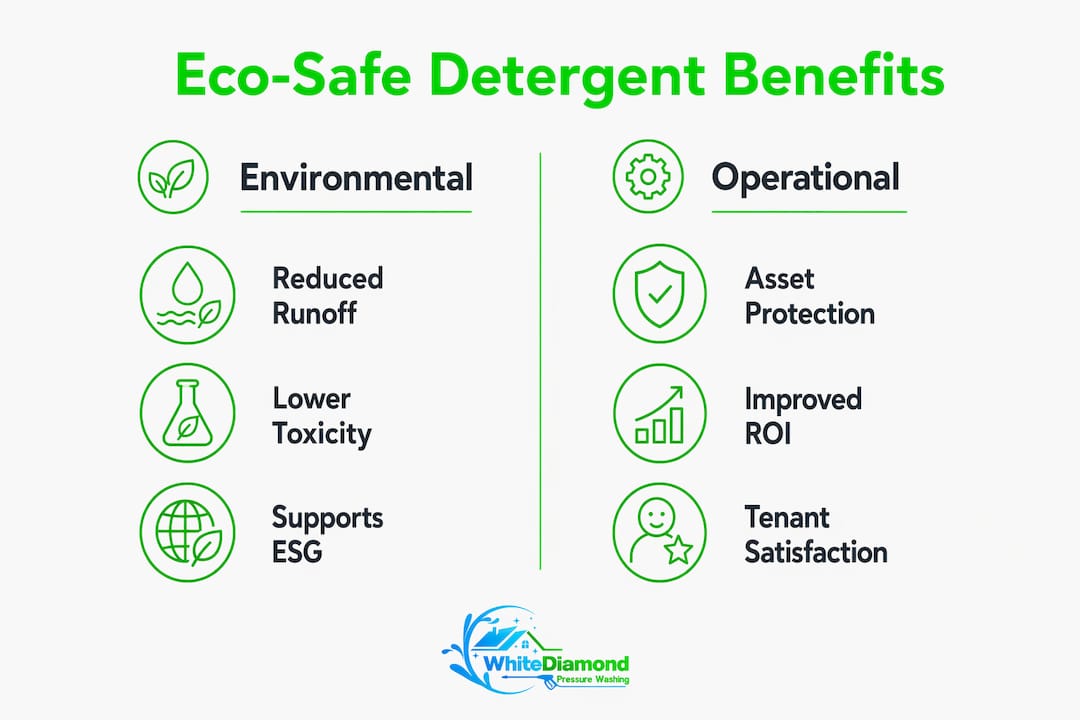
Eco-safe cleaning supports ESG goals, reduces tenant complaints, and creates a paper trail that satisfies investor-facing sustainability requirements. Those are three separate wins from one vendor specification change.
Operational benefits worth putting in your vendor contracts:
- Predictable maintenance schedules tied to biological growth cycles, not reactive damage calls
- Quieter operations compared to high-pressure equipment, which matters for occupied buildings
- Lower water consumption through precision application
- Reduced slip-and-fall liability from regular removal of moss, algae, and biofilm
- Documented sustainability evidence for LEED EBOM green cleaning credits and ESG reporting
How to use this in practice:
- Add a certification requirement (EPA Safer Choice or DfE) to your cleaning RFP.
- Require the vendor to provide SDS for every product used on-site.
- Include a wastewater containment and recovery clause in the contract.
- Request a post-service report with product names, application rates, and site photos.
- File the documentation with your ESG or sustainability coordinator.
Institutional tenants in technology, professional services, and finance increasingly treat building sustainability as a lease factor. Green cleaning specifications are one of the lowest-effort ways to meet that expectation.
How to evaluate eco-safe detergent claims and certifications
Most “green” marketing language on cleaning products is unverifiable without documentation. Here is what to require.
Procurement checklist:
- EPA Safer Choice or DfE endorsement on the product label
- Phosphate-free formulation confirmed on the SDS
- No NPEs listed in the ingredient disclosure
- OECD 301B biodegradability data (a pass rate above 60% in 10 days is the standard threshold)
- Hazard classification on the SDS that confirms low aquatic toxicity
Red flags that should stop a procurement:
- Vague “natural” or “eco” language with no third-party certification
- Vendor unable or unwilling to produce an SDS
- No biodegradation metrics anywhere in product documentation
- Application rates not disclosed
Pro Tip: Require a sample application on an inconspicuous area before committing to a long-term contract. Keep the SDS on file. If a vendor resists either request, that tells you everything.
Application best practices and wastewater management
Correct application, containment, and timing are non-negotiable even for biodegradable detergents. A product that breaks down safely over time can still cause harm during the breakdown window if it reaches a storm drain untreated.
- Pre-wet all surrounding vegetation before applying any detergent, biodegradable or not. Saturating leaf pores reduces chemical uptake and prevents leaf burn.
- Set up containment using berms or vacuum recovery units before washing begins.
- Apply at low volume with precision nozzles to minimize overspray and reduce total wastewater generated.
- Allow full dwell time before rinsing so the chemistry does its work without requiring excess water volume.
- Collect and filter runoff using filtration tanks that separate solids, oils, and surfactant residue before any discharge.
- Time the job away from rain events. Washing just before a heavy rain multiplies the environmental load by flushing accumulated contaminants into storm drains in a single event.
Equipment that reduces wastewater risk:
- Vacuum recovery units
- Four-stage filtration tanks
- HEPA-shielded spray zones for enclosed areas
- Adjustable nozzles to limit PSI and volume by surface type
A closed-loop recovery program piloted by Clear Wave reduced nutrient runoff by 73% compared to unmanaged washing. Recovery hardware matters as much as the detergent itself. For a detailed look at containment options, water reclamation in pressure washing covers the equipment side.
Common myths and compliance risks to know
The most dangerous assumption in exterior cleaning procurement is that “biodegradable” means safe to discharge anywhere. It does not.
UNC Environment, Health and Safety is direct on this: biodegradable labels do not guarantee safe discharge to storm drains. During the breakdown period, byproducts including nitrates, phosphates, and residual surfactants can remain active in soil and water, harming aquatic life before they fully decompose. Proper containment is required regardless of the detergent’s label.
Vendor red flags that signal compliance risk:
- No containment plan presented before the job starts
- Refusal to pre-wet plants or cover sensitive landscaping
- No SDS available for products being used
- Wash water flowing freely toward storm drains or property edges
Quick mitigation steps property managers can require:
- Written containment and recovery plan as part of the scope of work
- Confirmation that the vendor carries liability insurance covering environmental incidents
- Post-job documentation of products used and disposal method
Pro Tip: Build a runoff mapping requirement into your vendor scope. Ask the vendor to walk the site with you before the job and identify every drainage path. That one step prevents most accidental discharge situations.
How to vet exterior-cleaning vendors who claim to use eco-safe products
A vendor’s claim to use green cleaners is only as good as the documentation behind it.
Must-have proofs before you sign:
- SDS for every product proposed for your property
- EPA Safer Choice or DfE certification for those products
- Water recovery equipment on the truck, not just mentioned in the proposal
- Proof of liability insurance covering environmental incidents
- Photo documentation from a comparable prior job showing plant protection protocols in place
Questions to ask during the bid:
- What is the active surfactant in your soft-wash mix, and what is its OECD biodegradability rating?
- How do you contain and dispose of wastewater on a job this size?
- What is your application rate per square foot, and how do you adjust for sensitive substrates?
- Can you provide two local references from properties similar to mine?
Automatic disqualifiers:
- Lowest-price-only bid with no chemistry disclosure
- Refusal to sign an environmental procedure or provide a containment plan
- No local references or before-and-after documentation available
For a full vendor evaluation checklist, Whitediamondpressurewashing has published a practical guide for property teams.
How Whitediamondpressurewashing applies eco-safe detergents in Citrus County
Whitediamondpressurewashing uses a soft-wash process on roofs, siding, stucco, and EIFS that applies professional-grade biodegradable surfactants at low pressure. Before any detergent is applied, the crew pre-wets surrounding vegetation to saturate leaf pores and covers sensitive plantings. Product SDS documentation is available on request for every formulation used. Post-job photos are standard practice, giving property managers a documented record of condition before and after service.
For Citrus County properties, where Florida’s climate accelerates algae and mildew growth on building exteriors, this approach matters beyond aesthetics. Biological growth left untreated traps moisture against siding and roofing materials, accelerating deterioration. Soft washing with biodegradable chemistry removes that growth at the root, extending material life and reducing the frequency of reactive repairs.
Property managers in Citrus County can request SDS documentation, a site-specific containment plan, and soft-wash application examples before committing to a service schedule.
Key Takeaways
Eco-safe detergents protect building materials, reduce runoff risk, and support ESG documentation when applied by a certified professional using containment and recovery systems.
| Point | Details |
|---|---|
| Runoff risk is measurable | A single unmanaged wash can release 20–40 gallons of contaminated runoff; containment systems cut that load significantly. |
| Certification is verifiable | Require EPA Safer Choice or DfE listing and an SDS before approving any product for use on your property. |
| Soft wash extends material life | Low-pressure biodegradable application kills growth at the root and prevents abrasive substrate damage on siding, stucco, and roofing. |
| ESG documentation starts with vendor specs | Adding certification requirements and a wastewater containment clause to your RFP creates the paper trail investors and tenants expect. |
| Whitediamondpressurewashing | Serves Citrus County with soft-wash biodegradable protocols, SDS documentation on request, and plant protection as standard practice. |
The case for treating eco-safe cleaning as a policy, not a preference
Most property managers treat green cleaning as a nice-to-have. That framing underestimates what is actually at stake.
The real argument for eco-safe detergents is not environmental virtue. It is liability management and asset longevity. A vendor who uses undisclosed chemistry, skips containment, and lets wash water flow toward a storm drain is creating an environmental incident on your property, with your name on the permit. The cleanup cost, the regulatory exposure, and the tenant relations fallout from that scenario dwarf the modest premium a certified eco-safe service commands.
The ESG angle is real too, but it is downstream of the core case. Biodegradable surfactants applied with proper dwell time and recovery systems simply clean better on biological growth, damage surfaces less, and leave a documented record. That is what a well-run property operation looks like regardless of what investors are asking for this quarter.
Get a professional eco-safe exterior cleaning assessment for your property
Whitediamondpressurewashing provides property managers and owners in Citrus County with a surface-specific assessment before every job, covering substrate type, detergent selection, containment plan, and scheduling around weather windows.

When you contact Whitediamondpressurewashing, here is what to expect: a site walkthrough to identify drainage paths and sensitive surfaces, a written scope that names the products and application rates, SDS documentation for every formulation, and a post-job photo record. No guesswork on chemistry, no wash water left to find its own way to the storm drain.
Property managers handling tenant move-in cleaning or ongoing maintenance contracts can request a free estimate and a sample SDS package before committing to a schedule. Visit Whitediamondpressurewashing to book your assessment or get a free estimate today.
Useful sources
- EPA Safer Choice — The primary certification database for safer cleaning product ingredients. Use it to verify any product a vendor proposes before it touches your property.
- Identifying Greener Cleaning Products (US EPA) — EPA guidance on ecolabels including Safer Choice and DfE; helps procurement teams cut through greenwashing claims.
- The Environmental Impact of Pressure Washing (Clear Wave) — Source for the 20–40 gallon contaminated runoff figure and the 73% nutrient runoff reduction from closed-loop recovery. Supports the environmental benefits and wastewater management sections.
- Pollution Prevention During Pressure Washing (UNC EHS) — Authoritative guidance confirming that biodegradable labels do not guarantee safe storm drain discharge. Cited in the myths and compliance section.
- Exterior Cleaning for Property Managers: The 2026 Guide to Asset Protection (Poseidon) — Links soft washing with improved net operating income and reduced material erosion; supports the ROI and property preservation section.
Recommended
- Why use eco-friendly cleaners? Healthier homes, safer Citrus County – white-diamond-pressure
- What is property washing? A homeowner’s guide to safer, cleaner homes – white-diamond-pressure
- Eco-friendly outdoor cleaning guide for Citrus County homes – white-diamond-pressure
- Why Schedule Multi-Unit Cleaning: A Property Manager’s Guide – white-diamond-pressure
One thought on “Why Choose Eco-Safe Detergents for Property Managers”