

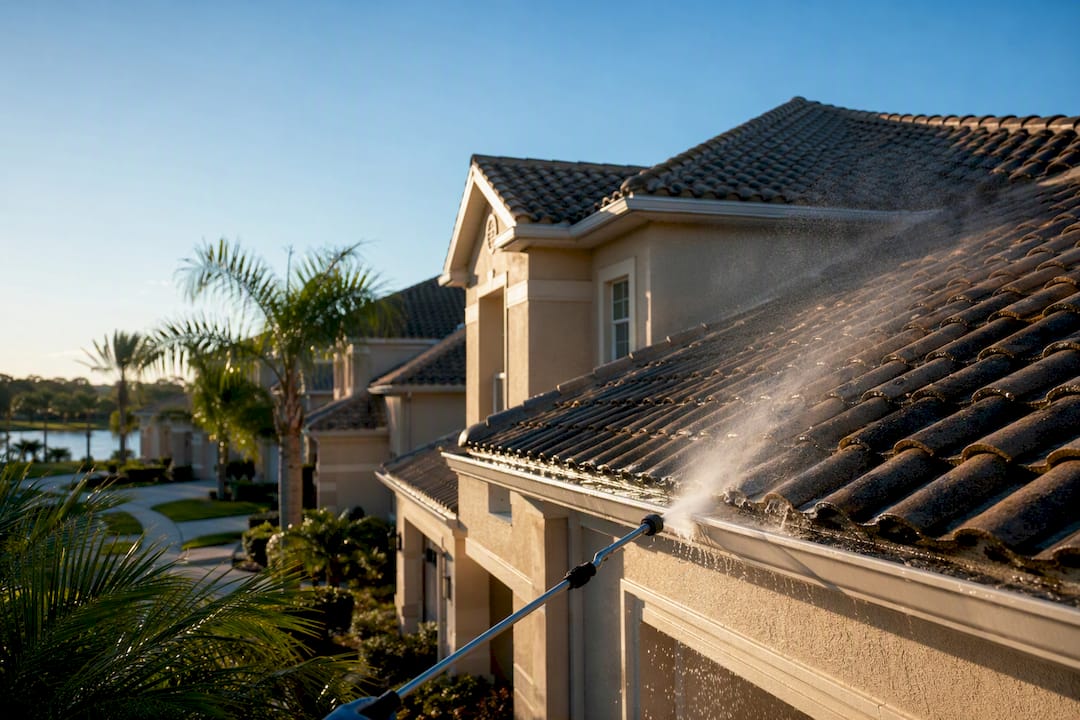
Yes, a Florida HOA can require you to pressure wash your roof, siding, or driveway, but only if that authority is written into your recorded governing documents, and the association must follow the strict notice and hearing procedure in Florida Statute §720.305. The moment you get a notice, do three things: keep every page of it, submit a written hearing request, and file a records request under §720.303(5). Curing the issue before your hearing date stops a fine before it starts.
TL;DR:
- HOA authority to require pressure washing must be clearly documented in recorded governing documents, not based on vague community standards or informal communication.
- Valid violation notices must include specific details about the rule, the required action, and details of the hearing, with at least 14 days’ notice and a hearing within 90 days.
- Responding effectively involves requesting a hearing and records, documenting the cure with photos and invoices, and avoiding admitting fault or paying fines prematurely.
- Properly documented soft washing by professionals is usually preferred to avoid damage and provide reliable proof of compliance, especially before scheduled hearings.
- Many HOA enforcement errors, such as citing non-existent rules or improper committee composition, can be grounds for dismissing a fine without extensive dispute.
Table of Contents
- What Gives an HOA the Authority to Require Pressure Washing?
- What a Valid Notice Must Include, and the Clock That Starts Ticking
- How to Respond to a Pressure Washing Notice, Step by Step
- Choosing the Right Cleaning Method for HOA Compliance
- What a Professional Documentation Package Looks Like
- How Long Does an HOA Have to Send a Violation Notice?
- How the Enforcement Committee Actually Works
- Beyond an Appeal: Building a Real Case Against a Notice
- What Pressure Washing Actually Costs
- Single-Family Homes vs. Condos: Enforcement Isn’t the Same
- Bobby’s Take: The Mistakes That Kill an HOA’s Case
- If You’d Rather Have a Pro Handle the Cure
- Statutes and Resources Worth Bookmarking
- Sources
- FAQ
What Gives an HOA the Authority to Require Pressure Washing?
An HOA’s power to make you clean your roof or driveway comes entirely from paper, not from a manager’s opinion about what looks tidy. Florida Statute §720.3035 limits architectural and appearance enforcement to whatever is specifically stated, or reasonably inferred, in the recorded declaration and any properly adopted guidelines. If the rule isn’t in a document you can pull up and read, the board is on shaky ground.
Most CC&Rs use fairly predictable language: homes must be kept in a “neat, clean, and well-maintained condition,” or exteriors must be free of “visible mold, mildew, or algae growth.” That kind of wording holds up. What doesn’t hold up is a board citing a vague “community standard” that never made it into a recorded document or a distributed guideline.
Watch for these weak spots in a notice:
- The rule cited doesn’t exist in your declaration or bylaws, only in a board meeting summary or an email.
- The association never published written maintenance guidelines, yet claims one now.
- The architectural review committee missed its own response deadline and is enforcing anyway.
- The requirement conflicts with something the board itself hasn’t maintained on common areas.
If any of those apply, you have a real argument, not just a complaint.
What a Valid Notice Must Include, and the Clock That Starts Ticking
A pressure washing violation notice isn’t valid just because it’s on letterhead. Under §720.305, it has to include specific elements, and Florida’s 2024 HB 1203 updates changed how much time you have to respond.
A compliant notice must contain:
- A description of the violation (roof algae, siding mildew, a stained driveway, etc.).
- The specific covenant or rule being cited, quoted or clearly referenced.
- The exact action required to cure the problem.
- The date, time, location, and access details for the hearing.
Beyond content, the timeline matters just as much:
- At least 14 days’ written notice is required before a fining committee hearing.
- The hearing must take place within 90 days after the notice is issued.
- The committee has up to 7 days to send written findings after the hearing.
- A confirmed fine is payable only after a minimum 30-day wait following the committee’s written notice.
Fines are capped, too. Florida law caps most HOA fines at $100 per day per violation, with a $1,000 aggregate cap, unless your governing documents specifically authorize more. Fines under $1,000 generally can’t become a lien on your home, which matters if a notice threatens otherwise.
How to Respond to a Pressure Washing Notice, Step by Step
Don’t pay a fine or admit fault the day a notice shows up. Slow down and work the process instead.
- Preserve everything. Photograph the notice, the envelope, and the postmark. Note the date you received it.
- Request a hearing in writing, citing §720.305 directly, and send it by certified mail with an emailed copy for a timestamp.
- Send a records request the same day, invoking §720.303(5). Ask for committee minutes, prior notices sent to any homeowner for the same issue, and ARC files related to your property.
- Document your cure with dated photos, a contractor invoice describing the method used (soft washing, for instance), and a one-page cover letter summarizing what was done and when.
- Escalate only if needed. If the association skipped a step, seated an improper committee, or recorded a lien improperly, that’s when a demand letter or attorney involvement makes sense.
Sending an appeal and a records request together is the single highest-leverage move available. Associations that know their own paperwork is thin often withdraw the notice rather than risk a fight over fee-shifting exposure.
Pro Tip: File your records request the same day as your appeal, not after. If the 10 business-day response window for records overlaps with your hearing prep, you’ll already have what you need to challenge the notice on the spot.
Choosing the Right Cleaning Method for HOA Compliance
Not every surface should get blasted with a pressure washer, and HOAs generally don’t care how you clean, only that the result matches what the notice describes. Roofs, shingles, and painted siding usually call for soft washing, a low-pressure method using biodegradable cleaners that kills algae and mildew without stripping granules or paint. Concrete driveways and some masonry can typically handle direct pressure without damage.
Keep this documentation on hand regardless of who does the work:
- Dated before-and-after photos of the exact surface cited in the notice.
- An invoice listing the method used and any cleaning products applied.
- Proof of the contractor’s license and liability insurance.
- A short cover letter for your HOA file summarizing the cure.
DIY pressure washing carries real risk here: cracked roof tiles, stripped paint, and chemical runoff into a neighbor’s yard or a storm drain can turn a simple cleaning notice into a bigger dispute. Check how water pressure affects different surfaces before you rent equipment.
Pro Tip: A cover letter that names the exact covenant, the exact date the work was completed, and the exact method used gives the board nothing to argue about. Vague documentation invites a second notice.
What a Professional Documentation Package Looks Like
A properly cured violation should come with paperwork the board can’t poke holes in. When White Diamond Pressure Washing handles an HOA cure, the packet typically includes a signed invoice, a written description of the method (soft wash versus standard pressure), a note on the biodegradable products used, timestamped before-and-after photos, and proof of liability insurance.
Bundle those into one cover letter and submit the whole packet to the association at once, rather than trickling in receipts over a week. A single, complete submission gives the board less room to claim the cure wasn’t documented and speeds up the case closing before a hearing is even needed.
[author_bio]
[brand_signal]
How Long Does an HOA Have to Send a Violation Notice?
Florida law doesn’t set a hard deadline for how fast an HOA must issue a notice after spotting a dirty roof or stained driveway, which surprises a lot of homeowners. Boards typically act after a routine walkthrough, a neighbor complaint, or a management company’s periodic inspection, and the timing varies widely from one community to the next.
What the statute does control is what happens after the notice goes out. Once you’re notified, the 14-day hearing notice minimum and the 90-day hearing deadline under §720.305 kick in immediately. That means the association can sit on an observed violation for months before acting, but once it moves, the clock on your due process rights starts running on a fixed schedule.
This gap matters for a practical reason: if you fixed the problem months ago but the notice still cites an old photo or an outdated inspection, that’s worth raising at your hearing. Associations sometimes issue notices based on stale evidence, especially in larger communities where inspections happen in batches. Ask for the date of the inspection that triggered the notice when you request records. If it doesn’t match current conditions, you have a legitimate procedural objection, not just an excuse.
How the Enforcement Committee Actually Works
The fining committee isn’t the board. That distinction trips up a lot of homeowners who assume the same people writing the rules are also deciding the punishment.
Under §720.305, the committee must include at least three members who are not officers, directors, employees, or relatives of any of those. Its job is narrow: review the evidence, hear from the homeowner, and decide whether to confirm the fine the board proposed. The committee can reduce a fine or reject it outright, and its decision has to be delivered in writing within 7 days of the hearing.
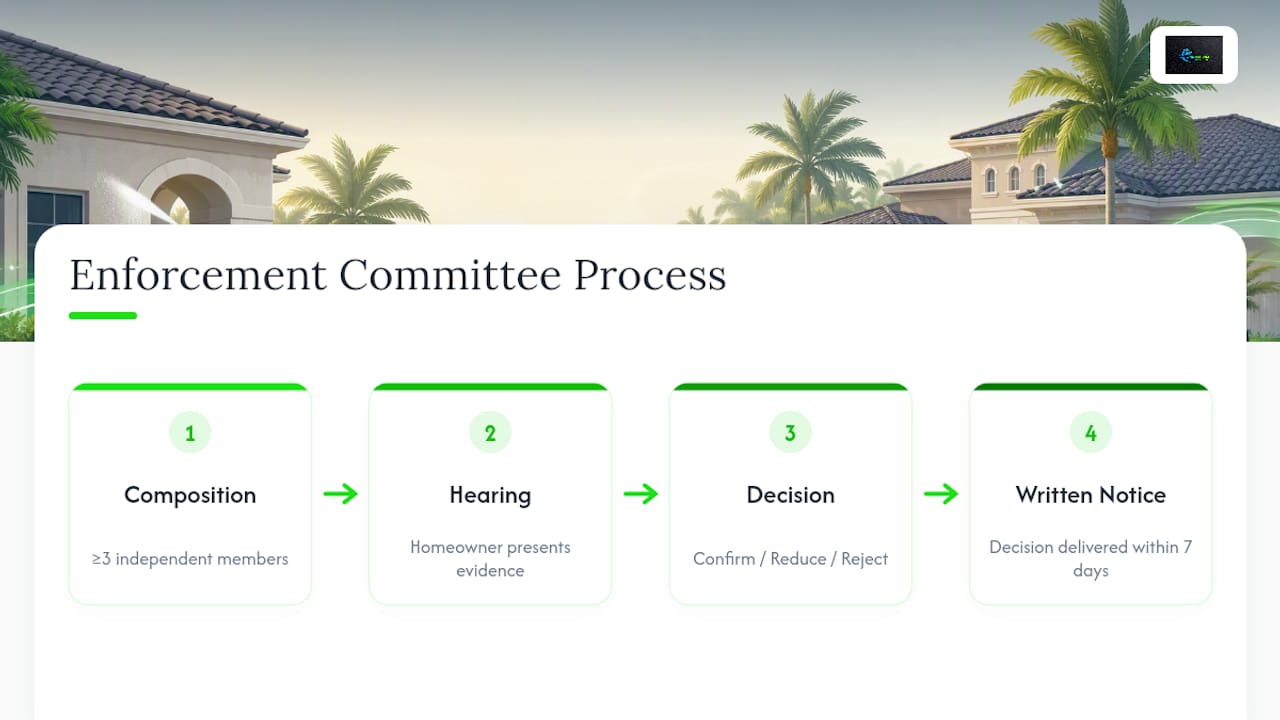
At the hearing itself, you have the right to appear, present evidence, and explain your side before the committee votes. Bring your cure documentation, your records request response, and anything showing the notice was vague, late, or based on a rule that doesn’t exist in writing. If the committee wasn’t properly composed, if it includes a board member’s spouse, or only has two people voting, that’s a procedural defect you can raise immediately, and it can invalidate the whole enforcement action.
Beyond an Appeal: Building a Real Case Against a Notice
Requesting a hearing is step one. Winning it takes more than showing up and saying the notice feels unfair.
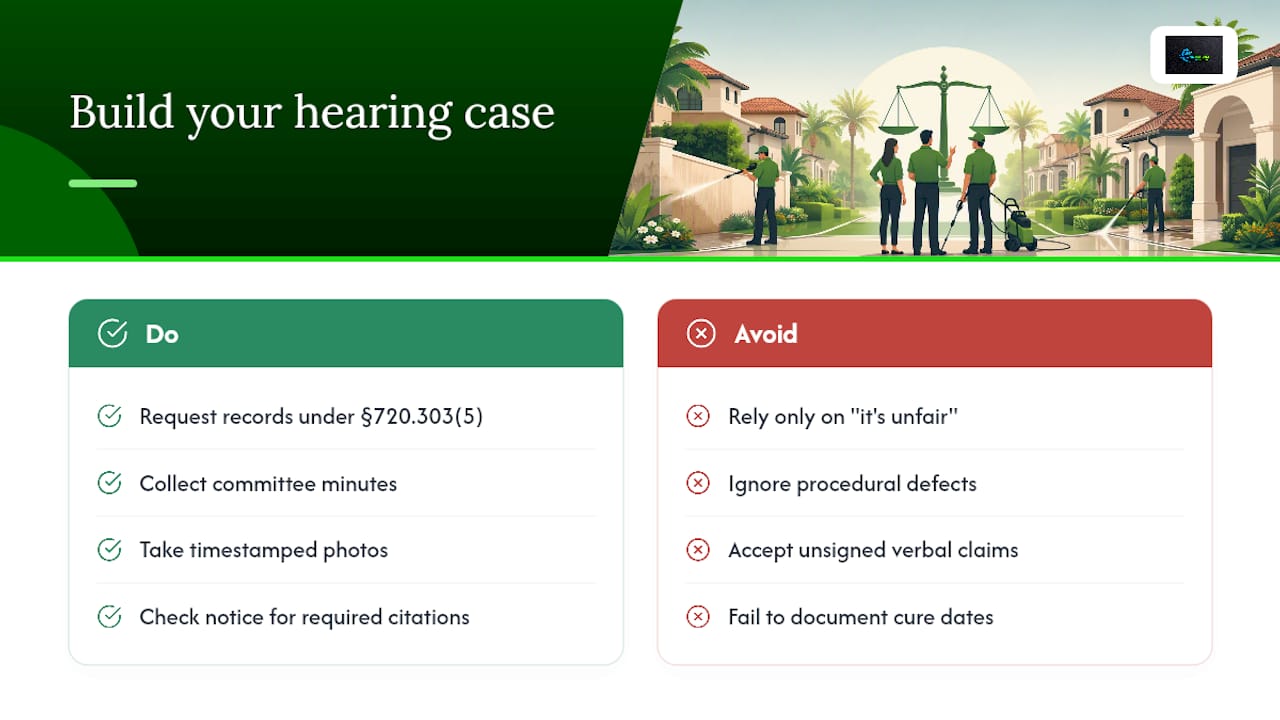
Start with the records you requested under §720.303(5). Committee minutes often reveal whether the board followed its own rules for other homeowners, which matters if you can show selective enforcement. Prior violation letters sent to neighbors for the same condition, mold on a roof, algae streaking on siding, help establish a pattern the board either enforced consistently or didn’t.
Photographic evidence works both ways here. Timestamped photos showing the condition was already cured before the hearing date can end the matter outright, since current law prevents a fine once the violation is fixed before the hearing. If a neighbor or a contractor can speak to when work was completed, a short written statement from them adds weight, especially if the association’s own inspection date is unclear or disputed.
Don’t overlook the notice’s own language. If it fails to cite a specific covenant, omits the required cure instructions, or gets the hearing date wrong, point that out directly and ask the committee to dismiss on procedural grounds before any argument about the roof itself. Boards that skip these statutory requirements risk having the fine thrown out entirely, and in some cases owe the homeowner’s attorney fees for the trouble.
What Pressure Washing Actually Costs
Most Florida homeowners responding to an HOA notice end up paying for roof cleaning, house washing, or driveway cleaning, sometimes all three if the notice covers multiple surfaces. Costs vary by home size, surface material, and how much buildup has accumulated, but a few patterns hold across most jobs.
Roof soft washing tends to run higher than a driveway or walkway cleaning because of the labor involved in careful, low-pressure application and the specialized equipment needed for tile or shingle roofs. House washing (siding, stucco) generally falls in a middle range, while concrete surfaces like driveways and patios are usually the least expensive per square foot since they tolerate more direct pressure and faster work.
Beyond the base cleaning fee, budget for a few common add-ons: a documentation package with detailed photos and a method statement, protective treatments if algae or mildew is severe, and occasionally a repeat visit if the HOA’s cure deadline lands right before Florida’s rainy season brings the growth back. Getting a written estimate that breaks out method, chemicals used, and turnaround time helps you compare quotes and gives you paperwork the association will actually accept as proof of cure.
Single-Family Homes vs. Condos: Enforcement Isn’t the Same
A single-family homeowner in an HOA and a condo owner in a condominium association are dealing with two different rulebooks, even though both involve exterior cleaning disputes.
Single-family HOA enforcement usually targets what the individual homeowner owns and maintains directly: the roof, the siding, the driveway. The homeowner is responsible for hiring the cleaning, paying for it, and submitting proof. Chapter 720 governs this relationship, and §720.305’s notice and hearing procedure applies in full.
Condominiums fall under a separate statute, Chapter 718, and the lines of responsibility blur. Roofs and exterior building surfaces are frequently common elements the association itself is obligated to maintain, not the individual unit owner. If you own a condo and get a notice demanding you personally pressure wash a shared roof or exterior wall, that’s worth questioning immediately. Check your declaration to see who actually owns maintenance responsibility for that surface before assuming the notice is valid. Limited common elements, like a private balcony or an assigned parking space, are more likely to fall on the owner, while shared building exteriors typically don’t.
Bobby’s Take: The Mistakes That Kill an HOA’s Case
The HOA notices I see fail most often aren’t complicated. They cite a rule that isn’t written anywhere, skip the required cure instructions, or seat a fining committee with a board member’s relative on it. Any one of those can unravel the whole enforcement action.
Three moves fix most situations without ever reaching a hearing: send the records request, document your cure with dated photos and a real invoice, and deliver everything by certified mail. Associations that know their paperwork is thin tend to drop the matter rather than risk a fight. Save “pay under protest” or calling an attorney for cases involving a recorded lien threat or a committee that’s clearly stacked.
— Bobby
If You’d Rather Have a Pro Handle the Cure
Curing a notice yourself means renting equipment, researching the right method for your roof material, and hoping your photos hold up as proof. White Diamond Pressure Washing exists for homeowners who’d rather skip that risk entirely.

Every HOA cure job generally includes soft washing for roofs and siding where pressure would cause damage, work by professional crews, and a documentation packet built for association review: method statement, before-and-after photos, and a signed invoice as proof of compliance. That combination matters most when you’re racing a hearing deadline and can’t afford a redo. If your notice has a cure date attached, request an estimate through our services page and get the paperwork your HOA will actually accept the first time.
Statutes and Resources Worth Bookmarking
- Florida Statutes §720.305: the core notice, hearing, and fine procedure every HOA must follow.
- Florida Statutes §720.3035: defines the limits of architectural and appearance enforcement.
- How to write an HOA appeal letter in Florida: sample language for a hearing request.
- How to challenge an HOA fine in Florida: records-request strategy and step-by-step dispute guidance.
This article is general information, not a substitute for advice from a qualified lawyer. Consult a qualified legal professional about your own circumstances before acting on anything here.
Sources
- Florida Statutes §720.305 (2023)
- Florida Statutes §720.3035 (2026)
- New procedures for violation notices — The Orlando Law Group (2024)
- How to challenge an HOA fine in Florida — JD Woods Law PLC
FAQ
What Are the Laws Regulating Pressure Washing Services in Florida?
Florida doesn’t require a special pressure washing license statewide, but contractors need general business licensing, liability insurance, and must follow local water discharge rules. HOA enforcement itself is governed by §720.305, not by cleaning-specific statutes.
What Is the New Law in Florida for HOAs?
The 2024 HB 1203 updates require hearings within 90 days of notice, committee findings in writing within 7 days, and confirmed fines that aren’t due until at least 30 days after that written notice.
What Are the New HOA Laws for Homeowners in Florida in 2026?
Current law builds on the 2024 changes, keeping the 14-day minimum hearing notice, the 90-day hearing deadline, and the rule that curing a violation before the hearing prevents a fine. Fine caps remain at $100 per day with a $1,000 aggregate unless governing documents state otherwise.
Can an HOA Tell Me What to Do in My Backyard in Florida?
Only if the authority is written into your recorded declaration or a properly adopted guideline under §720.3035. An HOA generally can’t enforce an unwritten “community standard” against backyard maintenance, landscaping, or exterior appearance.
What Should I Do First When I Receive a Pressure Washing Notice?
Preserve the notice, submit a written hearing request citing §720.305, and send a records request under §720.303(5) the same day. Curing the issue with documented before-and-after proof before your hearing date typically prevents any fine.