

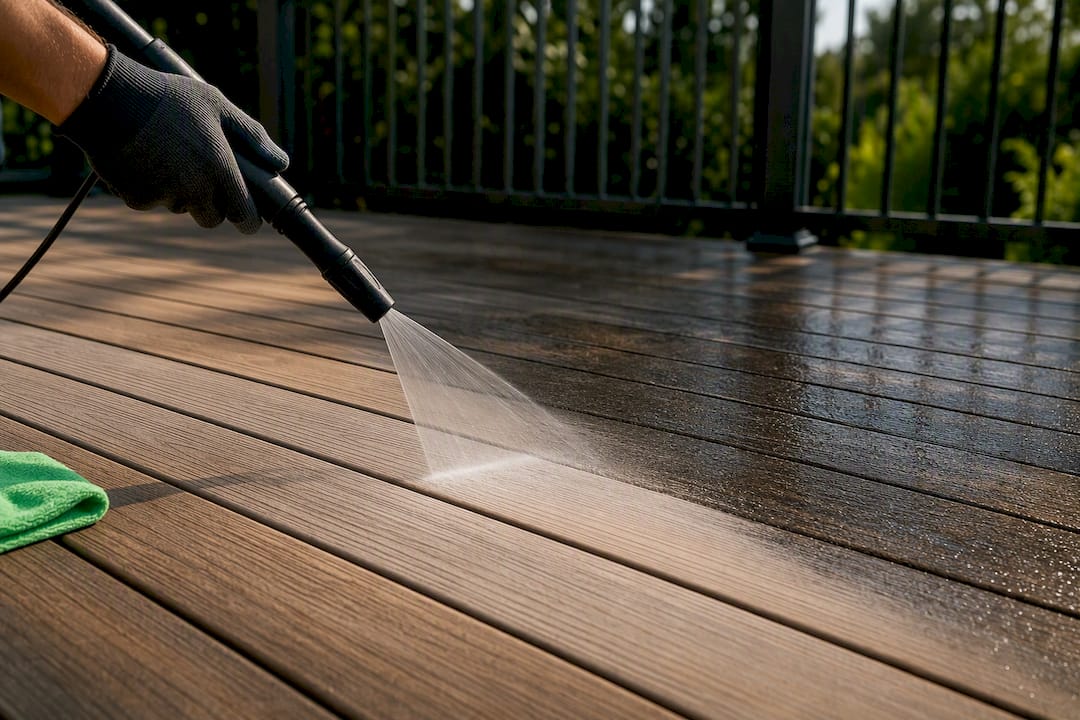
The fastest safe route to a clean composite deck is a warm water and mild soap scrub with a soft nylon brush. For mildew that won’t budge, switch to an oxygen-bleach composite cleaner and let it sit before rinsing. Skip chlorine bleach, metal bristles, and turbo pressure-washer tips entirely. Below: the exact steps, the cleaners worth buying, safe pressure-washing limits, and how to keep mildew from coming back.
TL;DR:
- Use oxygen-bleach solutions sparingly on stubborn mildew to avoid dulling the deck’s finish, and always test a small hidden area first.
- Wear safe pressure-washing settings at or below 1,500 PSI with a wide fan tip, always keeping the nozzle at least 12 inches from the surface.
- Regularly sweep, wash, and move furniture to prevent organic buildup and reduce moisture-prone shaded corners that nurture mildew.
- Avoid chlorine bleach, metal brushes, and rotary pressure nozzles, and instead opt for soft brushes and biodegradable cleaners for warranty protection.
- Call a professional for large or heavily stained decks, especially if warranty concerns or existing damage restrict the use of harsh chemicals.
Table of Contents
- How Do You Get Rid of Mildew on Composite Decking?
- Which Cleaners Actually Work on Composite Decking?
- Can You Use a Pressure Washer on Composite Decking?
- How Do You Stop Mildew from Coming Back?
- When Should You Call a Pro Instead of DIY?
- Get a Warranty-Friendly Deck Clean Without the Guesswork
- Manufacturer Care Guides Worth Bookmarking
- Sources
- FAQ
How Do You Get Rid of Mildew on Composite Decking?
Cleaning a composite deck properly is less about scrubbing hard and more about doing things in the right order. Rush the process and you’ll push mildew stains deeper into the board’s texture instead of lifting them out.
Step 1: Clear and protect the deck. Move furniture, planters, and grills off the surface. Sweep out leaves, pollen, and dirt trapped in the board gaps. If you’re using any cleaner stronger than dish soap, drape wet burlap or plastic sheeting over nearby shrubs and flower beds. Oxygen-based cleaners are generally plant-friendly, but overspray on delicate foliage can still cause leaf burn.
Step 2: Start with a routine wash. Mix a few drops of mild dish soap into a gallon of warm water. Apply it with a mop or soft brush, then scrub along the direction of the wood grain pattern, never across it or in circles. Rinse thoroughly with a garden hose. Trex recommends this exact combination as the standard maintenance wash for its decking, and it handles the light gray film of surface mildew that builds up after a rainy stretch.
Step 3: Treat stubborn mildew. If soap and water leave dark spots behind, move to an oxygen-bleach solution or a cleaner formulated specifically for composite. TimberTech’s cleaning method breaks this into manageable stages: clear the section, apply cleaner, let it dwell 10 to 15 minutes, scrub, then rinse before moving to the next section. Working in smaller areas keeps the cleaner from drying out before you can scrub it off.
Step 4: Spot-treat grease and tannin stains separately. A baking-soda paste lifts most grease spots from grills or fallen berries. Tannin stains from leaves or wood furniture often respond better to a mild degreaser. Two gentle passes beat one aggressive scrub session that risks dulling the cap’s finish.
Step 5: Rinse, inspect, and dry. Hose down the entire deck to clear every trace of cleaner residue, since leftover soap or bleach film actually attracts dirt faster. Let the boards air dry for 24 hours before putting furniture back. Walk the deck once it’s dry and check board gaps, corners, and shaded rail posts. Those spots often need a second light pass since they trap moisture longer than open sections.
A few materials make this process faster:
- Soft or medium-bristle nylon brush (never wire or metal)
- Garden hose with adjustable spray nozzle
- Plastic bucket for mixing soap or oxygen-bleach solution
- Wet burlap or plastic sheeting for nearby plants
- Baking soda for stubborn grease spots
Pro Tip: Work in the shade or during overcast weather. Direct sun dries cleaning solutions before they finish breaking down mildew, which forces you into extra rounds of scrubbing you could have skipped.
Which Cleaners Actually Work on Composite Decking?
Not every cleaner marketed for decks belongs on composite. Some of the most common household fixes do more harm than good, and manufacturer warranties often hinge on which chemicals touched the boards.
Oxygen bleach (sodium percarbonate) is the strongest option that’s still considered safe for composite caps when used as directed. Testing-based comparisons show it typically lifts resilient mildew stains more effectively than vinegar while treating the cap gentler than chlorine bleach does when applied per package instructions. Mix it with warm water, apply, let it dwell, then scrub and rinse. Overusing it, however, can dull the cap’s finish over time, so reserve it for genuinely stubborn spots rather than every weekly cleaning.
Mild dish soap remains the right first move for routine upkeep. It’s cheap, gentle, and handles light surface mildew without any risk to the finish, as long as you rinse it completely.
Chlorine bleach is where most DIY cleaning goes wrong. Full-strength chlorine bleach can lighten or damage many composite cap finishes and kill grass and plants beneath the deck. Some brands permit a heavily diluted mix in rare cases, but the safer call is skipping it altogether and reaching for oxygen bleach instead.
Vinegar sits in a gray zone. It handles light mildew on some composite formulations, but its acidity means several manufacturers caution against regular use since it can affect certain cap coatings over time.
Before treating the whole deck with anything beyond soap and water:
- Test the cleaner on a hidden board or corner first and wait 10 minutes to check for discoloration
- Cover nearby plants and grass before applying oxygen bleach or diluted alternatives
- Never mix cleaning chemicals together, especially bleach with ammonia-based products
Mildew growing on composite isn’t a sign the board is failing. It’s typically surface growth feeding on organic film left behind by pollen and decomposing leaves, not rot in the material itself.
Can You Use a Pressure Washer on Composite Decking?
Yes, but the margin for error is smaller than most people expect. Manufacturer guidance commonly caps safe pressure at around 1,500 PSI for most composite boards, applied through a wide fan tip, never a rotary or turbo nozzle. Hold the nozzle at least 12 inches from the surface and spray along the grain, not across it.
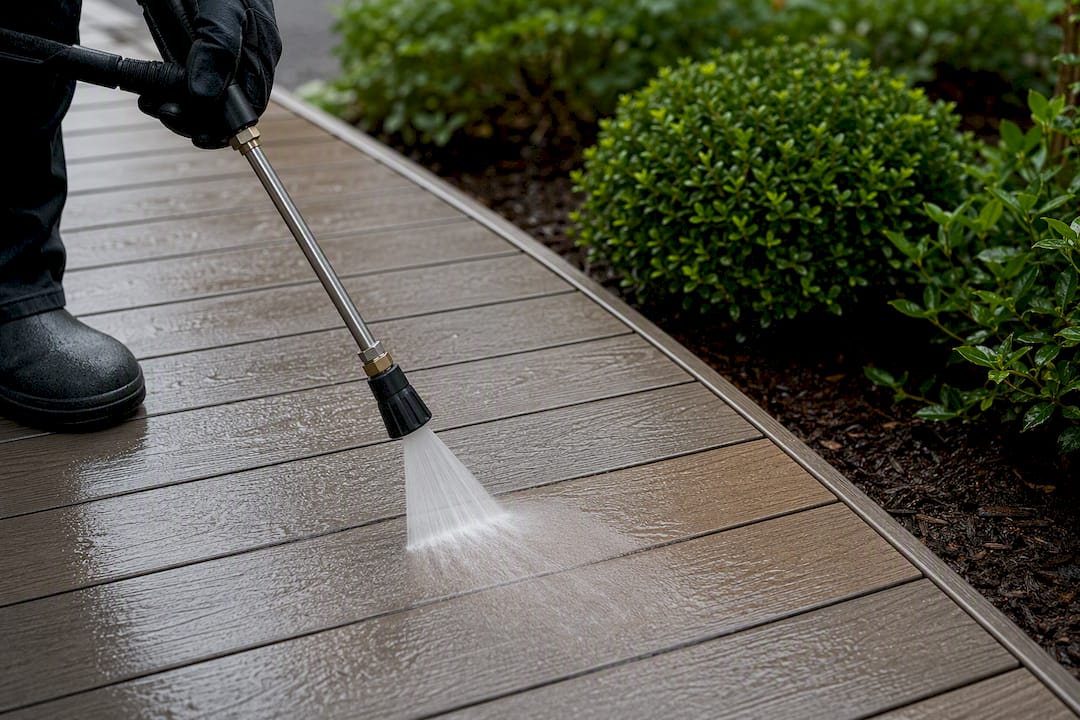
Pressure washing works best as a rinse tool after chemical treatment, not as the primary way to remove mildew. Blasting a dirty deck with a washer alone can etch the surface without fully clearing the organic film that’s feeding the mildew in the first place.
The mistakes that cause the most damage:
- Using a turbo or rotary nozzle instead of a fan tip
- Holding the wand closer than 12 inches to “get it cleaner faster”
- Spraying perpendicular to the board grain, which creates visible striping
- Running higher PSI than the manufacturer allows to save time
Pro Tip: If you notice fuzzy white streaks or a slightly rougher texture after washing, that’s early etching. Stop immediately and switch to a lower PSI or a soft-wash approach before the damage spreads across the whole board.
If the deck is large, multi-level, or has years of buildup, a soft-wash approach that relies on low pressure and the right cleaning chemistry, rather than raw force, protects the cap finish far better than a homeowner-grade pressure washer ever will.
How Do You Stop Mildew from Coming Back?
Cleaning solves the immediate problem. Preventing it from returning means changing the conditions mildew needs to grow in the first place, since the same treatment applied to a deck that stays consistently damp only buys temporary relief.
- Sweep weekly during high-pollen and leaf-fall seasons. Pollen and decomposing leaves create the organic film mildew actually feeds on.
- Wash the full deck twice a year, once in spring and again in fall. This catches buildup before it has months to set into the texture.
- Move furniture and planters every few weeks. Anything sitting in one spot too long traps moisture underneath it.
- Clear planter bottoms and board gaps regularly. Shaded corners and blocked gaps hold moisture longer than open sections, making them the first places mildew reappears.
- Trim overhanging tree canopies. Less shade means faster drying after rain.
- Improve drainage and airflow underneath the deck. Standing water beneath the boards keeps humidity high right at the surface where mildew grows.
Winter brings its own moisture risk, especially in regions with freeze-thaw cycles that trap water in seams and fasteners. The same logic that applies to winterizing doors against seasonal moisture applies here: seal up entry points for water before cold weather locks it in place.
When Should You Call a Pro Instead of DIY?
Some decks are worth handling yourself. Others aren’t. If you’ve got a large or multi-level deck, staining that keeps returning after two or three cleaning attempts, or genuine warranty concerns about which chemicals touched the boards, that’s the point to call a soft-wash professional instead of buying a stronger cleaner.
Soft-wash professionals work differently than a homeowner with a rental pressure washer. They apply targeted, biodegradable cleaning solutions at low pressure, protect surrounding plants and hardware before spraying, and control the rinse to avoid pushing water under fasteners or into seams. That combination handles biofilm without the etching risk that comes with high-PSI blasting.
Before hiring anyone, ask for proof of insurance, a clear description of their soft-wash method, and references from recent composite deck jobs. A contractor who can’t explain their approach to vendor vetting clearly, or who pushes straight to high-pressure equipment without asking about your board manufacturer, is a red flag worth walking away from.
— Bobby
Get a Warranty-Friendly Deck Clean Without the Guesswork
You can choose a low-pressure alternative to a rental pressure washer that risks etching your composite caps. Instead of guessing at PSI settings or hoping an oxygen-bleach mix dwells long enough, you get a soft-wash process built around biodegradable cleaners, plant protection, and controlled rinsing from start to finish.

The soft-washing process targets the organic film that feeds mildew without the aggressive force that voids manufacturer warranties on Trex, TimberTech, and similar composite boards. That matters most on large decks, multi-level structures, or boards that have already been cleaned a few times with the wrong tools.
If your composite deck has stains that keep coming back no matter what you scrub with, book an estimate and get a soft-wash plan built for your specific board type and layout.
Manufacturer Care Guides Worth Bookmarking
Following your board maker’s own rules protects your warranty and prevents the most common cleaning mistakes.
- Trex’s care and cleaning guide covers soap ratios, brush types, and pressure-wash limits.
- TimberTech’s 5-step cleaning guide lays out a repeatable section-by-section wash routine.
- Testing-based cleaner comparisons show how oxygen bleach performs against chlorine bleach and vinegar.
Sources
- Care Guide: How to Clean Composite Decking
- How to Clean Composite Decking: 5-Step Guide
- How to Clean Composite Decking: Testing-Based Guide (2026)
- Composite Decking Mold, Mildew & Algae: Why It Happens (and How to Keep Your Deck Looking New)
- How to Prevent Mold, Mildew, and Moisture Buildup on Composite Decking – Feelingwood
FAQ
What Should You Not Use on Composite Decking?
Skip chlorine bleach, wire or metal brushes, and turbo pressure-washer nozzles. Chlorine bleach can lighten or damage many composite cap finishes, and metal bristles or aggressive rotary tips scratch the surface permanently.
Will Vinegar Damage Composite Decking?
Vinegar can handle light mildew on some composite boards, but its acidity means several manufacturers warn against regular use since it may affect certain cap coatings over time. Stick to soap and water or oxygen bleach for routine and stubborn cleaning instead.
Can I Use Dawn Dish Soap to Clean My Composite Deck?
Yes. A few drops of mild dish soap like Dawn mixed into a gallon of warm water is a standard first-line cleaner for composite decking, recommended in Trex’s own care guidance. Apply with a soft brush and rinse thoroughly to avoid soap residue buildup.
How Do I Remove Black Mold from My Trex Deck?
Apply an oxygen-bleach solution or a composite-rated cleaner, let it dwell for 10 to 15 minutes, then scrub with a soft nylon brush and rinse completely. For persistent black staining across a large area, a professional soft-wash treatment removes the organic film feeding the mold without risking the cap finish.
How Often Should I Clean My Composite Deck to Prevent Mildew?
Wash the full deck twice a year, in spring and fall, and sweep weekly during heavy pollen or leaf-fall seasons. Shaded corners and areas around planters need extra attention since they hold moisture longer than open sections of the deck.