


Your property’s value is not just a number on Zillow. It directly controls how much you pay in taxes, whether your insurance covers a full rebuild, how much a lender will let you borrow, and what you walk away with at closing. Get it wrong in any one of those areas and the financial hit can be significant.
Here is what to do right now:
- Check your assessed value on your county assessor’s website and compare it to recent comparable sales in your neighborhood.
- Confirm your dwelling coverage (Coverage A) matches your home’s current rebuild cost, not its sale price. Insurers and industry experts recommend reviewing this annually because replacement costs move independently from market prices.
- Document every improvement you have made: permits, contractor receipts, and before-and-after photos.
NOAA’s billion-dollar disasters database shows a clear multi-decadal rise in the frequency and cost of major weather events, which means underinsurance is a growing risk, not a theoretical one. Exterior condition also feeds directly into appraisals and buyer perception, which is why services like professional soft washing from Whitediamondpressurewashing belong in any serious maintenance plan.
Pro Tip: Set a calendar reminder each year to call your insurance agent and your county assessor’s office. Two calls, once a year, can prevent five-figure surprises.
Key Takeaways
Accurate property valuation is the foundation of sound financial decisions for homeowners and investors alike, connecting taxes, insurance coverage, borrowing power, and resale outcomes in ways that reward annual attention.
| Point | Details |
|---|---|
| Assessed value drives your tax bill | Multiply assessed value by your local millage rate to get your annual tax; errors in the record card directly inflate what you owe. |
| Coverage A must match rebuild cost | Review dwelling coverage annually because replacement costs move independently from market prices and can diverge sharply after construction inflation. |
| Appeal windows are short | Most jurisdictions allow only 30 days from the tax notice to file; act immediately if your assessed value looks wrong. |
| Maintenance protects appraised value | Visible deferred maintenance triggers negative condition adjustments in appraisals; professional exterior cleaning is a low-cost preventive measure. |
| Whitediamondpressurewashing | Offers soft washing and low-pressure cleaning in Citrus County to protect curb appeal and support accurate condition assessments at appraisal time. |
Table of Contents
- What do “market value,” “assessed value,” and “replacement cost” actually mean?
- How inaccurate valuation puts your insurance coverage at risk
- How property valuation drives your tax bill
- How appraisers and assessors calculate what your property is worth
- How to check your assessed value, correct errors, and update your coverage
- How property tax appeals work and what evidence actually helps
- Maintenance and curb appeal: what actually moves the needle on perceived value
- Your annual property value checklist
- How property value fluctuations affect refinancing and loan approvals
- Using property valuation in investment decision-making
- What routine maintenance tells you about long-term value
- Protect your property’s value with professional exterior cleaning
- Sources
What do “market value,” “assessed value,” and “replacement cost” actually mean?
These three numbers are often confused, and mixing them up is expensive.
- Market value is what a willing, informed buyer would pay for your property in an arm’s-length transaction today. It is the number that drives your sale price and your listing strategy.
- Assessed value is a government estimate used solely for property tax purposes. Assessed value often differs from market value because of assessment ratios, reassessment cycles, and statutory caps. Many jurisdictions apply an assessment ratio, so a home with a market value in a jurisdiction with a common assessment ratio carries a proportionally lower assessed value.
- Appraised value is a single-property opinion of value ordered by a lender or requested by an owner. A licensed appraiser inspects the property and produces a formal report. This number governs loan approvals and refinancing decisions.
- Replacement cost is what it would cost to rebuild your home’s structure from the ground up at today’s labor and materials prices, excluding land. This is the figure your insurer uses to set dwelling coverage (Coverage A), and it can diverge sharply from market value.
The quick rule: taxes follow assessed value, insurance follows replacement cost, and sale price follows market value. Knowing which number applies to which decision keeps you from making costly assumptions.
How inaccurate valuation puts your insurance coverage at risk
Homeowners insurance prices your dwelling coverage on replacement cost, not on what you paid for the house or what it would sell for today. That distinction matters more than most homeowners realize.
Replacement cost is the primary driver of your insurance premium, and the gap between replacement cost and market value can be substantial. A home in a desirable neighborhood might sell for $600,000 while costing only $350,000 to rebuild, or the reverse in a high-labor market. Residential construction input prices rose sharply in the early 2020s, with one Eye On Housing report noting a 23% year-over-year rise in certain input categories at mid-2021. Older policy limits set before that surge can now understate true rebuild costs by a wide margin.
The risk is real on both ends. Underinsuring leaves you with a large out-of-pocket gap at claim time. Overinsuring inflates your premium every month for coverage you cannot legally collect (insurers pay no more than actual rebuild cost).
NOAA’s data on billion-dollar weather and climate disasters shows these events are becoming more frequent and more costly, which raises the stakes for anyone in a disaster-prone region. A policy that was adequate five years ago may not be today.
Home insurance already accounts for roughly 8.5% of typical monthly housing costs nationally, and in some states it rivals or exceeds property taxes. Getting the coverage level right is not a minor administrative task.
Practical steps to reduce your exposure:
- Request a replacement-cost estimator from your insurer or agent every year.
- Review your Coverage A limit after any renovation, addition, or major system upgrade.
- Ask about guaranteed replacement cost or extended replacement cost endorsements if you are in a high-risk area.
- Document all upgrades with receipts and photos so your insurer can accurately recalculate rebuild cost.
If your insurer’s estimate and an independent estimator diverge by more than that, push for a formal review.*
How property valuation drives your tax bill
Assessors use mass-appraisal models and, in many jurisdictions, an assessment ratio to arrive at the taxable value of your property. That number, multiplied by your local millage rate, produces your annual tax bill.
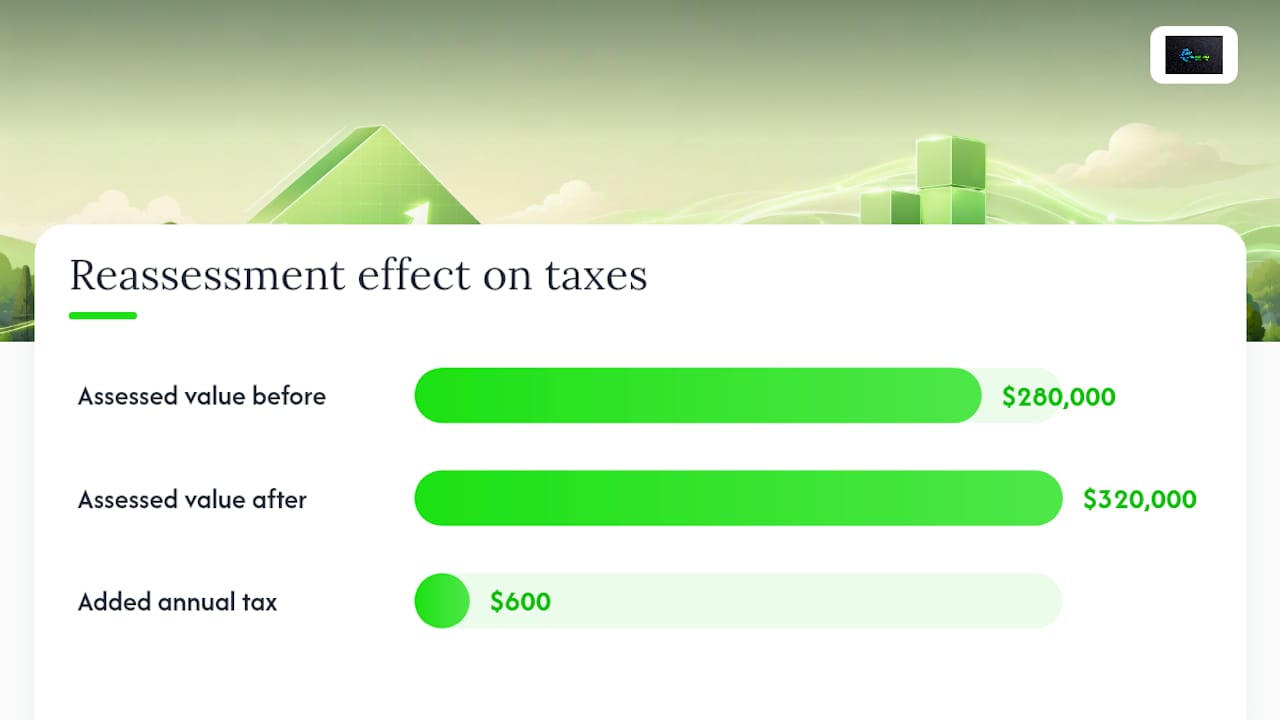
The math in plain terms: If your home’s assessed value is $280,000 and your local millage rate is 15 mills (0.015), your annual property tax is $4,200. A reassessment that bumps assessed value to $320,000 at the same rate adds $600 to your bill with no change in your income or the property itself.
Assessed value often lags market value because many jurisdictions reassess on two- to four-year cycles, and some states cap annual increases by statute. That lag can work in your favor in a rising market, but it can also mean a sudden large jump when reassessment finally catches up.
| Exemption Type | Who Qualifies | Typical Benefit |
|---|---|---|
| Homestead exemption | Primary-residence owners | Reduces assessed value by a fixed amount (varies by state) |
| Senior exemption | Homeowners above a set age | Additional reduction in assessed value or tax bill |
| Senior freeze | Low-to-moderate income seniors | Locks assessed value at a base year to prevent increases |
| Veteran exemption | Qualifying veterans or surviving spouses | Partial or full exemption depending on disability rating |
| Income-based exemption | Low-income homeowners | Reduction or deferral tied to household income |
Most exemptions require an annual or one-time application. Missing the filing deadline means losing the benefit for that tax year, with no retroactive credit in most jurisdictions.
One serious consequence many homeowners overlook: unpaid property taxes create a tax lien that takes priority over a mortgage. Prolonged nonpayment can result in a tax sale. If your tax bill is climbing due to reassessment, applying for every exemption you qualify for is the first line of defense.
How appraisers and assessors calculate what your property is worth
Three standard methods govern most property valuations, and knowing which one applies to your situation helps you spot errors.
Comparable sales (market approach): The appraiser or assessor identifies recent sales of similar properties, adjusts for differences in size, condition, location, and features, and derives a value. This is the dominant method for residential properties and the one most likely to affect your assessed value.
Cost approach: The appraiser estimates what it would cost to replace the structure at current prices, then subtracts depreciation and adds land value. Assessors use this method for newer homes or properties with few comparable sales. It is also the basis for insurance replacement-cost estimates.
Income approach: Used for rental and commercial properties. The formula is straightforward:
Property value = Net Operating Income (NOI) ÷ Capitalization Rate
Example: A rental property generating $24,000 NOI annually in a market where similar properties trade at a 6% cap rate is valued at $400,000 ($24,000 ÷ 0.06).
Mass appraisal (used by county assessors) applies statistical models to large groups of properties simultaneously. A licensed appraiser conducting a single-property appraisal for a lender inspects the specific home and produces a more granular report. Mass appraisal is faster and cheaper but more prone to errors on individual properties, which is why appeals exist.
| Data Point | Why It Matters |
|---|---|
| Square footage | Errors here directly inflate or deflate value |
| Year built and condition | Drives depreciation in the cost approach |
| Recent permitted improvements | Adds to assessed value; missing permits can cause undervaluation |
| Lot size and zoning | Affects highest-and-best-use determination |
| Recent comparable sales | The primary benchmark in the market approach |
How to check your assessed value, correct errors, and update your coverage
Start with your county assessor’s website. Most publish a searchable database where you can pull your property record card, which lists the data the assessor used to calculate your value: square footage, bedroom and bathroom count, year built, outbuildings, and any recorded improvements.
Step-by-step verification checklist:
- Pull your property record card from the county assessor’s portal.
- Compare the listed square footage against your deed, closing statement, or a recent appraisal.
- Check that all permitted improvements (additions, finished basements, new HVAC) are recorded.
- Verify that no outbuildings or features are listed that do not exist on the property.
- Compare your assessed value to recent sales of similar homes in your neighborhood (Zillow, Redfin, or the MLS if you have access).
- If you spot a discrepancy, call the assessor’s office first. Many errors are corrected informally without a formal appeal.
For insurance, contact your agent and request a replacement-cost estimator review. Bring your contractor receipts and permit records for any work done since your last policy renewal.
Who to contact and in what order:
- County assessor’s office for assessed-value errors and exemption applications.
- Insurance agent for Coverage A updates and replacement-cost estimator reviews.
- Licensed appraiser if you need an independent opinion for a sale, refinance, or formal appeal.
Pro Tip: Keep a dedicated folder, physical or digital, with your deed, closing statement, contractor receipts, permit records, and dated photos of every room and the exterior. This single habit saves hours during insurance claims, appeals, and resale negotiations.
How property tax appeals work and what evidence actually helps
The appeals process is layered, and the window to act is short. Most jurisdictions mail tax notices in late summer or fall, and the appeal deadline can be as little as 30 days from the notice date.
The standard appeals sequence:
- Informal review with the assessor. Call or visit the assessor’s office and present your evidence. Many errors, a wrong square footage, a misrecorded bedroom count, a missing exemption, are resolved here without a formal hearing.
- Formal hearing before a local board. If the informal review does not resolve the issue, file a formal appeal with your county’s board of equalization, assessment appeals board, or equivalent body. Submit your evidence packet in advance of the hearing date.
- State-level appeal or court. If the board’s decision is still unfavorable, most states allow a further appeal to a state tax court or circuit court. This step usually involves legal costs and is worth pursuing only for large discrepancies.
Common grounds for a successful appeal:
- Incorrect property data (wrong square footage, extra bathrooms that do not exist, misclassified property type)
- Assessment out of line with recent comparable sales
- Misapplied valuation method (cost approach used where comparable sales exist and produce a lower value)
- Failure to account for property condition, deferred maintenance, or functional obsolescence
Evidence that carries weight at a hearing:
- Printed comparable sales from the past 6–12 months showing lower values for similar properties
- Dated photographs documenting condition issues the assessor may have missed
- A recent independent appraisal (the strongest single piece of evidence)
- Permit records confirming that a listed improvement was never completed
Pro Tip: Request the assessor’s own comparable sales data before your hearing. If their comps are cherry-picked or outdated, pointing that out directly, with your own current comps, is often the most effective argument.
Maintenance and curb appeal: what actually moves the needle on perceived value
Appraisers conducting comparable-sales analyses adjust for condition. A home that shows visible deferred maintenance, stained siding, a dirty roof, cracked concrete, gets a negative condition adjustment that can shave thousands off the appraised value. Buyers make the same judgment in the first 30 seconds of a showing.
High-ROI maintenance items worth prioritizing:
- Soft washing and pressure washing: Removes algae, mold, mildew, and staining from siding, roofs, driveways, and walkways without damaging surfaces. Professional exterior cleaning directly supports curb appeal and perceived value, and the cost is low relative to the impression it creates.
- Roof cleaning: Algae streaking on a roof reads as age and neglect to buyers and appraisers alike. A clean roof looks newer and extends actual shingle life.
- Landscaping and lawn care: Overgrown or dead landscaping signals neglect. Basic trimming and mulching are inexpensive and high-visibility.
- Paint touch-ups: Peeling or faded exterior paint is one of the most common negative condition adjustments in appraisals.
Whitediamondpressurewashing uses low-pressure and soft-wash techniques specifically designed to clean without damaging roofing materials, stucco, siding, or concrete. For investors managing multiple properties, exterior cleaning has a measurable effect on rental and resale returns.
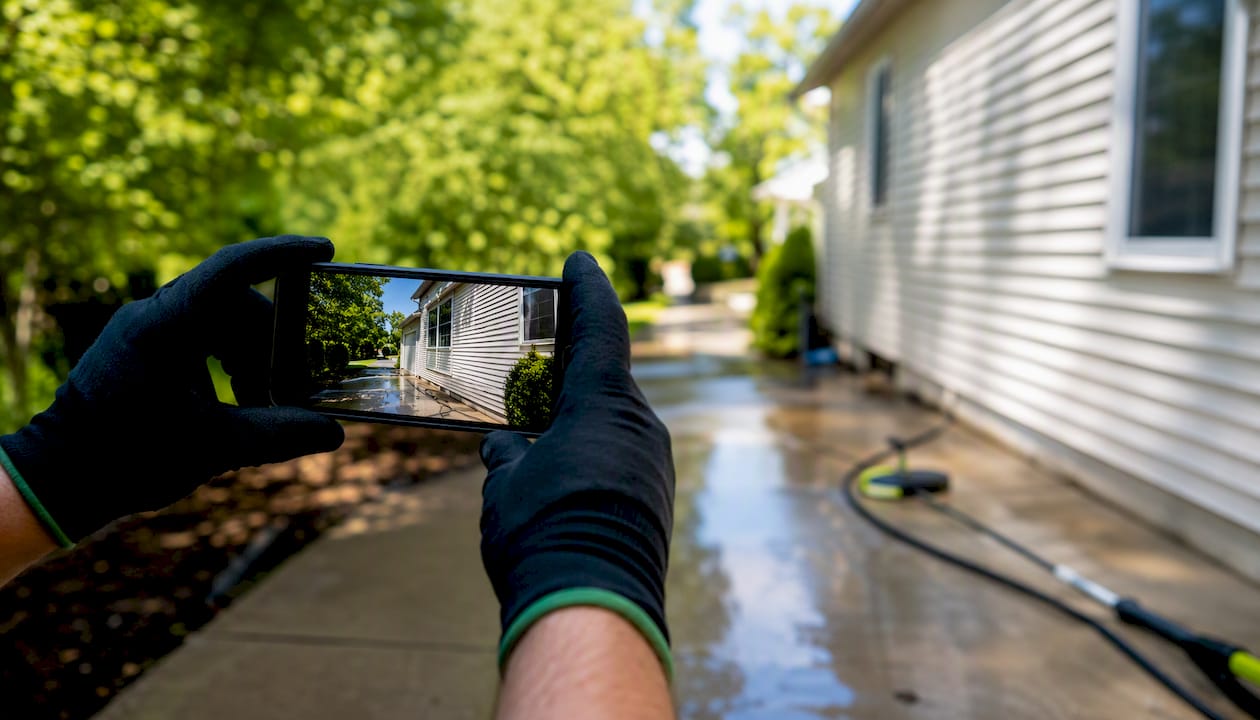
Pro Tip: Photograph your property before and after any cleaning or maintenance work. These dated photos serve double duty: they support your case in an insurance claim and give buyers or appraisers visible proof of upkeep.
Your annual property value checklist
Prioritize these items first:
- Verify your assessed value on the county assessor’s website and flag any data errors immediately.
- Schedule a replacement-cost review with your insurance agent. Confirm Coverage A reflects current rebuild costs.
- Pull your permit history and confirm all improvements are recorded in the assessor’s records.
- Document recent improvements with photos and receipts.
Secondary items to complete within the year:
- Apply for every exemption you qualify for (homestead, senior, veteran) before the filing deadline.
- Schedule professional exterior cleaning if your siding, roof, or driveway shows visible staining or growth. Routine pressure washing is one of the lowest-cost ways to protect curb appeal.
- Get an independent appraisal if you are planning to sell, refinance, or formally appeal your assessment.
Pro Tip: Do the assessor check and the insurance review in the same week each year, right after tax notices arrive. Pairing them means you catch both types of errors while the numbers are fresh.
How property value fluctuations affect refinancing and loan approvals
A lender’s willingness to refinance, and the terms they offer, depends almost entirely on your home’s appraised value at the time of application. The loan-to-value ratio (LTV) is the key metric: divide your outstanding loan balance by the appraised value.
When property values fall, LTV rises. In a declining market, some homeowners find themselves unable to refinance at all because the appraisal comes in below the lender’s minimum threshold.
The reverse is also true. Rising values build equity faster than scheduled mortgage payments do, and that equity is what makes cash-out refinancing possible. Homeowners who tracked their property’s value and maintained their exterior condition were better positioned to access that equity when rates dropped.
Using property valuation in investment decision-making
For investors, the importance of real estate appraisal goes beyond the purchase price. Valuation is the foundation of every return calculation.
Cap rate and purchase price: As shown in the income approach above, a property’s value in an investment context is a function of its net operating income and the prevailing cap rate in that market. Buying a property above its income-justified value means accepting a lower yield from day one.
ROI and forced appreciation: Investors who buy undervalued properties, correct deferred maintenance, and improve curb appeal can force appreciation that outpaces the market. The key is buying at a price where the post-improvement value justifies the acquisition cost plus renovation spend. Accurate valuation at each stage, before purchase, after renovation, and at refinance or sale, is what separates a profitable flip or rental from a break-even one.
Portfolio diversification: Property value and investment strategy are linked at the portfolio level too. Concentrating holdings in a single market or property type exposes a portfolio to correlated risk. Investors who track assessed values, cap rates, and replacement costs across multiple markets can identify where values are stretched and where they remain supported by fundamentals.
Exterior condition as a value lever: For rental properties specifically, exterior cleaning before tenant move-in reduces vacancy time and supports higher asking rents. A clean, well-maintained exterior signals to prospective tenants that the property is managed attentively.
What routine maintenance tells you about long-term value
Most homeowners think about property value at two moments: when they buy and when they sell. The gap between those events is where value is either protected or quietly eroded.
Deferred maintenance compounds. A dirty roof becomes a roof with algae damage. Stained siding becomes siding with moisture intrusion. Each of those conditions shows up as a negative adjustment in an appraisal and as a red flag in a buyer’s inspection report. The cost to prevent them is a fraction of the cost to remediate them.
My recommendation is straightforward: schedule professional exterior cleaning at least once a year, more often in humid or high-pollen climates. For most homes, soft washing is the right method because it removes biological growth without the surface damage that high-pressure equipment can cause on roofing and painted surfaces. When the job calls for more pressure, on concrete driveways and walkways, use a professional who knows the difference and adjusts accordingly.
Protect your property’s value with professional exterior cleaning
Keeping your home’s exterior clean is one of the lowest-cost, highest-visibility ways to protect the value you have built. Stained siding, algae-streaked roofs, and grimy driveways all register as deferred maintenance in appraisals and buyer walkthroughs, and correcting them costs far less than a negative condition adjustment at closing.

Whitediamondpressurewashing specializes in soft washing and low-pressure exterior cleaning for residential and commercial properties in Citrus County and surrounding areas. The approach matters: soft washing removes algae, mold, and mildew at the source without stripping paint, damaging shingles, or etching concrete. It is the method insurers and roofing manufacturers recommend for roof surfaces, and it is what separates a cleaning that lasts from one that just moves dirt around.
Whether you are preparing for a sale, a refinance appraisal, or simply protecting your investment year-round, request a free estimate and see what a clean exterior does for your property’s presentation and long-term condition.
Sources
- How rising property values are affecting home insurance costs — Wawanesa
- Property Tax Assessment: How Assessors Determine Value — LegalClarity
- How Home Insurance Rates Are Calculated: The 11 Factors Insurers Weigh — Real Cost Report
- What is a property tax assessment? — Opendoor
This article is general information, not a substitute for advice from a qualified financial advisor. Consult a qualified financial professional about your own circumstances before acting on anything here.