

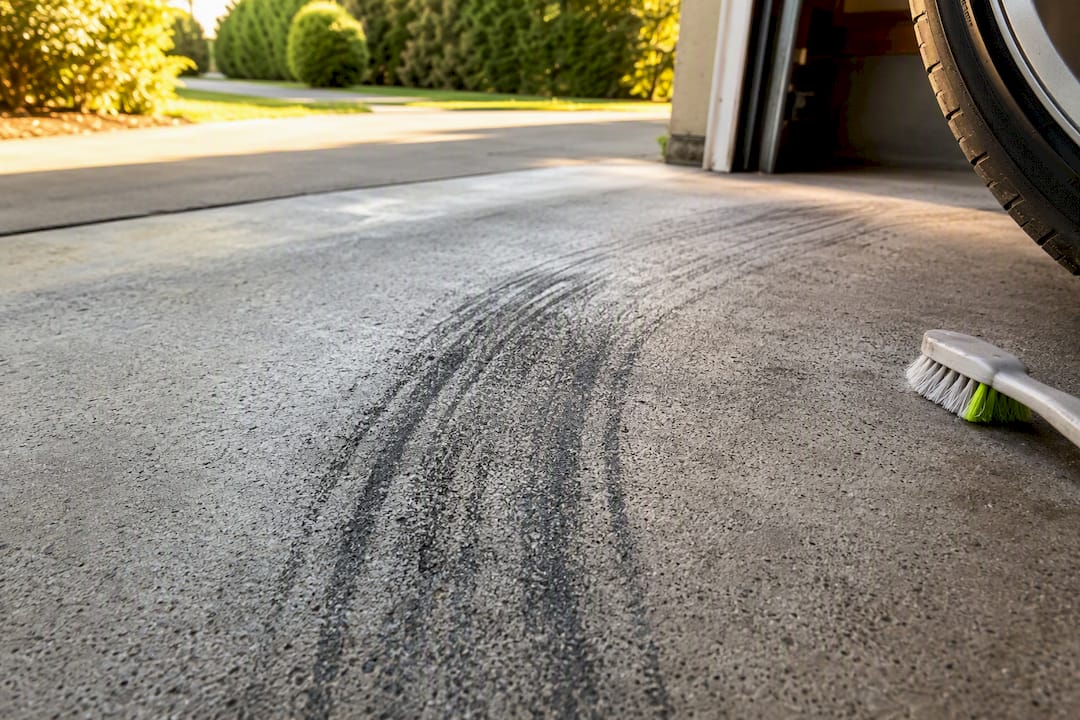
Most tire marks on concrete come off with a concrete-safe degreaser, a stiff brush, and a thorough rinse. That handles the majority of cases within one or two cleaning cycles. If marks persist after repeated attempts, or the sealer looks tacky or lifted, you’re likely dealing with coating damage that needs a professional clean and reseal. When you’re not sure which situation you’re facing, test a small, hidden section with a mild cleaner before reaching for anything stronger.
TL;DR:
- Repeated cleaning with degreasers, brushes, and rinses can often remove tire marks, but embedded rubber may require multiple cycles or professional tools.
- Sealers with poor adhesion or overapplication increase the risk of permanent tire impressions, especially if vehicles drive on them before full curing.
- Using penetrating sealers or basic acrylic coatings offers limited resistance to hot-tire pickup, whereas polyaspartic coatings are marketed as more resistant, though outcomes vary.
- Applying thin, even coats and waiting 48 to 72 hours for curing before parking prevent most tire mark issues; sealing over existing stains makes removal more difficult.
Table of Contents
- How to Remove Tire Marks From a Concrete Driveway
- Why Won’t Some Tire Marks Come Off?
- Preventing Tire Marks: Sealers, Coatings, and Parking Habits
- What Tools and Cleaners Should You Use Safely?
- A Pro’s Take on the Mistakes That Make Tire Marks Worse
- Let White Diamond Pressure Washing Handle the Stubborn Marks
- Sources
How to Remove Tire Marks From a Concrete Driveway
Work from gentlest to strongest. Jumping straight to aggressive chemicals or high pressure is how homeowners end up with etched concrete or a stripped sealer, which turns a five-minute chore into a much bigger project.
- Prep the surface. Sweep away loose gravel, leaves, and grit. Cover nearby plants with plastic sheeting if you’re using any chemical cleaner, since runoff can scorch grass and flower beds.
- Apply a degreaser or citrus-based cleaner. Spread it evenly over the marked area. A practical removal workflow starts with a concrete degreaser or citrus cleaner applied directly to the stain.
- Let it dwell. Give the product 5 to 10 minutes to break down the rubber and grime. Reapply if the surface dries out before you scrub, especially on hot afternoons.
- Scrub with a stiff-bristle brush. Use a push-pull motion rather than circles, which tend to just smear the residue around. Stick to nylon or polypropylene bristles. Metal bristles can scratch bare concrete and shred a sealed surface. Rotate to a clean section of the brush once it loads up with black residue.
- Rinse thoroughly. A garden hose works for light marks. For anything stubborn, step up to a pressure washer at 1,500 to 3,000 psi with a 15 or 25 degree nozzle, held 12 to 18 inches from the surface and kept moving at all times.
- Repeat before escalating. Run the cycle two or three times before reaching for stronger tools. Automotive brake cleaner works well on small, isolated spots. A baking soda paste (roughly three parts baking soda to one part water) handles lighter marks without the fumes.
Pro Tip: Test any new cleaner on a two-foot patch first, especially on colored or stamped concrete. Some citrus degreasers can lighten dye or leave a faint halo on decorative finishes.
Rubber and plasticizer compounds get pressed into the pores of the concrete itself, which is why a single pass with a hose rarely finishes the job on marks that have been baking in the sun for weeks.
Why Won’t Some Tire Marks Come Off?
Surface grime lifts easily and usually responds to the first or second cleaning pass. Embedded rubber sits deeper and needs more dwell time plus repeated scrubbing. Sealer delamination is a different problem entirely, and no amount of degreaser fixes it.
Watch for these signs that you’re past the DIY stage:
- The stain looks the same after three or more full cleaning cycles.
- The sealer feels tacky, soft, or peels up at the edges when scratched with a fingernail.
- Discoloration shows up in multiple spots where cars regularly park, not just one isolated patch.
Professional cleaning typically involves commercial-grade degreasers, hot-water pressure washing, and, when the coating has failed, stripping and recoating the surface. A full clean-and-reseal project generally runs a few days once you account for stripping, cure time, and reapplication, and costs vary based on square footage and how much coating removal is involved.
Preventing Tire Marks: Sealers, Coatings, and Parking Habits
A good sealer keeps rubber sitting on top of the concrete instead of soaking into it. Bare concrete is porous, and once rubber and plasticizers migrate into those pores, no amount of scrubbing pulls them all back out.
Not every sealer performs the same under a hot tire:
- Penetrating sealers protect against moisture and staining but offer limited resistance to hot-tire pickup.
- Acrylic sealers are affordable and easy to apply, though some formulations soften enough in summer heat to pick up tire prints.
- Epoxy coatings hold up well to daily wear but can be more prone to hot-tire marking than newer alternatives.
- Polyaspartic coatings are often marketed as more resistant to hot-tire pickup than basic acrylics, though results still depend on correct installation.
Coating adhesion, not heat alone, is usually the real culprit. Hot-tire pickup happens when tire heat combines with weak sealer adhesion and plasticizer migration, letting rubber compounds bond directly to the coating rather than simply resting on it.
Application matters as much as the product you pick. Overapplying sealer or driving on it before it cures fully is one of the most common causes of permanent tire imprints, so plan on thin, even coats and a 48 to 72 hour cure window before any vehicle touches the surface. Clean off existing marks before you reseal. Sealing over a stain traps it permanently and makes it far harder to remove later.
Simple habits help too: let tires cool before parking on a freshly cleaned driveway, avoid sharp power-steering turns that grind rubber into the surface, and check our driveway maintenance checklist for a general resealing schedule. Our complete guide to driveway sealing covers coating selection in more depth if you’re weighing options.
What Tools and Cleaners Should You Use Safely?
Stick to concrete-labeled degreasers or citrus cleaners for most jobs, and skip harsh acids unless you’re dealing with a professional-grade situation. A baking soda paste or diluted vinegar handles lighter marks without the risk of etching a sealed surface.
- Keep pressure washers in the 1,500 to 3,000 psi range for concrete, and never park the nozzle in one spot.
- Wear gloves and eye protection any time you’re mixing or applying degreasers.
- Dilute chemical runoff before it reaches storm drains or garden beds.
Pro Tip: If you’re unsure whether your pressure washer settings are safe for a sealed or decorative driveway, read up on how pressure washing can affect concrete before you start.
A Pro’s Take on the Mistakes That Make Tire Marks Worse
The three errors we see most: parking on a driveway before the sealer has fully cured, piling on too many coats thinking it adds protection, and holding a pressure washer wand too close for too long in one spot. Low-pressure, material-aware cleaning preserves decorative coatings that high-pressure blasting destroys in seconds. Test a small patch first, and never park a car until the sealer has cured completely.
— Bobby
Let White Diamond Pressure Washing Handle the Stubborn Marks
When a driveway has gone past what a brush and degreaser can fix, hiring a professional exterior cleaning service is the alternative to guesswork and repeat trips to the hardware store. We inspect the surface first to tell you honestly whether you’re looking at surface grime, embedded rubber, or a failed coating, then apply the fix that actually matches the problem instead of throwing high pressure at everything.

Professional cleaning approaches often lean on low-pressure, soft-wash techniques that lift stains without etching concrete or damaging decorative finishes, and handle stripping old, failed coatings before applying durable coating systems built to resist hot-tire pickup. That combination matters if your driveway has been resealed once already and picked up marks anyway. Browse available driveway and concrete services to see what’s included, or request a free estimate to get a personalized assessment before any recommendations.
Sources
- What causes hot tire pickup? — Concrete Decor
- How To Get Tire Marks off Concrete (+ Prevention Tips) — SUNDEK
- How to Prevent Tire Marks on My Driveway — Black Diamond Coatings
- How to Remove Tire Marks From Concrete — 317 Seal