

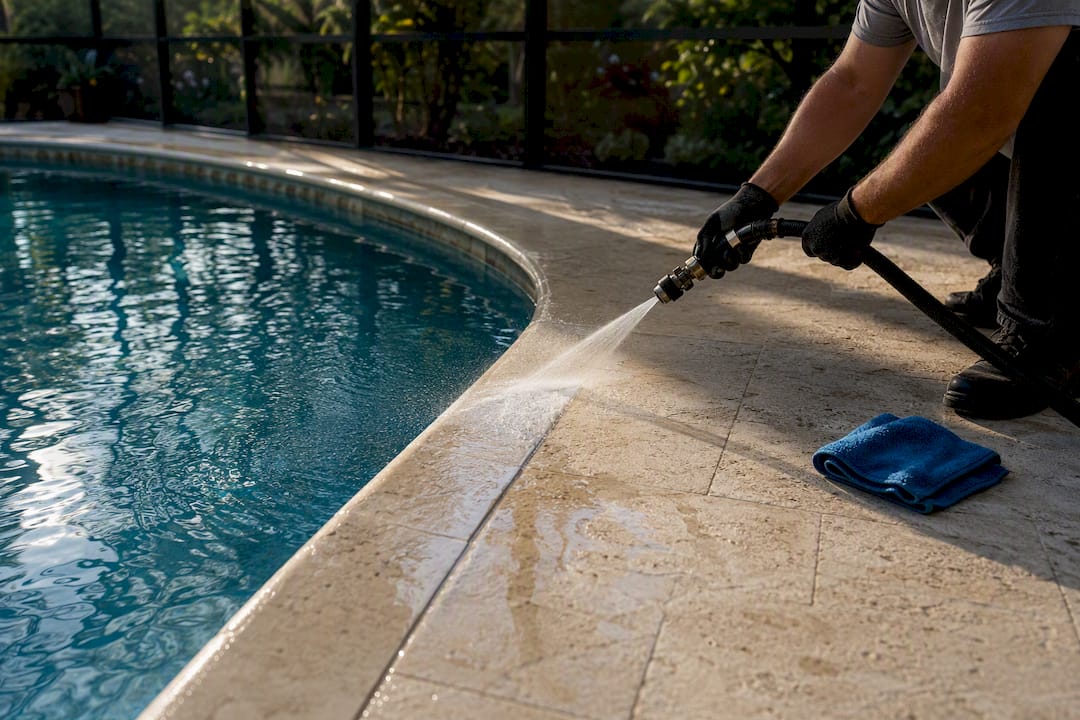
The right move for a stained, slippery, or algae-streaked pool deck is to hire a professional who uses calibrated low-pressure or soft-wash equipment paired with an EPA-acceptable biocide, not a rental pressure washer turned up to full blast. Done correctly, this removes algae, mold, and biofilm, cuts slip risk, and restores the deck’s appearance without etching stone or blasting out paver joints. Expect pricing tied to square footage and material condition, plus a maintenance rhythm of about once or twice a year depending on shade and exposure.
TL;DR:
- Proper cleaning requires calibrated low-pressure equipment and biocide application, not rental pressure washers used at high pressure, to avoid damage.
- Florida’s climate accelerates algae, mold, and stain buildup on porous or natural stone surfaces, necessitating more frequent professional cleaning and sealing.
- A comprehensive process includes surface assessment, biocide dwell time, material-specific low-pressure cleaning, protection of surroundings, and joint sand top-off.
- Costs vary mainly with material, condition, and access, with natural stone and heavily stained decks costing more to clean and restore.
- Homeowners should prioritize PSI clarification and material experience when selecting a contractor to prevent surface damage and ensure effective cleaning.
Table of Contents
- What Kind of Pool Deck Do You Have, and What Is Florida Doing to It?
- What Does a Professional Pool Deck Cleaning Process Actually Look Like?
- How Much Does Pool Deck Cleaning Cost in Florida?
- How Do You Pick the Right Pool Deck Cleaning Company?
- How Often Should You Clean and Seal a Pool Deck in Florida?
- Where This Guide’s Advice Comes From
- Why Vetting Matters More Than the Clean Itself
- Get a Free Estimate for Your Pool Deck
- Sources
- FAQ
What Kind of Pool Deck Do You Have, and What Is Florida Doing to It?
Before you call anyone, know what you’re standing on. Florida’s mix of humidity, heavy rain, and relentless UV treats every deck material differently, and misidentifying yours is the fastest way to approve the wrong cleaning method.
- Broom-finish concrete develops a rough, slightly porous surface that grabs algae and mildew fast. It also shows tannin stains from oak leaves and rust streaks from irrigation.
- Stamped or cool-deck coatings wear thin over time. UV breaks down the topcoat, and once it peels, cleaning alone won’t fix the exposed concrete underneath.
- Concrete pavers are durable but rely on jointing sand to stay locked in place. Rain and pressure washing both wash that sand out over time, which is a well-documented failure mode according to the Interlocking Concrete Pavement Institute.
- Travertine and other natural stone is calcium-based, meaning it etches under high PSI or acidic cleaners. Efflorescence, that chalky white haze, is common and needs the right chemistry, not just water pressure.
- Brick holds moisture in its pores, encouraging deeper mildew growth than sealed surfaces.
- Composite decking resists rot but can trap algae film in its grain pattern, especially in shaded areas.
Some damage is beyond what cleaning can fix. If you see peeling coating, deep etching on stone, or efflorescence that returns within weeks of cleaning, you’re likely looking at a resurfacing or repair job, not a maintenance clean.
What Does a Professional Pool Deck Cleaning Process Actually Look Like?
A legitimate job follows a sequence, and skipping steps is usually where DIY attempts and bargain-bin contractors go wrong.
- Assessment and documentation. A technician should walk the deck, photograph problem areas, and note the material before touching a hose. This is also where PSI limits get set, since travertine and stamped concrete tolerate far less pressure than broom-finish concrete.
- Pre-treatment with a biocide. An EPA-acceptable biocide or pH-balanced cleaner gets applied and given dwell time, often 10 to 20 minutes, to kill algae and mold at the root rather than just knocking loose the visible growth. Field guidance on black spot removal confirms this dwell-then-rinse sequence is what actually eliminates recurring algae and mold on pool patios instead of temporarily lightening it.
- Calibrated cleaning matched to material. Soft washing (low pressure, wider fan tip) handles travertine and natural stone. Concrete and pavers can typically take a bit more pressure, but a skilled operator still adjusts PSI and uses flat-surface cleaners with agitation on stubborn spots rather than a single pressure wand held inches from the surface.
- Protection and runoff control. Pool water gets covered or diverted, plants get rinsed or shielded, and screen enclosures are protected from overspray. Chemical runoff should be directed away from the pool and landscaping wherever possible.
- Rinse, joint sand, and optional sealing. A full rinse removes residue, and paver joints that lost sand during cleaning get topped off, often with polymeric sand for better lock-in. Sealing is offered at this stage if the deck is due.
Pro Tip: Ask whether the crew brings a Safety Data Sheet for whatever biocide they’re using. A company that can hand you an MSDS on request is one that actually knows its chemistry, not just its hose pressure.
Reputable providers also mention what happens if algae reappears in the following weeks, since that’s often a sign of drainage or shade issues rather than a bad cleaning job.
How Much Does Pool Deck Cleaning Cost in Florida?
Pricing scales with square footage, but material and condition swing the number more than most homeowners expect. A small screened lanai deck sits at the low end of most quotes, while a large, heavily stained paver deck with joint sand loss and algae buildup climbs toward the top. Waterfront or resort-style decks with multiple levels, steps, or extensive travertine push costs higher still because of the slower, lower-pressure technique required.
Several factors move the number beyond raw square footage:
- Material. Natural stone and stamped coatings take longer to clean safely than broom-finish concrete.
- Condition. Heavy biological staining, years of neglect, or embedded algae require longer dwell times and sometimes a second pass.
- Access. Decks behind locked gates, through narrow side yards, or requiring hose runs of 100 feet or more add labor time.
- Add-ons. Sealing, polymeric sand replacement, and rust or tannin stain treatment are usually priced separately from the base clean.
Before you accept a quote, check that it spells out what’s included. A detailed cost breakdown should list protection measures, chemical treatment, water disposal, and whether joint sand top-off is bundled or extra. If a quote is dramatically cheaper than others you’ve collected, ask why. The usual answer is that the crew skips pre-treatment, protection setup, and disclosure of what chemicals they’re spraying near your pool water, all of which show up later as recurring algae or a stripped sealer.
How Do You Pick the Right Pool Deck Cleaning Company?
Comparing quotes on price alone is how homeowners end up with etched travertine or a paver deck that looks worse after “cleaning” than before it. A short vetting process filters out most of the risk.
- Confirm insurance and experience with your exact material. Ask directly: “Have you cleaned travertine or stamped concrete before, and can you show photos?” A company with real experience won’t hesitate.
- Ask the PSI question. “What PSI will you use on my surface?” A confident, specific answer (not “we always use high pressure for a deep clean”) tells you they actually calibrate by material.
- Ask about chemistry. “Which product will you apply, and is it safe near my pool water?” You want a named product or product category, not a vague “our special solution.”
- Ask about protection. “How will you protect the pool, my landscaping, and the screen enclosure?” Covering the pool and rinsing nearby plants should be standard, not an upsell.
- Ask about sealing. “Is sealing included or optional, and which sealer would you use?” This tells you whether they’re thinking about long-term protection or just today’s job.
Pro Tip: Ask to see before-and-after photos from a job on the same material as yours, not just a generic driveway. Travertine and stamped concrete photograph very differently from broom-finish, and a company that only shows concrete may not have real stone experience.
Red flags are usually easy to spot once you know to look. Walk away from anyone who promises “high pressure for a deeper clean” as a selling point, refuses to discuss pool or plant protection, can’t produce proof of insurance, or won’t itemize the quote in writing.
How Often Should You Clean and Seal a Pool Deck in Florida?
Florida’s climate doesn’t give decks a break the way cooler states do. Year-round humidity, near-constant UV exposure, heavy rain, and salt air in coastal areas combine to accelerate algae regrowth and sealer breakdown faster than almost anywhere else in the country, according to industry analysis on how Florida’s climate affects pavers and hardscaping.
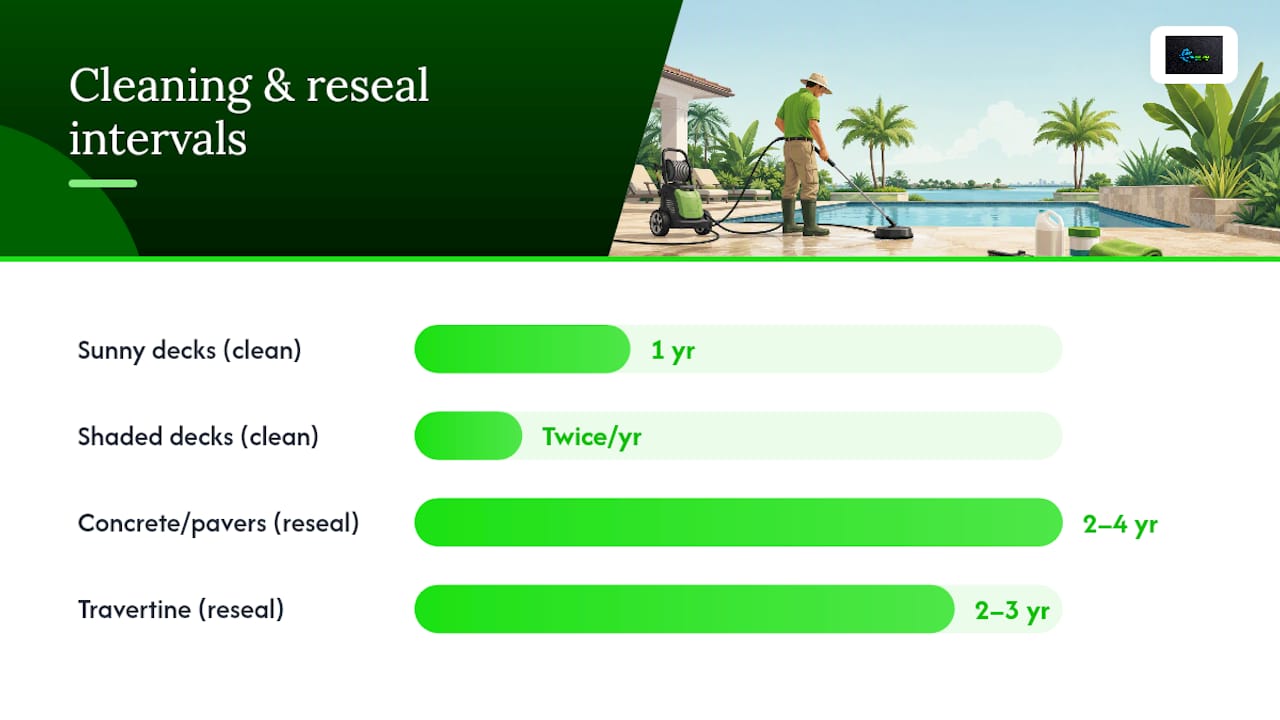
- Sunny, unshaded decks: a professional cleaning once a year usually keeps algae and staining under control.
- Shaded or screened-in decks: twice yearly is often necessary, since trapped moisture behind a lanai enclosure lets algae recur faster than on open decks, per local Florida provider guidance.
- Concrete and pavers: reseal roughly every 2 to 4 years depending on porosity, sun exposure, and foot traffic.
- Travertine: typically needs resealing every 2 to 3 years since it’s more porous and prone to staining without a fresh sealer coat.
Penetrating sealers soak into the material and preserve a natural look, while film-forming sealers sit on top and add sheen but wear faster under UV. Many sealers marketed for Florida include anti-microbial additives, which meaningfully cut down regrowth when paired with regular cleaning and joint-sand upkeep.
Between professional visits, a few habits go a long way: sweep debris before it decomposes into organic stain, keep gutters and drainage clear so water doesn’t pool on the deck, trim back overhanging branches that hold shade and moisture, and rinse off sunscreen and pool chemicals rather than letting them dry into the surface. Skip vinegar or other acidic homemade cleaners on stone; instead, choose a pH‑neutral cleaner safe for delicate surfaces. If you notice pitting, coating that flakes off in sheets, or cracks widening between pavers, that’s a call for restoration, not another cleaning appointment.
Where This Guide’s Advice Comes From
This guide draws on Whitediamondpressurewashing’s real-world work in Citrus County and the surrounding region, where soft washing and low-pressure techniques are used specifically to protect stone, coatings, and pavers while removing algae and mold. The company’s pool cage and lanai cleaning services and customer reviews reflect the same material-first approach described above. For deeper detail, see the maintenance best-practices guide and the pool deck cost breakdown. This article does not include first-hand case studies or lab-tested comparisons. It’s built from documented industry standards and publicly available provider guidance, cross-checked for the Florida market specifically.
Why Vetting Matters More Than the Clean Itself
Most guides on this topic focus on the wash: PSI numbers, chemical names, rinse technique. That’s necessary information, but it’s not where homeowners actually get burned. They get burned by hiring based on price alone and skipping the five minutes of questions that would have exposed a crew planning to blast their travertine at driveway-grade pressure.
The conventional advice treats “pressure washing” as one service. It isn’t. Cleaning a broom-finish concrete deck and cleaning a travertine deck require different pressure, different chemistry, and different judgment, and a company that doesn’t distinguish between them in their sales pitch probably won’t distinguish between them with a wand in hand either.
If you take one thing from this guide, make it the PSI question. Ask it before you ask about price. Everything else, the sealing schedule, the protection protocol, the joint sand top-off, follows naturally once you’re talking to someone who actually knows what surface they’re standing on.
— Bobby
Get a Free Estimate for Your Pool Deck
A professional service gives homeowners a straightforward alternative to guessing at PSI settings or hiring a rental-equipment crew: a technician who assesses your specific material before quoting a price, not after.
Booking starts with a free estimate, which includes an on-site surface assessment and a written quote that spells out what’s covered, from pool and landscape protection to any recommended sealing. Pool deck cleaning pairs naturally with lanai and pool cage cleaning, since both areas face the same algae and humidity pressure in Florida’s climate. If your deck is overdue, book your estimate and get a technician’s read on your surface before the next rainy season pushes the problem further.
Sources
This guide draws on the EPA’s mold guidance for safe biological cleanup, the National Floor Safety Institute for slip-hazard standards, the Interlocking Concrete Pavement Institute for paver joint-sand care, and Florida-specific provider data from Alliance Pavers and Residential Concrete on climate-driven sealing cadence.
- Interlocking Concrete Pavement Institute (ICPI)
- Alliance Pavers — How Florida climate affects your pavers and hardscaping
- Residential Concrete — Why Florida pool decks need professional cleaning
FAQ
What Is the Average Cost to Pressure Wash a Pool Deck?
Cost depends mainly on square footage, material, and condition, with natural stone and heavily stained decks costing more than a straightforward broom-finish concrete clean. For a breakdown by deck size and material, see Whitediamondpressurewashing’s cost guide; current pricing is listed there rather than as a flat rate.
How Much Does It Cost to Have a Pool Cleaned in Florida?
Pool water cleaning (chemical balancing, skimming, filter care) is a separate service from pool deck cleaning, which addresses the surrounding concrete, pavers, or stone. Deck cleaning costs scale with the surface’s square footage and condition rather than pool volume.
What Do I Need to Start a Pool Cleaning Business in Florida?
That question typically covers pool water service, which involves different licensing, chemical certification, and equipment than pool deck cleaning. Deck cleaning businesses generally need general liability insurance, pressure washing equipment calibrated for multiple PSI levels, and EPA-acceptable biocide products, but exact licensing requirements should be confirmed with Florida’s state and local business authorities.
What Is the Best Material for a Pool Deck in Florida?
There’s no single best material. Broom-finish concrete is affordable and durable, pavers offer repairability since individual pieces can be replaced, and travertine stays cooler underfoot in direct sun but needs gentler cleaning and more frequent sealing. The right choice depends on budget, sun exposure, and how much maintenance you want to commit to.
How Often Should a Florida Pool Deck Be Professionally Cleaned?
Most sunny, unshaded decks need a professional cleaning about once a year, while shaded or screened-in decks often need it twice a year because trapped moisture speeds up algae regrowth. Sealing runs on a longer cycle, typically every 2 to 4 years for concrete and pavers and every 2 to 3 years for travertine.