

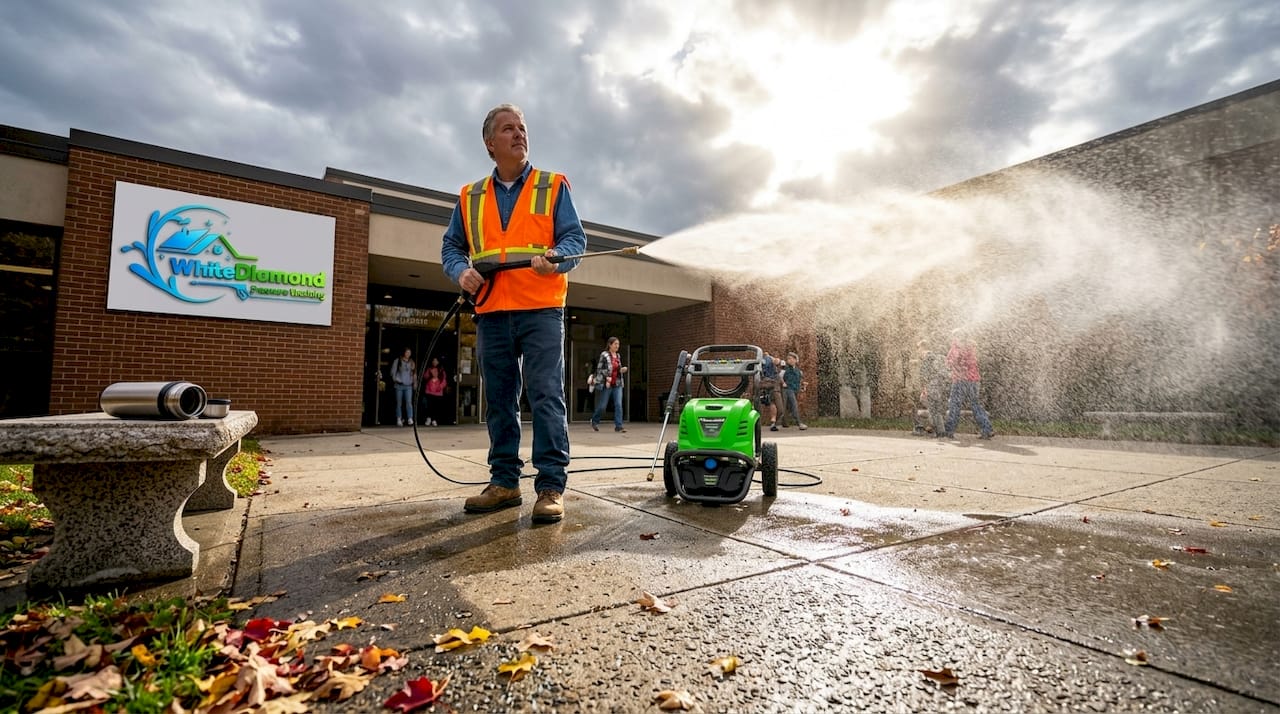
TL;DR:
- Weather significantly impacts exterior cleaning by affecting chemical reactions, drying times, and outcomes. Understanding conditions like temperature, humidity, wind, and rain helps schedule cleaning for optimal, long-lasting results. Proper planning around weather prevents costly reapplications and ensures surfaces are thoroughly cleaned.
Most homeowners schedule exterior cleaning based on convenience, not conditions. That’s a mistake. The role of weather in surface cleaning is far more significant than most people realize, and ignoring it costs time, money, and results. Temperature, humidity, wind, and sunlight don’t just affect your comfort while cleaning outdoors. They directly change how well your cleaning chemicals work, how long they stay active on a surface, and whether the job actually gets done right. Here’s what you need to know to stop guessing and start cleaning smarter.
Table of Contents
- Key takeaways
- How weather shapes your cleaning chemicals
- Humidity and rain effects on cleaning outcomes
- Wind and sunlight: the underrated disruptors
- Planning your cleaning schedule around weather
- Common mistakes that weather exposes
- My take on weather-aware cleaning
- Let Whitediamondpressurewashing handle the timing for you
- FAQ
Key takeaways
| Point | Details |
|---|---|
| Temperature changes chemical speed | Cold slows cleaning reactions and may require 20–50% longer dwell time to match warm-weather results. |
| Rain timing ruins results | Cleaning within 24–48 hours of rain risks diluting active ingredients and forces costly reapplication. |
| Surface temp beats air temp | Direct sunlight can make surfaces far hotter than the air, causing chemicals to evaporate before they finish working. |
| Wind wastes product | Wind disperses spray and accelerates drying, creating uneven results and chemical waste. |
| Schedule around forecasts | Mild, dry, low-wind days consistently produce the most durable and thorough cleaning outcomes. |
How weather shapes your cleaning chemicals
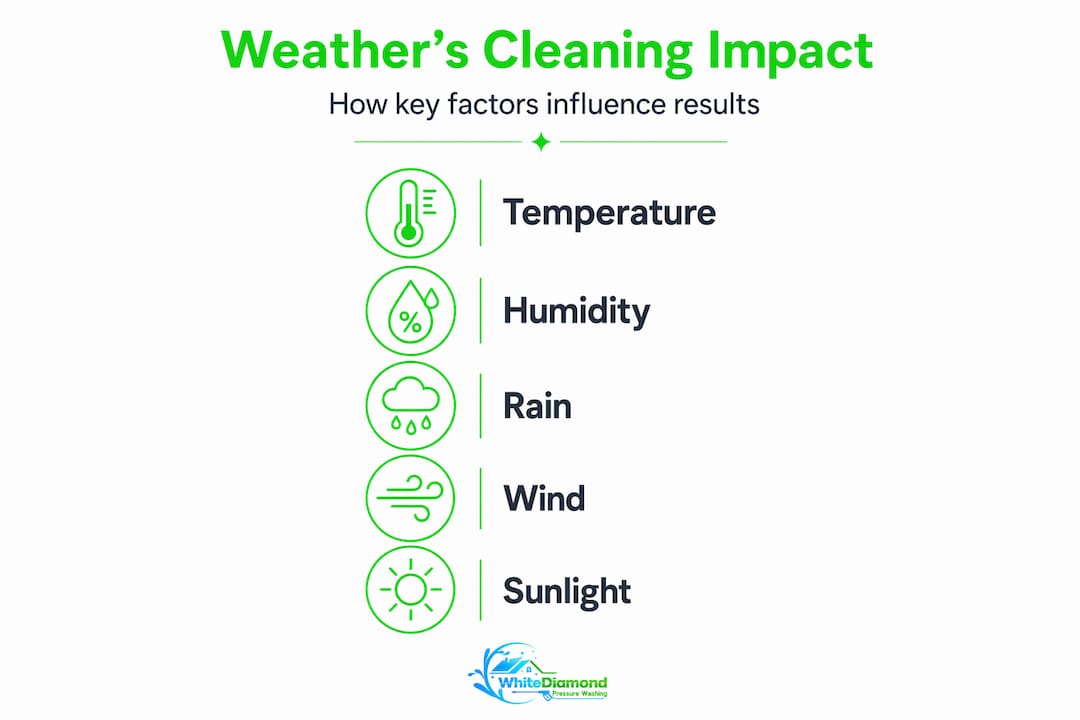
Weather is not a backdrop to surface cleaning. It is an active participant. Weather affects cleaning performance through temperature, humidity, sunlight, wind, and rainfall, all of which alter reaction rates and evaporation speed. When you understand this, you stop wondering why a freshly cleaned driveway looks patchy or why algae came back six weeks after treatment.
Temperature and chemical reaction rates
Every cleaning product has an ideal operating range. Warm surfaces speed up the chemical reactions that break down grease, algae, and biofilm. Cold surfaces slow everything down. Professionals know that cold weather increases dwell time by roughly 20 to 50 percent compared to warm, dry conditions. Below 40°F, many detergents thicken and lose penetrating power altogether.
Hot conditions create the opposite problem. When a concrete driveway sits in direct Florida sun for a few hours, its surface temperature can climb well above the air temperature. Surface temps can exceed air temp by tens of degrees, which causes chemicals to flash-evaporate before they complete the cleaning cycle. The result? Streaks, uneven treatment, and the frustrating need to redo the job.
Here is what temperature does to your cleaning process at each extreme:
- Below 40°F: Cleaning agents thicken or freeze, reducing penetration into porous surfaces like concrete or brick.
- 40°F to 60°F: Reaction rates are slower. Longer dwell times are needed, and rinse water may not effectively flush loosened debris.
- 60°F to 80°F: The sweet spot. Chemicals activate well, dwell times are predictable, and surfaces dry at a manageable rate.
- Above 85°F with direct sun: Rapid evaporation shortens contact time and increases the risk of streaking, especially on vertical surfaces.
Pro Tip: Touch the surface before you apply any chemical. If it feels uncomfortably hot to the hand, wait for shade or a cooler part of the day. Your cleaning products will work better, and you will use less of them.
Humidity and rain effects on cleaning outcomes
Moisture in the air and on the surface fundamentally changes what happens when you apply a cleaning agent. The impact of weather on cleaning is nowhere more obvious than in how humidity and precipitation affect dwell time and chemical potency.
High humidity slows evaporation. That sounds useful, and in some ways it is. Slower drying means cleaning agents stay wet on the surface longer, giving them more time to work. The catch is that extended wetness after cleaning, especially in warm climates, also creates conditions where mold and algae can quickly reestablish. Controlling humidity below 60% RH is critical for preventing mold from returning after a cleaning job. If you clean in high humidity but don’t account for the extended drying period, you may trade one problem for another.
Rain is the most disruptive factor in exterior cleaning. Rain dilutes active ingredients and washes away cleaning agents before they can fully work, which forces reapplication and drives up costs. Cleaning should ideally avoid any rain forecast within 24 to 48 hours. Pre-wet surfaces are also problematic because water already present on the surface dilutes your detergent the moment it makes contact.
| Condition | Effect on cleaning |
|---|---|
| High humidity (above 70%) | Slows drying, extends chemical dwell time, raises mold regrowth risk |
| Low humidity (below 40%) | Accelerates drying, shortens contact time, increases risk of incomplete cleaning |
| Rain within 24 hours | Dilutes chemicals, reduces penetration, likely requires reapplication |
| Wet surface before application | Cuts detergent concentration, weakens cleaning power from the first spray |
| Moderate humidity (40–60%) | Supports stable drying and reliable chemical performance |
Dry conditions create their own challenges. When humidity is very low and temperatures are high, chemicals dry so fast that they never reach the full contact time required for effective treatment. Surfaces can look clean while still harboring active biological growth.
Wind and sunlight: the underrated disruptors
Most homeowners think about rain when they plan an exterior cleaning day. Wind and sun get far less attention, but they are just as capable of ruining a job.
How wind undermines precision
Strong gusts cause spray drift, scattering chemicals away from the intended surface and creating uneven application. Wind also dramatically accelerates evaporation, which cuts dwell time short on the areas that did get treated. You end up wasting product and getting inconsistent results, even if the job looked fine from a distance.
Practical steps to manage wind during cleaning:
- Check the forecast for wind speed. Anything above 10 to 15 mph significantly increases drift and uneven application.
- Work with the wind direction when you can. Apply chemicals downwind from yourself and rinse upwind so you are not chasing product across adjacent surfaces.
- Use lower-pressure application in windy conditions to keep your spray pattern controlled and close to the surface.
How sunlight affects surfaces and chemicals
Direct sunlight heats surfaces unevenly. A north-facing wall stays cool and shaded while the south-facing side can be nearly too hot to touch. Cleaning during cooler, shaded times consistently produces more uniform drying and better chemical activity. Early morning, late afternoon, or fully overcast days are your best options for serious exterior cleaning work.
UV radiation also degrades certain chemical formulations over time, which is another reason to avoid leaving products sitting in direct sun during application. Work in sections, apply fresh product, and rinse before moving on.
Pro Tip: Never apply cleaning chemicals to a sun-baked surface in the middle of a summer afternoon. The chemical reaches the surface already partially evaporated, and the remaining amount has nowhere near the concentration you intended.
Planning your cleaning schedule around weather
Understanding how weather influences cleaning is only useful if you build that knowledge into how you plan and schedule work. A seasonal exterior cleaning checklist is one of the best tools for staying ahead of conditions specific to your local climate.
Here is a step-by-step approach to weather-smart cleaning planning:
-
Check a 5-day forecast before scheduling. Look for a window with mild temperatures (between 60°F and 80°F), no rain within 48 hours post-cleaning, and wind speeds below 10 mph. This single habit eliminates most preventable cleaning failures.
-
Match your chemical concentration to conditions. In colder weather, increase your product concentration slightly to compensate for slower reaction rates. In hot, dry weather, consider working in smaller sections and applying product more frequently to maintain an adequate wet surface.
-
Monitor surface temperature, not just the air. Use an inexpensive infrared thermometer. If a paved surface reads above 100°F, apply chemicals in the shade first and work toward sun-exposed areas. For detailed guidance on material-specific approaches, reviewing safe cleaning by material type helps you avoid compounding weather-related risks with product incompatibility.
-
Avoid cleaning before forecast rain. If rain is expected within 24 hours, reschedule. The investment in chemicals and time will be largely wasted, and you may face the same biological regrowth within weeks.
-
Add mechanical action when conditions are against you. When humidity or temperature limits chemical efficacy, scrubbing combined with fresh wet conditions dramatically improves sanitizer and detergent performance on biofilm-heavy surfaces. Physical agitation compensates for what the chemistry alone cannot achieve in difficult conditions.
-
Build a season-appropriate cleaning calendar. Spring and early fall typically offer the best exterior cleaning conditions in most parts of the country. Winter and peak summer heat are the hardest windows to work in effectively.
Common mistakes that weather exposes
Several persistent misconceptions make cleaning in different weather conditions more frustrating and expensive than it needs to be.
-
Assuming a surface looks clean means it is clean. Fast drying from heat or wind can leave a surface appearing treated when the contact time requirements were never actually met. Biological matter that survived the cleaning cycle will recolonize quickly.
-
Cleaning right before rain as a shortcut. Some homeowners think an incoming rain shower will help rinse the job. It doesn’t. Rain washes away active ingredients before they have time to penetrate and work.
-
Ignoring surface temperature variation. A single property can have surfaces at vastly different temperatures depending on sun exposure, material type, and color. Treating them all identically produces uneven results.
-
Underestimating moisture’s role in regrowth. Wet surfaces that don’t dry properly after cleaning create conditions for rapid algae and mold regrowth. Premature drying or prolonged wetness both lead to faster recontamination if moisture control isn’t part of the cleaning strategy.
Weather changes not only how dirt looks but the entire chemistry timeline. Getting the timing right is what separates a cleaning that lasts from one that needs to be redone in six weeks.
My take on weather-aware cleaning
I’ve been watching homeowners and property managers make the same expensive mistake for years. They pick a cleaning day when they have free time, not when the weather is right. And then they’re puzzled when the results don’t last or when the whole surface looks blotchy a week later.
What I’ve learned from working in exterior cleaning across Florida is that surface temperature and moisture state are the two most underrated variables in the process. Everyone knows not to clean in a downpour. Almost nobody checks whether the concrete they’re about to treat is sitting at 110°F because it’s been baking in afternoon sun since noon.
Weather changes not just dirt appearance but the chemistry timeline of cleaning products, requiring precise timing for the chemistry to actually work. I’ve seen crews do everything technically right, use quality products, and still get patchy results because they started at 2 PM on a hot, sunny August day.
My practical advice is to start treating weather forecasting as part of your cleaning equipment. You wouldn’t show up without your hose. Don’t show up without knowing the surface temperature and the 48-hour precipitation outlook either. That shift in thinking, more than any product upgrade, is what produces results that actually hold.
— Bobby
Let Whitediamondpressurewashing handle the timing for you
Weather-aware exterior cleaning takes more than good intentions. It takes experience knowing when conditions are right, how to adjust chemicals on the fly, and which surfaces need special handling in heat, humidity, or wind.

Whitediamondpressurewashing builds weather awareness into every job. Our team evaluates surface temperature, moisture levels, and local forecast conditions before applying any product to your property. We use soft washing and low-pressure techniques that are specifically suited to variable weather conditions, reducing the risk of premature evaporation and uneven results. Whether you need a driveway, roof, or full exterior cleaned the right way and at the right time, get your free estimate and let us handle the planning.
FAQ
What is the best weather for exterior cleaning?
Mild temperatures between 60°F and 80°F, low humidity, no rain within 48 hours, and wind speeds under 10 mph produce the most consistent results. Early morning or overcast days work especially well.
How does cold weather affect cleaning chemical performance?
Cold temperatures slow chemical reaction rates and can thicken or partially freeze some products. You may need to increase dwell time by 20 to 50 percent compared to warm conditions to achieve the same cleaning result.
Can I clean my driveway before it rains?
No. Rain within 24 to 48 hours after cleaning dilutes active cleaning ingredients before they fully penetrate and work. The job will likely need to be redone, and biological regrowth will return faster.
Why does my cleaned surface look streaky after cleaning in summer?
Direct sunlight heats surfaces well above air temperature, causing chemicals to evaporate before completing their work. Cleaning during cooler or shaded periods and working in smaller sections prevents this.
Does humidity affect how well cleaning chemicals work?
Yes. Very high humidity slows drying and can extend chemical contact time but also increases mold regrowth risk if surfaces stay wet too long. Very low humidity causes chemicals to dry too quickly, cutting contact time short before the cleaning process finishes.
3 thoughts on “The Role of Weather in Surface Cleaning Results”