

TL;DR:
- Proper pressure-washing safety involves strict adherence to sequential phases like inspections, PPE use, and emergency preparedness before operation begins. Hazards such as high-pressure injection injuries and carbon monoxide poisoning pose serious risks, requiring immediate action and proper controls to prevent fatalities. Regular training, documentation, and clear SOPs ensure crew safety and regulatory compliance across commercial and residential pressure-washing jobs.
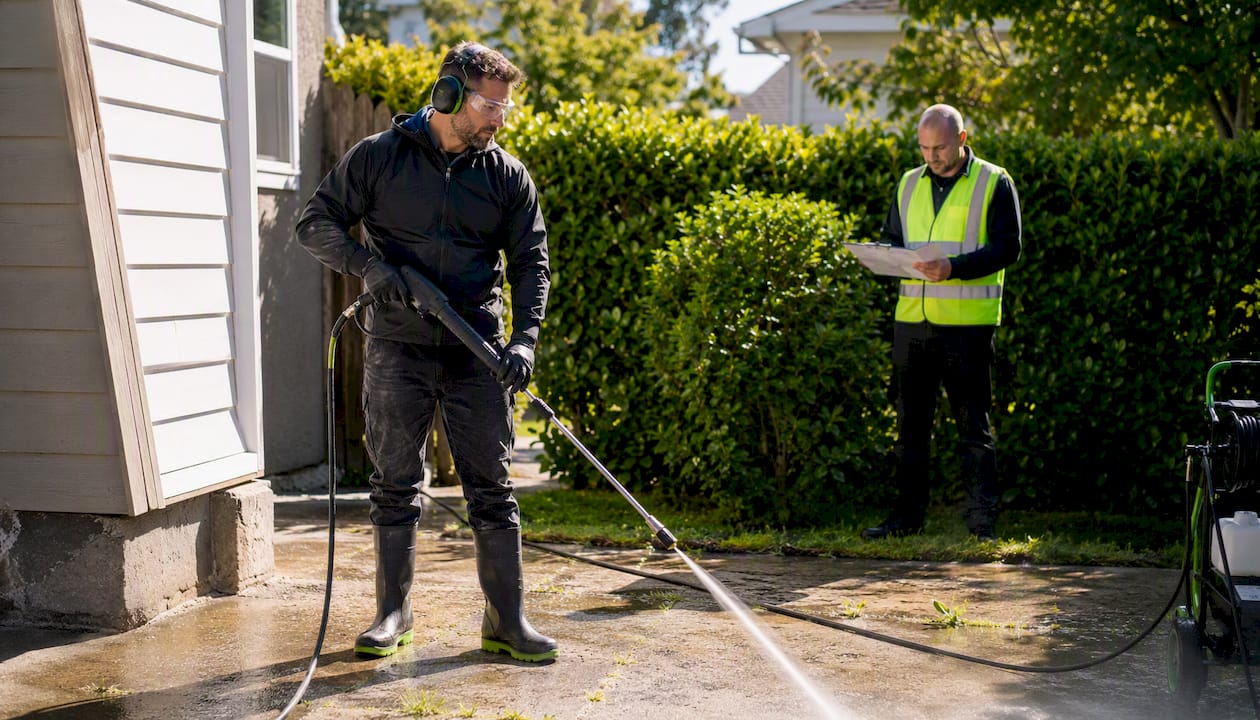
A safe pressure-washing job follows five phases in strict order: pre-operation inspection and exclusion zone setup, PPE and equipment verification, controlled operation with fatigue management, emergency response readiness, and post-job documentation. Before any trigger is pulled, the following must be confirmed:
- CO control: Gas-powered units stay at least 20 feet from any window, door, or air intake. No exceptions, no “just this once.”
- Exclusion zone: Rope off or cone the work area. Bystanders, especially children, cannot be allowed near a running wand.
- SDS on site: Safety Data Sheets for every chemical in use must be physically present, not back at the shop.
- GFCI protection: Electric units require a ground-fault circuit interrupter on every outlet used.
- PPE donned before pressurizing: Eye protection, hearing protection, and gloves go on before the machine starts, not after.
Pro Tip: Never rely on arm strength alone to control wand kickback. Plant your feet shoulder-width apart, keep both hands on the wand, and treat the first 30 seconds after pressurizing as a test run at the lowest effective pressure.
Table of Contents
- What hazards does pressure washing actually put you at risk for?
- Which U.S. regulations apply to a pressure-washing operation?
- What PPE does each pressure-washing task actually require?
- Pre-use equipment and site inspection: what to check before pressurizing
- Step-by-step operating workflow from setup through shutdown
- Why soft washing still carries serious chemical and aerosol risks
- Emergency response: what to do in the first minutes
- How to train crews and document the workflow so it actually sticks
- A printable SOP snippet you can adapt for your crew
- Key Takeaways
- The part of this workflow most crews skip until something goes wrong
- Whitediamondpressurewashing handles the safety workflow so you don’t have to
- Useful sources for your SOP and compliance file
What hazards does pressure washing actually put you at risk for?
The risk map for a pressure-washing job has seven entries, and two of them can kill or permanently disable an operator before anyone realizes something went wrong.
High-pressure injection injuries are the most underestimated hazard on the list. Streams operating between 1,500 and 4,000+ PSI can penetrate skin, muscle, and bone. The entry wound often looks minor, a small puncture, so operators and bystanders dismiss it. That is a fatal mistake: injection injuries require emergency surgery and can cause tissue necrosis within hours. Any skin contact with a live stream is a 911 call, not a bandage situation.
Carbon monoxide poisoning from gasoline-powered units is the other high-severity hazard. CO from small engines can accumulate to fatal concentrations within minutes, even in spaces that appear well-ventilated. NIOSH incident records include fatalities from engines operated in garages and partially open structures. The danger is invisible and odorless, which is exactly why prior successful use indoors creates a false sense of safety.
The remaining hazards are lower severity on average but far more frequent:
- Slips and trips: Wet surfaces, hose runs across walkways, and spray mist on concrete are the leading cause of on-site injuries by volume.
- Electrical shock: Water and electricity in close proximity require GFCI protection and awareness of overhead lines.
- Flying debris: Dislodged material, gravel, paint chips, and biological matter travel at high velocity. Eye and face protection is non-negotiable.
- Chemical exposure and aerosolized contaminants: Cleaning agents, mold spores, lead paint particles, and silica dust become airborne during washing. Respiratory protection requirements depend on what is on the surface being cleaned.
- Musculoskeletal strain: Wand reaction forces and sustained awkward postures cause cumulative injury, particularly in the shoulders and lower back.
Which U.S. regulations apply to a pressure-washing operation?
The regulatory framework for pressure washing in the United States draws from OSHA, NIOSH/CDC, and EPA, and the applicable standards shift depending on the task, the surface, and the chemicals involved. Supervisors building SOPs should cross-reference these directly.
OSHA standards to cite in your SOP:
- 29 CFR 1910.133 — Eye and face protection. Safety glasses alone are insufficient; chemical splash tasks require a full-face shield or chemical splash goggles.
- 29 CFR 1910.95 — Occupational noise exposure. Pressure washers commonly exceed 85 dB(A), which triggers hearing conservation requirements including monitoring and hearing protection.
- 29 CFR 1910.136 — Foot protection. Waterproof, puncture-resistant footwear is required where high-pressure streams or chemical splash are present.
- 29 CFR 1910.138 — Hand protection. Glove selection must be based on the chemical hazards identified in the SDS.
- Fall protection (29 CFR 1926.502 for construction; 1910.28 for general industry): Elevated surface work requires documented fall protection systems when heights exceed the applicable threshold. Roof washing and lift-mounted operations both trigger this requirement.
- Lockout/tagout (29 CFR 1910.147): Applies when servicing or clearing blockages in pressurized systems.
NIOSH/CDC guidance on CO:
Never operate a gasoline-powered pressure washer indoors or within 20 feet of any window, door, or air intake. NIOSH recommends CO monitors when engine placement near structures is unavoidable. Treat any CO alarm as an immediate evacuation trigger, not a warning to investigate.
EPA and wastewater:
NPDES Construction General Permit rules and local pretreatment ordinances control washwater discharge on most commercial and construction sites. Alkaline concrete washwater is frequently prohibited from entering storm drains without treatment. Lead paint or mold remediation washwater may trigger RCRA considerations. Check with your local municipality before any job where runoff could reach a storm drain.
For industry standards alignment, Whitediamondpressurewashing maintains SOPs that map directly to these regulatory checkpoints.
What PPE does each pressure-washing task actually require?
PPE selection is task-specific. The table below maps common pressure-washing tasks to the protection required at each body zone. Use it alongside the SDS for any chemical in use.
| Task | Eye/Face | Respiratory | Hearing | Hands | Body | Feet |
|---|---|---|---|---|---|---|
| Concrete/driveway (cold water, no chemicals) | Safety glasses | None required | Earplugs/earmuffs (NRR 25+) | Nitrile gloves | Work clothing | Waterproof, steel-toe boots |
| House siding (detergent application) | Chemical splash goggles | N95 if misting | Earplugs/earmuffs | Chemical-resistant gloves | Long sleeves/pants | Waterproof boots |
| Roof soft-wash (chemical application) | Full-face shield | P100 half-mask or full-face respirator | Earplugs/earmuffs | Chemical-resistant gloves (elbow length) | Impermeable coveralls | Non-slip, waterproof boots |
| Hot-water scouring (grease/oil) | Full-face shield | N95 minimum | Earplugs/earmuffs | Heat-resistant, chemical-resistant gloves | Long sleeves/pants | Waterproof, insulated boots |
| Lead paint or mold surface | Full-face respirator | P100 or PAPR | Earplugs/earmuffs | Chemical-resistant gloves | Disposable Tyvek suit | Waterproof boots with boot covers |
| Chemical mixing/dilution station | Chemical splash goggles + face shield | P100 half-mask | Not required | Chemical-resistant gloves | Impermeable apron | Chemical-resistant boots |
Respirator selection triggers: An N95 is the floor when aerosolization of cleaning agents is expected. Move to a P100 cartridge half-mask when mold, silica dust, or lead paint is confirmed or suspected. A powered air-purifying respirator (PAPR) is appropriate for extended work on heavily contaminated surfaces or when a worker cannot achieve a proper seal with a half-mask. Respirator fit tests are required under 29 CFR 1910.134 before first use and annually thereafter.
Glove guidance: Always pull the SDS before selecting gloves. Sodium hypochlorite (bleach-based soft-wash solutions) degrades latex quickly; use nitrile or neoprene. Caustic degreasers require thicker neoprene or butyl rubber gloves. “Chemical-resistant” printed on a box is not enough, check the SDS compatibility chart.
Pro Tip: Before every shift, check respirator gasket seals by doing a positive and negative pressure fit check. A cracked gasket on a half-mask provides zero protection. For hearing protection, verify the NRR rating on the packaging matches what you ordered — substitutions happen in supply chains and a lower-NRR plug looks identical.
Pre-use equipment and site inspection: what to check before pressurizing
No job starts until this checklist clears. Use it as a pre-shift sign-off form, with the operator and supervisor both initialing the accept/reject column.
| Item | What to check | Accept criteria | Reject action |
|---|---|---|---|
| High-pressure hose | Cuts, abrasions, bulges, fittings | No visible damage; fittings hand-tight | Replace hose; do not tape |
| Quick-connect couplers | Locking mechanism, O-ring condition | Positive lock; O-ring intact | Replace coupler |
| Trigger gun and safety lock | Lock engages/disengages cleanly | Lock holds under light pressure | Remove from service |
| Unloader valve | Bypasses smoothly at no-load | No chattering or pressure spike | Service before use |
| Pressure relief valve | Manually test pop-off | Releases at rated pressure | Do not operate; tag out |
| Nozzles | Tip angle marked, no wear flat | Correct angle for task; no erosion | Replace nozzle |
| GFCI (electric units) | Test/reset button function | Trips on test; resets cleanly | Use different outlet or GFCI adapter |
| Fuel/oil (gas units) | Level, leaks, exhaust routing | Full; no leaks; exhaust directed away from work area and air intakes | Refuel/repair before start |
| Burner/fuel lines (hot units) | Connections, flame sensor | No leaks; sensor responds | Service before use |
| Site exclusion zone | Cones/rope in place | Zone clear of bystanders | Re-establish before starting |
| Drainage/containment | Berms or collection for washwater | Runoff directed to approved discharge | Set up containment first |
| Overhead hazards | Power lines, overhangs | Minimum 10-foot clearance from lines | Reposition or call utility |
Safe test-run procedure: After the checklist clears, connect water supply, open the supply valve fully, and run water through the gun at low pressure with the nozzle pointed at the ground in a safe direction. This purges trapped air and confirms there is no wand kick before pressure builds. Only after a clean low-pressure run should you engage full operating pressure.
For substrate-specific inspection guidance before selecting nozzle angles and standoff distances, Whitediamondpressurewashing’s surface damage prevention resource covers the key variables.
Step-by-step operating workflow from setup through shutdown
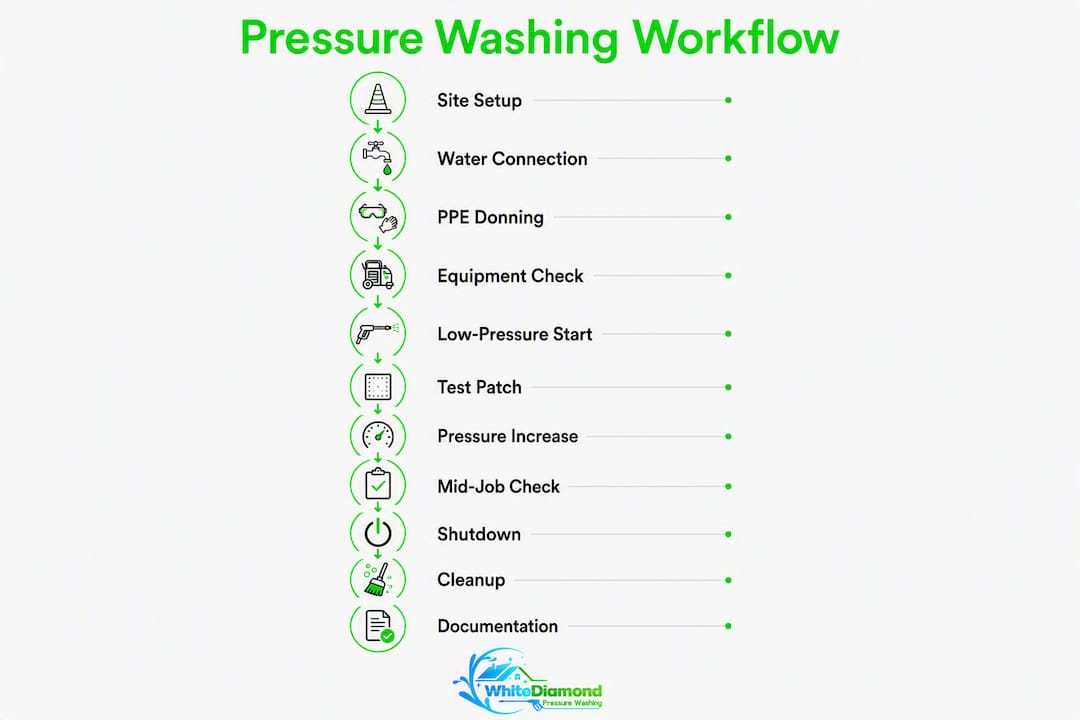
This sequence follows the 14-step industry standard workflow and maps each phase to the safety controls that matter most.
1. Site setup and exclusion zone. Place cones or barrier tape at least 10 feet beyond the spray radius. Post a spotter if pedestrian traffic cannot be fully stopped. Confirm drainage direction before water flows.
2. Water and electrical hookup. Connect supply hose to a verified water source. For electric units, plug into a GFCI-protected outlet only. Confirm the outlet is rated for the unit’s amperage draw.
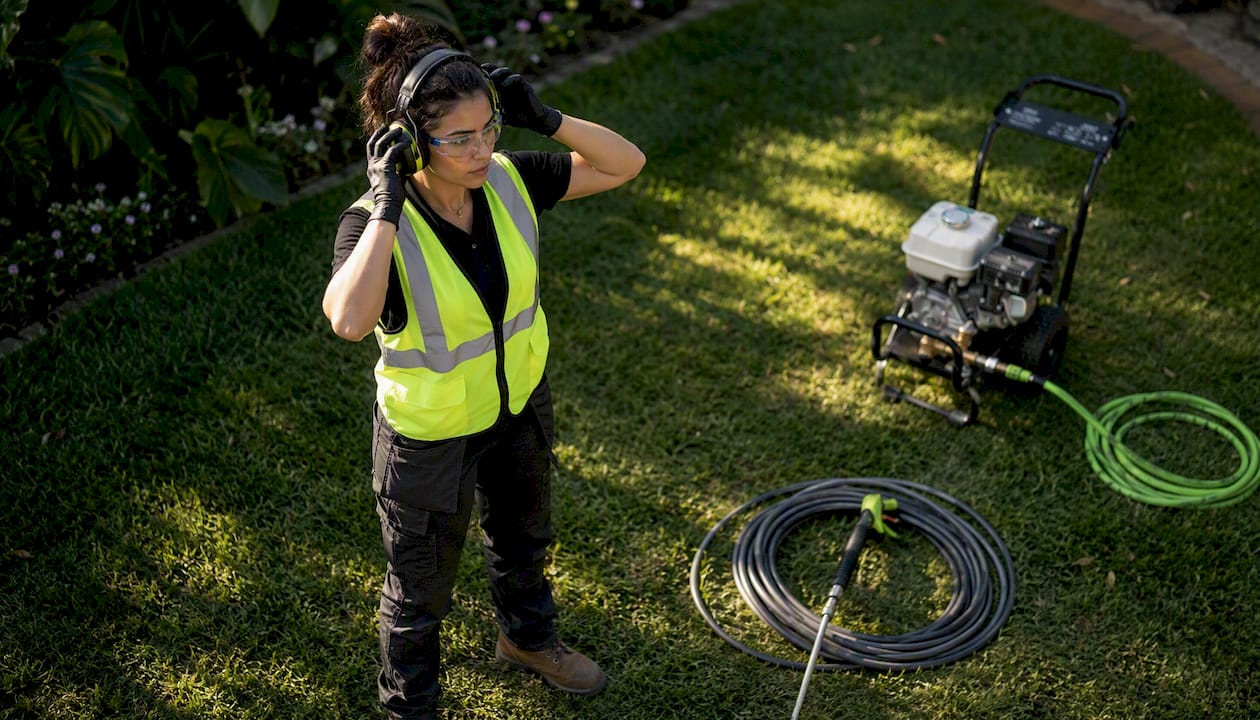
3. PPE donning. Full PPE goes on before the machine starts. Sequence: boots, hearing protection, eye/face protection, gloves, respirator if required. Do not skip items because the job “looks quick.”
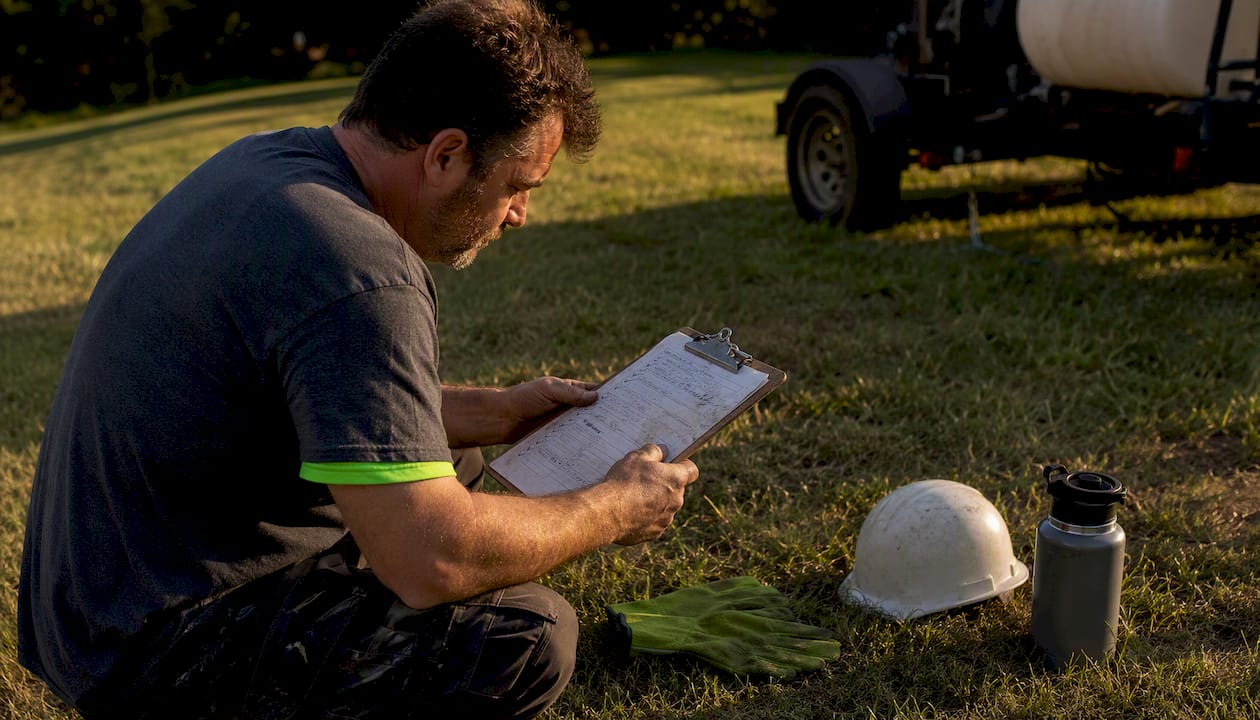
4. Pre-start equipment check. Run through the inspection checklist above. Both operator and supervisor initial the form. No signature, no start.
5. Purge and low-pressure start. Open the water supply fully. Run water through the gun at low pressure, pointed at the ground, for 30 seconds. Confirm no air pockets, no wand kick, no leaks at fittings.
6. Test patch. On any surface being washed for the first time, run a test patch in a non-visible area at the planned pressure and nozzle angle. Verify no etching, delamination, or discoloration before proceeding to the main surface.
7. Nozzle selection and standoff distance. Match nozzle angle to the surface: 40-degree for general rinsing, 25-degree for concrete, 15-degree only for heavy deposits on hard surfaces. Maintain a safe standoff distance appropriate for the surface material. Equipment rated above specific PSI thresholds requires proportionally greater standoff to maintain operator control.
8. Progressive pressure increase. Start at the lowest effective pressure and increase only as needed. Never start at maximum pressure during initial use on a surface.
9. Controlled operation with fatigue management. Sweep in consistent, overlapping passes. Keep the wand moving; dwelling in one spot damages surfaces and increases injection risk if the wand slips. Schedule a break every 45–60 minutes — fatigue is a primary contributor to loss of equipment control. For high-risk tasks (roof edges, elevated lifts, chemical application), apply a two-person rule: one operator, one spotter.
10. Mid-job safety check. At each break, inspect hose connections, nozzle condition, and exclusion zone integrity. Confirm gas unit placement has not shifted toward air intakes.
11. Shutdown and depressurize. Turn off the machine, then squeeze the trigger to release residual pressure before disconnecting any fittings. Never disconnect a pressurized hose.
12. Post-job cleanup and waste containment. Collect washwater per the containment plan. Dispose of chemical waste per SDS instructions and local ordinance. Remove PPE in the correct doffing order (gloves last if chemical contamination is possible).
13. Post-job documentation. Complete the post-shift checklist, note any equipment issues, and file the form with the job record.
Pro Tip: Two-handed wand control is not optional on any unit above 1,500 PSI. Plant your dominant foot forward, keep elbows slightly bent, and let your body absorb reaction force rather than fighting it with wrist strength. Operators who try to steer with one hand are the ones who end up with injection injuries.
Why soft washing still carries serious chemical and aerosol risks
Low pressure does not mean low risk. Soft washing uses concentrated caustics and biocides, typically sodium hypochlorite solutions, that can cause severe chemical burns, respiratory irritation, and environmental damage if handled without proper controls. The soft-wash process requires the same disciplined PPE and containment approach as high-pressure work, just with different hazard priorities.
| Chemical type | Common use | Primary hazard | Required PPE additions |
|---|---|---|---|
| Sodium hypochlorite (bleach) | Roof, siding, mold | Skin/eye burns, chlorine gas if mixed with acid | Full-face shield, neoprene gloves, impermeable coveralls |
| Caustic degreasers (NaOH-based) | Concrete, grease | Severe burns, saponification of skin | Butyl rubber gloves, face shield, impermeable apron |
| Surfactants/detergents | General cleaning | Eye and skin irritation | Chemical splash goggles, nitrile gloves |
| Biocides (quaternary ammonium) | Mold, algae | Respiratory sensitization, skin irritation | N95 minimum, chemical-resistant gloves |
Containment at the mixing station: Mix chemicals at a designated station with a berm or absorbent pad underneath. Never mix bleach-based solutions with any acid-containing product. Label every container. Keep the SDS physically present at the mixing station, not in the truck.
Downstream injection vs. pump-up sprayers: Downstream injection through the pressure washer dilutes the chemical before it reaches the surface, reducing splash concentration. Pump-up sprayers deliver undiluted or lightly diluted product and require full chemical PPE at all times during application.
When soft-wash operations trigger environmental rules: If the surface being washed contains lead paint or significant mold, the washwater carries regulated contaminants. Document dilution ratios, containment measures, and disposal method. On construction sites, the NPDES Construction General Permit may require washwater treatment before discharge.
Pro Tip: Always apply soft-wash chemicals at the lowest effective concentration and let dwell time do the work. Test a small patch first. Increasing concentration to speed up the job is the most common cause of substrate damage and the most common cause of chemical burns on residential soft-wash jobs.
Emergency response: what to do in the first minutes
Clear, fast action in the first few minutes of a pressure-washing emergency determines outcomes. Every operator on site should know these steps before the job starts.
High-pressure injection injury:
- Do not squeeze or probe the wound. The entry point will look minor.
- Immobilize the affected limb.
- Call 911 immediately and tell the dispatcher it is a high-pressure injection injury. Surgeons need to know this before the patient arrives.
- Do not apply a tourniquet unless there is uncontrolled arterial bleeding.
- Keep the operator calm and still until EMS arrives.
Chemical exposure (skin or eyes):
- Skin: Remove contaminated clothing immediately. Flush with large amounts of water for at least 15–20 minutes.
- Eyes: Flush with clean water for at least 15 minutes, holding eyelids open. Do not rub.
- Consult the SDS for the specific chemical for additional first-aid steps.
- Call Poison Control (1-800-222-1222) if symptoms persist or if the SDS recommends it.
- Transport to an emergency room if burns are present or vision is affected.
CO poisoning:
- Move everyone out of the affected area immediately. Do not re-enter.
- Call 911. Describe it as a CO poisoning emergency.
- If the affected person is unconscious, do not attempt rescue without respiratory protection.
- Treat any CO alarm as a confirmed emergency, not a malfunction to investigate.
- CO from small gasoline engines can incapacitate within minutes, even outdoors in partially enclosed spaces.
Electrocution or electrical shock:
- Do not touch the person if they are still in contact with the electrical source.
- Cut power at the breaker if accessible without entering the hazard zone.
- Call 911. Even a “minor” shock requires medical evaluation.
Severe laceration or fall:
- Control bleeding with direct pressure.
- Do not move a person who may have a spinal injury from a fall.
- Call 911 and preserve the scene for incident investigation.
How to train crews and document the workflow so it actually sticks
A safety workflow written in a binder and never reviewed is not a safety program. The goal is to move the workflow from orientation paperwork into daily habit, and that requires a specific training cadence and a documentation system that is simple enough to actually use.
Training cadence:
| Training type | Frequency | Format | Documentation required |
|---|---|---|---|
| Initial operator training | Before first job | Classroom + hands-on competency check | Signed competency record, respirator fit-test record |
| Toolbox talk (safety topic) | Weekly | 10–15 minute job-site discussion | Signed attendance sheet, topic noted |
| Weekly one-on-one | Weekly | Supervisor + operator review of recent jobs | Notes on performance, corrective actions |
| Practical refresher | Quarterly | Hands-on skills check against SOP | Supervisor sign-off on checklist |
| Incident review | After any near-miss or injury | Team debrief | Incident report, corrective action log |
What to document and retain:
- Pre-shift inspection checklists (retain for one year minimum)
- SDS sign-off sheets confirming operators have reviewed chemicals in use
- Respirator fit-test records (retain for the duration of employment plus one year)
- Toolbox talk attendance sheets
- Incident reports and corrective action logs
- Operator competency records
Practical competency check items: Can the operator correctly identify the right nozzle for a given surface? Can they demonstrate a proper purge sequence? Can they describe the CO exclusion distance for a gas unit without prompting? Can they locate the SDS for the chemicals on today’s job? These are the questions that reveal whether training transferred.
For outdoor service crew documentation practices that translate well to pressure-washing operations, the landscape safety workflow guide from McCullough Tree Service covers training frequency and record-keeping in a comparable field context.
Pro Tip: Photograph evidence during the job: the drainage setup before you start, the test patch result, the exclusion zone with cones in place. These photos take 30 seconds and become your audit record. If a complaint or incident arises later, you have timestamped documentation that the controls were in place.
A printable SOP snippet you can adapt for your crew
The following template is adapted from Whitediamondpressurewashing’s field SOPs. Copy it, add your company name and local permit conditions, and keep a laminated copy in every job box.
Pre-shift quick checklist
| Item | Accept criteria | Operator initial | Supervisor initial |
|---|---|---|---|
| High-pressure hose | No cuts, bulges, or damaged fittings | ||
| Trigger gun safety lock | Engages and holds | ||
| Nozzle tip | Correct angle marked; no wear flat | ||
| GFCI (electric) / CO exclusion (gas) | GFCI tested; gas unit 20+ ft from intakes | ||
| PPE complete | All items donned per task matrix | ||
| SDS on site | Present for all chemicals in use | ||
| Exclusion zone | Cones/tape in place; bystanders clear | ||
| Drainage/containment | Runoff directed to approved point | ||
| Test patch completed | No damage on non-visible area |
Job acceptance sign-off:
Operator: ________________ Date: _________ Time: ________
Supervisor: _______________ Date: _________ Time: ________
Adapting this template: Add your local NPDES permit number or municipal discharge restriction in the drainage row. Insert the specific SDS document numbers for your chemical inventory. If your jurisdiction requires a lead paint notification before washing pre-1978 structures, add a row for that confirmation. For localized safety protocol examples specific to Citrus County conditions, Whitediamondpressurewashing’s safety protocols page includes additional checklist items relevant to Florida’s climate and substrate types.
This template is a starting point. Verify it against your current OSHA standards, local permit conditions, and the SDS for every chemical your crew uses before putting it into production.
Key Takeaways
A safe pressure-washing operation requires pre-shift inspection, task-matched PPE, CO exclusion controls, and documented operator competency before any job begins.
| Point | Details |
|---|---|
| CO exclusion is non-negotiable | Gas units must be kept a safe distance from any window, door, or air intake on every job. |
| PPE must match the task | Roof soft-wash and lead/mold surfaces require full-face shields, P100 respirators, and impermeable coveralls, not just safety glasses. |
| Injection injuries are surgical emergencies | Any skin contact with a live pressure stream requires a 911 call and immediate ER transport, regardless of wound appearance. |
| Documentation protects everyone | Retain pre-shift checklists, SDS sign-offs, and respirator fit-test records for at least one year. |
| Whitediamondpressurewashing | Operates with documented SOPs, task-matched PPE protocols, and soft-wash expertise for residential and commercial properties in Citrus County. |
The part of this workflow most crews skip until something goes wrong
The paperwork feels like the least important part of a pressure-washing job. It is actually the part that determines whether a crew gets better or just repeats the same near-misses.
Every experienced supervisor has a version of the same story: a job that went sideways not because the crew lacked skill, but because no one had written down what “safe” looked like for that specific task. The CO exclusion distance was “common knowledge.” The SDS was “in the truck somewhere.” The test patch was skipped because the surface “looked fine.” None of those decisions were reckless in isolation. Together, they created the conditions for an incident.
What the workflow in this article does is force those decisions to be made consciously, before the pressure builds. The pre-shift checklist is not bureaucracy. It is the moment where a supervisor asks: do we actually have what we need to do this safely, or are we improvising again?
The one place most operators underestimate is soft washing. Because the pressure is low, the chemical risk gets minimized. Concentrated sodium hypochlorite at a roof-wash dilution will cause a chemical burn faster than most people expect. The PPE requirements for soft-wash chemical application are, in several respects, more demanding than for standard high-pressure work. That gap between perceived risk and actual risk is where injuries happen.
The workflow works when it becomes the default, not the exception. Short checklists, weekly conversations, and photographed evidence are the tools that get it there.
Whitediamondpressurewashing handles the safety workflow so you don’t have to
Running a pressure-washing job safely means managing CO placement, chemical handling, fall protection, washwater containment, and operator fatigue simultaneously. For property owners and managers in Citrus County who would rather not carry that compliance burden themselves, Whitediamondpressurewashing is the direct alternative.

Every job Whitediamondpressurewashing runs follows the documented SOP framework described in this article: pre-shift inspections, task-matched PPE, soft-wash chemical controls, and post-job documentation. The team is trained on OSHA-aligned procedures and carries full insurance, so the liability stays off your plate. Soft-wash techniques protect surfaces that high-pressure methods would damage, and biodegradable cleaning agents keep the job compliant with local environmental requirements.
For residential roofs, driveways, siding, and commercial building exteriors across Citrus County and surrounding areas, request a free estimate or browse the full service catalog to find the right option for your property.
Useful sources for your SOP and compliance file
| Source | What it covers | How to use it |
|---|---|---|
| NIOSH/CDC: Preventing CO Poisoning from Small Engines | CO hazards, fatality case examples, placement guidance | Cite in SOP CO control section; post the pictogram at the job site |
| CDC: Pressure Washer Safety | 20-foot CO exclusion rule, general safe-use guidance | Reference in pre-shift checklist and operator training materials |
| OSHA 29 CFR 1910.133 | Eye and face protection requirements | Cite when specifying goggles vs. face shield by task |
| OSHA 29 CFR 1910.95 | Occupational noise exposure and hearing conservation | Cite when selecting hearing protection NRR ratings |
| JSABuilder: Pressure Washing JSA Template | Job safety analysis template, injection injury data | Use as a starting-point JSA template for your SOP file |
| EPA NPDES Construction General Permit | Washwater discharge rules on construction sites | Consult before any job on a construction site or where runoff reaches storm drains |
| Cleaner Times: Pressure Washer Safety Guide | Equipment controls, PSI-based standoff guidance | Reference in equipment inspection and operating workflow sections |
When to consult local authorities: Before any job where washwater will contact a storm drain, call your local municipal utility or stormwater authority to confirm discharge requirements. Permit conditions vary by county and municipality. In Florida, the Florida Department of Environmental Protection (FDEP) administers state-level NPDES permits; local pretreatment ordinances may impose stricter limits than the state standard.
Recommended
- Pressure Washing Safety – How It Protects Your Home – white-diamond-pressure
- Safety Protocols in Pressure Washing: Protecting Citrus County Homes – white-diamond-pressure
- Industry Standards for Pressure Washing Safety – white-diamond-pressure
- Soft Washing Process Explained: A Step-by-Step Guide for Safety – white-diamond-pressure