


TL;DR:
- Documented cleaning procedures are essential for ensuring compliance, safety, and operational consistency within organizations. They provide clear records, reduce errors, and support training, audits, and liability management effectively.
Documented cleaning procedures are the formal, written instructions that define how cleaning tasks must be performed to meet compliance, safety, and operational standards. Every organization that cleans surfaces, equipment, or facilities needs this kind of controlled record. Without it, staff rely on memory, habit, or word of mouth, and that gap creates costly mistakes. The Centers for Disease Control and Prevention (CDC) and ISO quality management standards both emphasize written procedure control as a baseline requirement for safe operations. This article explains why document cleaning procedures matter and how to build a system that actually works.
What are the core benefits of documenting cleaning procedures?
Documented cleaning procedures deliver measurable advantages across compliance, cost, and staff performance. The benefits are not theoretical. They show up in audit results, incident reports, and training timelines.
The key benefits include:
- Regulatory compliance. Written procedures give inspectors and auditors a clear record of what was done, when, and by whom. This is the foundation of audit readiness.
- Consistent cleaning quality. When every team member follows the same written steps, results do not vary based on who is on shift. Consistency reduces errors and rework.
- Accountability and traceability. Accurate cleaning records provide proof of work that is essential for health and safety assurance. That proof matters when a client, regulator, or insurer asks questions.
- Cost savings. The 1-10-100 rule states that proactive cleaning investments save 10x in correction costs and 100x in failure costs. Fixing a problem after it causes damage is always more expensive than preventing it.
- Faster staff training. New employees learn faster from written workflows than from verbal instruction. Documented procedures reduce the time it takes to bring someone up to standard.
- Performance monitoring. Managers can measure whether procedures are being followed and identify where gaps exist. That visibility is impossible without written records.
Pro Tip: Review your cleaning procedure documents at least once every six months. Regulations change, products get updated, and surfaces wear differently over time. An outdated document in circulation is as dangerous as no document at all.
Documented workflows also support consistent property care quality by giving experienced staff a reference point and giving new staff a starting line. Both groups perform better with written guidance than without it.
How does documentation improve compliance and risk management?
Documentation is the primary defense against regulatory failure. Document control failures cause preventable critical errors and regulatory penalties because employees rely on obsolete information. That finding applies directly to cleaning operations in healthcare, food service, commercial property management, and residential services.
“Document control shifts organizations from reactive firefighting to controlled, auditable lifecycle management, reducing costly errors.” — Zoe Talent Solutions
When a cleaning team uses an outdated chemical concentration or skips a step because no one told them the procedure changed, the organization bears the liability. Written, version-controlled procedures eliminate that exposure. They show regulators that the organization has a system, not just intentions.
Documented procedures also support certification maintenance. ISO 9001, OSHA standards, and local health department requirements all ask for evidence of controlled processes. A binder of signed cleaning logs and approved procedure sheets satisfies that requirement. A verbal assurance does not.
Liability reduction is another direct outcome. If an incident occurs, a documented procedure proves that the organization defined the correct method and trained staff to follow it. Without that record, the organization has no defense. Safe cleaning methods backed by written procedures protect both the service provider and the property owner.
Systematic data hygiene including cleaning documentation and record management also reduces storage costs and supports compliance with privacy and safety laws. That principle applies whether you are managing digital records or physical cleaning logs.
What should be included in effective cleaning procedure documentation?
Strong documentation covers every variable a cleaner needs to do the job correctly. Vague instructions produce inconsistent results. The table below compares minimal documentation against comprehensive documentation.
| Element | Minimal documentation | Comprehensive documentation |
|---|---|---|
| Task description | “Clean the driveway” | Step-by-step method with surface type, pressure setting, and chemical dilution ratio |
| Frequency | “As needed” | Specific schedule: weekly, monthly, or after weather events |
| Materials and chemicals | “Use cleaner” | Named product, dilution rate, application method, and PPE required |
| Responsibility | “Staff” | Named role or individual with sign-off requirement |
| Safety and compliance | Not included | Reference to OSHA standard, SDS sheet location, and disposal instructions |
| Record-keeping | None | Dated log with staff signature and supervisor review |
The gap between these two columns is where most organizations get into trouble. A minimal document gives the illusion of a system without providing the structure that makes it work.
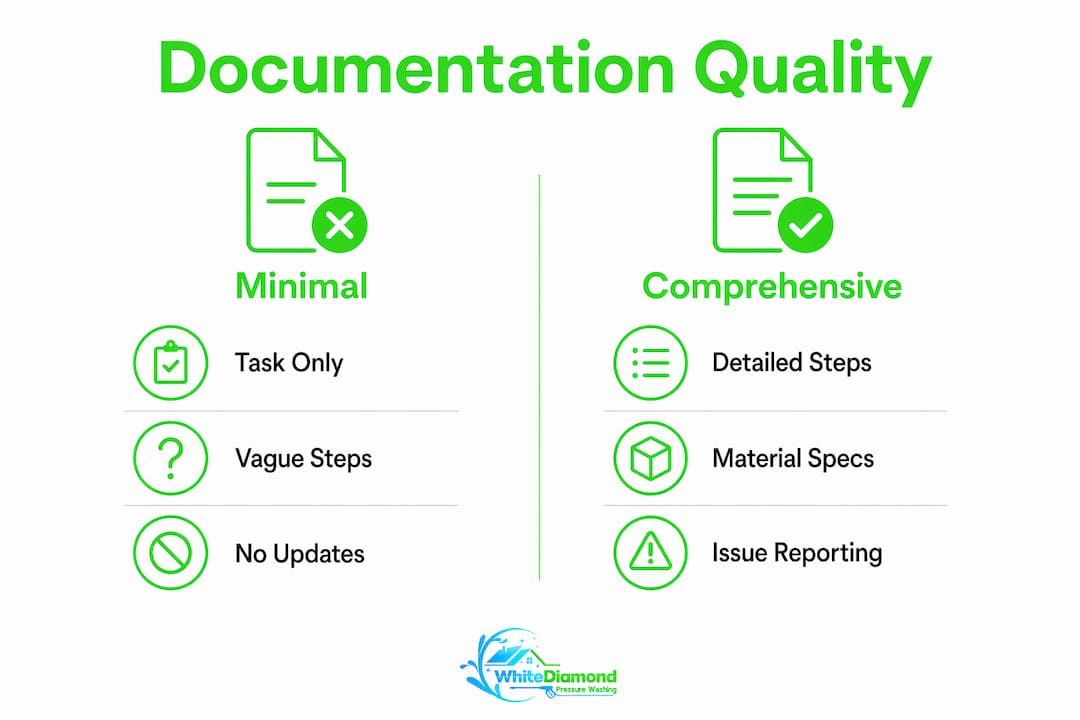
Every effective cleaning procedure document should also include an issue-reporting section. If a cleaner notices a surface defect, a chemical reaction, or a safety hazard, the procedure should tell them exactly how to report it and who to notify. That feedback loop is what turns a static document into a living quality management tool.
Standardized templates speed up this process. Organizations like the Property Manager’s network in Central Florida use structured cleaning checklists to keep documentation consistent across multiple properties and service providers. That consistency is what makes audits predictable rather than stressful.
Pro Tip: Use a version number and approval date on every document. When you update a procedure, collect and destroy old copies. One outdated version in the field can undo months of compliance work.
How can organizations implement and maintain documented cleaning procedures?
Building a documentation system is a project, not a task. These steps give you a practical path from zero to a working system.
- Audit your current practices. Walk through every cleaning task your team performs. Write down what actually happens, not what you think happens. That gap is your starting point.
- Draft procedures using a standard template. Include task description, frequency, materials, safety requirements, responsible party, and record-keeping method. Use plain language. If a new hire cannot follow the document on day one, rewrite it.
- Get formal approval. Every procedure should be reviewed and signed off by a supervisor or compliance officer before it goes into use. This step creates accountability at the management level.
- Train staff using the written document. Do not summarize the procedure verbally and hand out the paper later. Walk through the document together. Ask staff to demonstrate the steps. Confirm understanding before they work independently.
- Store documents where staff can access them. Digital document management systems like SharePoint, Google Workspace, or dedicated quality management platforms make current versions available on any device. Paper binders work too, but require tighter version control.
- Schedule regular audits and updates. Set a calendar reminder every six months to review all active procedures. When regulations change or new products are introduced, update the document immediately and re-train affected staff.
Real examples of cleaning schedules show that the most effective systems combine written procedures with regular supervisor spot-checks. The document sets the standard. The audit confirms it is being met.
Avoiding common pitfalls matters as much as building the system correctly. The most frequent failure is allowing multiple versions of the same document to circulate. Staff follow the version they have, not the version you updated last week. A single source of truth, whether digital or physical, prevents that problem entirely.
Key takeaways
Documented cleaning procedures are the foundation of compliant, consistent, and cost-effective cleaning operations for any individual or organization.
| Point | Details |
|---|---|
| Documentation prevents costly errors | The 1-10-100 rule shows proactive documentation saves 10x in corrections and 100x in failure costs. |
| Compliance requires written proof | Auditors and regulators require signed records, not verbal assurances, to confirm cleaning standards are met. |
| Comprehensive content is non-negotiable | Effective documents include steps, materials, frequency, safety references, responsibility, and record-keeping. |
| Version control is critical | Outdated documents in circulation cause the same errors as having no documentation at all. |
| Digital tools improve accessibility | Platforms like SharePoint and Google Workspace keep current versions available to all staff at all times. |
Why I think most organizations underestimate this
I have seen firsthand what happens when a cleaning operation runs on habit instead of documentation. A team that has been doing the same job for three years assumes everyone knows the right way. Then a new hire joins, a supervisor is out sick, and suddenly a surface gets cleaned with the wrong chemical concentration. The damage is real. The liability is real. And the fix costs far more than the procedure document would have.
The organizations that handle this best treat documentation as a competitive advantage, not a compliance burden. When your procedures are written, approved, and current, you can take on new clients, scale your team, and pass any audit without scrambling. That confidence is worth more than the hour it takes to write the document.
The other thing I have learned is that usability matters as much as completeness. A 20-page procedure manual that no one reads is worse than a one-page checklist that every cleaner carries. Balance detail with clarity. Write for the person doing the job, not the person filing the paperwork.
Proactive document control is a business advantage. It signals professionalism to clients, reduces risk for your organization, and gives your team the tools to do the job right every time. That is not a compliance checkbox. That is how you build a reputation worth protecting.
— Bobby
How Whitediamondpressurewashing delivers documented, professional results

Whitediamondpressurewashing builds every service around documented, industry-approved methods for pressure washing and soft washing in Citrus County and surrounding areas. Every job follows a defined process, from surface assessment to chemical selection to post-clean inspection, so clients get consistent results every time. That commitment to procedure is what separates a professional exterior cleaning service from a crew with a pressure washer. If you want exterior cleaning done right, explore the full range of professional cleaning services or get a free estimate today. Your property deserves a team that follows the right steps every time.
FAQ
Why should you document cleaning procedures?
Documented cleaning procedures prevent errors caused by inconsistent methods and give organizations a written record for regulatory audits. Proof of cleaning work is required for health and safety assurance in most commercial and residential service settings.
What happens without proper cleaning documentation?
Without documentation, employees rely on outdated or incorrect methods, which leads to preventable errors and regulatory penalties. Document control failures are a leading cause of compliance violations in facility and property management.
How often should cleaning procedure documents be updated?
Cleaning procedures should be reviewed at least every six months and updated immediately when regulations, products, or surfaces change. Any version update requires re-training affected staff and removing old documents from circulation.
What are the most important elements of a cleaning procedure document?
The most important elements are task steps, materials and chemical specifications, frequency, responsible party, safety references, and a record-keeping method. Documents that omit any of these create gaps that lead to inconsistent results and compliance risk.
Does documentation reduce cleaning costs?
Yes. The 1-10-100 rule shows that investing in proactive documentation saves 10x in correction costs and 100x in failure costs compared to addressing problems after they occur.
Recommended
- Commercial Cleaning Advantages That Protect Your Bottom Line – white-diamond-pressure
- Best practices for property cleaning in Citrus County 2026 – white-diamond-pressure
- Why choose industry-approved cleaners for safe results – white-diamond-pressure
- How cleaner experience impacts property care quality – white-diamond-pressure
One thought on “Why Document Cleaning Procedures: Benefits and Best Practices”